

ကလေးတွေမေးလို့ အခက်အခဲရှိတဲ့ပုစ္ဆာလေးတချို့ ဖြေရှင်းပြရင်း ပြန်လည်မျှဝေလိုက်ပါတယ်။
Cambridge IGCSE Additional Mathematics
Student Questions
-
[Problem 1]
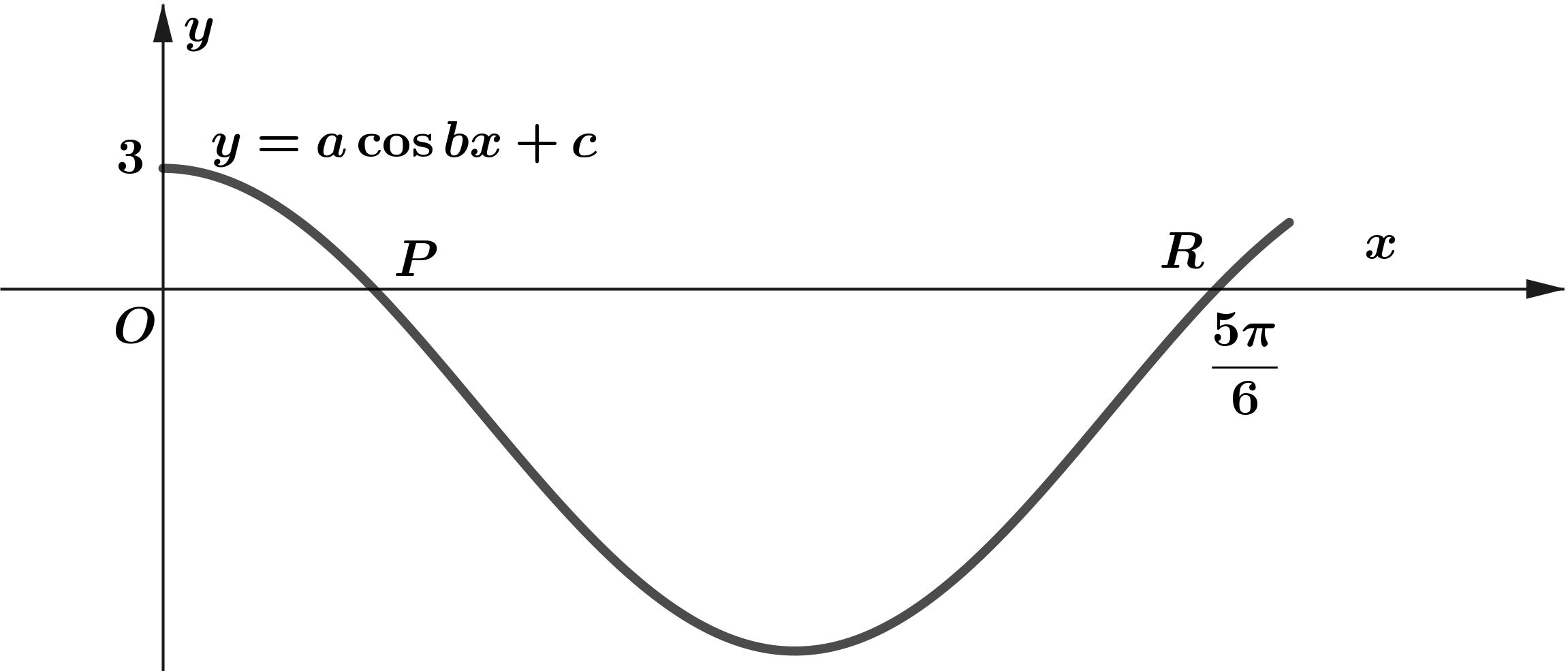
The graph shows the curve $\displaystyle y = a \cos bx + c$, for $\displaystyle 0 \leqslant x \leqslant 2.8$, where $\displaystyle a$, $\displaystyle b$ and $\displaystyle c$ are constants and $\displaystyle x$ is in radians. The curve meets the $y$-axis at $\displaystyle (0, 3)$ and the $x$-axis at the point $\displaystyle P$ and point $\displaystyle R\left(\frac{5\pi}{6}, 0\right)$.
The curve has a minimum at point $\displaystyle Q$. The period of $\displaystyle a \cos bx + c$ is $\displaystyle \pi$ radians.
- Find the value of each of $\displaystyle a$, $\displaystyle b$ and $\displaystyle c$.
\(\displaystyle \begin{aligned} & y = a \cos bx + c \\[2mm] & \text{Period } = \frac{2\pi}{b} = \pi \\[2mm] & b = 2 \\[2mm] & y\text{-intercept is } (0, 3): \\[2mm] & a \cos(0) + c = 3 \\[2mm] & a + c = 3 \\[2mm] & x\text{-intercept is } \left(\frac{5\pi}{6}, 0\right): \\[2mm] & a \cos\left(2 \cdot \frac{5\pi}{6}\right) + c = 0 \\[2mm] & a \cos\left(\frac{5\pi}{3}\right) + c = 0 \\[2mm] & \frac{1}{2}a + c = 0 \\[2mm] & a + 2c = 0 \\[2mm] & c = -3 \\[2mm] & a - 3 = 3 \\[2mm] & a = 6 \end{aligned}\) -
[Problem 2]
A piece of wire, of length 2 m, is divided into two pieces. One piece is bent to form a square of side $\displaystyle x$ m and the other is bent to form a circle of radius $\displaystyle r$ m.
- Express $\displaystyle r$ in terms of $\displaystyle x$ and show that the total area, $\displaystyle A \text{ m}^2$, of the two shapes is given by
$\displaystyle A = \frac{(\pi + 4)x^2 - 4x + 1}{\pi}.$
Given that $\displaystyle x$ can vary, find
- the stationary value of $\displaystyle A$,
- the nature of this stationary value.
\(\displaystyle \begin{aligned} \textbf{(i)} \quad & \text{Total perimeter} = 2 \text{ m} \\[2mm] & 4x + 2\pi r = 2 \\[2mm] & 2x + \pi r = 1 \\[2mm] & r = \frac{1 - 2x}{\pi} \\[2mm] & A = x^2 + \pi r^2 \\[2mm] & A = x^2 + \pi \left(\frac{1 - 2x}{\pi}\right)^2 \\[2mm] & A = x^2 + \frac{1 - 4x + 4x^2}{\pi} \\[2mm] & A = \frac{\pi x^2 + 4x^2 - 4x + 1}{\pi} \\[2mm] & A = \frac{(\pi + 4)x^2 - 4x + 1}{\pi} \quad \text{(shown)} \\[2mm] \textbf{(ii)} \quad & \frac{dA}{dx} = \frac{2(\pi + 4)x - 4}{\pi} \\[2mm] & \text{For stationary value, } \frac{dA}{dx} = 0: \\[2mm] & 2(\pi + 4)x - 4 = 0 \\[2mm] & 2(\pi + 4)x = 4 \\[2mm] & x = \frac{2}{\pi + 4} \\[2mm] & A = \frac{(\pi + 4)\left(\frac{2}{\pi + 4}\right)^2 - 4\left(\frac{2}{\pi + 4}\right) + 1}{\pi} \\[2mm] & A = \frac{\frac{4}{\pi + 4} - \frac{8}{\pi + 4} + \frac{\pi + 4}{\pi + 4}}{\pi} \\[2mm] & A = \frac{\pi}{\pi(\pi + 4)} = \frac{1}{\pi + 4} \\[2mm] \textbf{(iii)} \quad & \frac{d^2A}{dx^2} = \frac{2(\pi + 4)}{\pi} \\[2mm] & \text{Since } \frac{d^2A}{dx^2} > 0 \text{, the stationary value is a minimum.} \end{aligned}\) - Express $\displaystyle r$ in terms of $\displaystyle x$ and show that the total area, $\displaystyle A \text{ m}^2$, of the two shapes is given by
-
[Problem 3]
Solve the equation $\displaystyle (n - 4) \times ^{n+1}C_5 = ^{n+2}C_7$.
\(\displaystyle \begin{aligned} & (n - 4) \times ^{n+1}C_5 = ^{n+2}C_7 \\[2mm] & (n - 4) \times \frac{(n+1)!}{5! \cdot (n-4)!} = \frac{(n+2)!}{7! \cdot (n-5)!} \\[2mm] & \frac{(n+1)!}{5! \cdot (n-5)!} = \frac{(n+2)(n+1)!}{7 \times 6 \times 5! \cdot (n-5)!} \\[2mm] & 1 = \frac{n+2}{42} \\[2mm] & n + 2 = 42 \\[2mm] & n = 40 \end{aligned}\) -
[Problem 4]
Given that $\displaystyle (n + 9) \times ^nP_{10} = (n^2 + 243) \times ^{n-1}P_9$ find the value of $\displaystyle n$.
\(\displaystyle \begin{aligned} & (n + 9) \times ^nP_{10} = (n^2 + 243) \times ^{n-1}P_9 \\[2mm] & (n + 9) \times \frac{n!}{(n-10)!} = (n^2 + 243) \times \frac{(n-1)!}{(n-10)!} \\[2mm] & (n + 9) \times n(n-1)! = (n^2 + 243) \times (n-1)! \\[2mm] & n^2 + 9n = n^2 + 243 \\[2mm] & 9n = 243 \\[2mm] & n = 27 \end{aligned}\) -
[Problem 5]
The equation of a circle is $\displaystyle (x - 3)^2 + y^2 = 18$. The line with equation $\displaystyle y = mx + c$ passes through the point $\displaystyle (0, -9)$ and is a tangent to the circle. Find the two possible values of $\displaystyle m$ and, for each value of $\displaystyle m$, find the coordinates of the point at which the tangent touches the circle.
\(\displaystyle \begin{aligned} & (x - 3)^2 + y^2 = 18 \\[2mm] & y = mx + c \\[2mm] & \text{Passes through } (0, -9): \\[2mm] & -9 = m(0) + c \\[2mm] & c = -9 \\[2mm] & y = mx - 9 \\[2mm] & \text{Substitute into circle equation:} \\[2mm] & (x - 3)^2 + (mx - 9)^2 = 18 \\[2mm] & x^2 - 6x + 9 + m^2x^2 - 18mx + 81 - 18 = 0 \\[2mm] & (1 + m^2)x^2 - (6 + 18m)x + 72 = 0 \\[2mm] & \text{For tangent, discriminant } b^2 - 4ac = 0 \\[2mm] & (6 + 18m)^2 - 4(1 + m^2)(72) = 0 \\[2mm] & 36 + 216m + 324m^2 - 288 - 288m^2 = 0 \\[2mm] & 36m^2 + 216m - 252 = 0 \\[2mm] & m^2 + 6m - 7 = 0 \\[2mm] & (m + 7)(m - 1) = 0 \\[2mm] & m = 1 \text{ or } m = -7 \\[2mm] & \text{When } m = 1: \\[2mm] & (1 + 1^2)x^2 - (6 + 18(1))x + 72 = 0 \\[2mm] & 2x^2 - 24x + 72 = 0 \\[2mm] & x^2 - 12x + 36 = 0 \\[2mm] & (x - 6)^2 = 0 \\[2mm] & x = 6 \\[2mm] & y = (1)(6) - 9 = -3 \\[2mm] & \text{Point is } (6, -3) \\[2mm] & \text{When } m = -7: \\[2mm] & (1 + (-7)^2)x^2 - (6 + 18(-7))x + 72 = 0 \\[2mm] & 50x^2 + 120x + 72 = 0 \\[2mm] & 25x^2 + 60x + 36 = 0 \\[2mm] & (5x + 6)^2 = 0 \\[2mm] & x = -\frac{6}{5} \\[2mm] & y = -7\left(-\frac{6}{5}\right) - 9 = -\frac{3}{5} \\[2mm] & \text{Point is } \left(-\frac{6}{5}, -\frac{3}{5}\right) \end{aligned}\) -
[Problem 6]
Circles $\displaystyle C_1$ and $\displaystyle C_2$ have equations $\displaystyle x^2 + y^2 + 6x - 10y + 18 = 0$ and $\displaystyle (x - 9)^2 + (y + 4)^2 - 64 = 0$ respectively.
- Find the distance between the centres of the circles.
$\displaystyle P$ and $\displaystyle Q$ are points on $\displaystyle C_1$ and $\displaystyle C_2$ respectively. The distance between $\displaystyle P$ and $\displaystyle Q$ is denoted by $\displaystyle d$.
- Find the greatest and least possible values of $\displaystyle d$.
\(\displaystyle \begin{aligned} & C_1: x^2 + y^2 + 6x - 10y + 18 = 0 \\[2mm] & (x + 3)^2 - 9 + (y - 5)^2 - 25 + 18 = 0 \\[2mm] & (x + 3)^2 + (y - 5)^2 = 16 \\[2mm] & \text{Centre } A = (-3, 5), \text{ Radius } r_1 = 4 \\[2mm] & C_2: (x - 9)^2 + (y + 4)^2 - 64 = 0 \\[2mm] & (x - 9)^2 + (y + 4)^2 = 64 \\[2mm] & \text{Centre } B = (9, -4), \text{ Radius } r_2 = 8 \\[2mm] & \textbf{(a)} \\[2mm] & \text{Distance } AB = \sqrt{(9 - (-3))^2 + (-4 - 5)^2} \\[2mm] & AB = \sqrt{12^2 + (-9)^2} \\[2mm] & AB = \sqrt{144 + 81} \\[2mm] & AB = \sqrt{225} = 15 \\[2mm] & \textbf{(b)} \\[2mm] & \text{Greatest possible value of } d = AB + r_1 + r_2 \\[2mm] & d_{\text{max}} = 15 + 4 + 8 = 27 \\[2mm] & \text{Least possible value of } d = AB - r_1 - r_2 \\[2mm] & d_{\text{min}} = 15 - 4 - 8 = 3 \end{aligned}\) -
[Problem 7]
The rectangle $\displaystyle ABCDE$ represents a ploughed field where $\displaystyle AB = 300\text{ m}$ and $\displaystyle AE = 400\text{ m}$. Joseph needs to walk from $\displaystyle A$ to $\displaystyle D$ in the least possible time. He can walk at $\displaystyle 0.9\text{ ms}^{-1}$ on the ploughed field and at $\displaystyle 1.5\text{ ms}^{-1}$ on any part of the path $\displaystyle BCD$ along the edge of the field. He walks from $\displaystyle A$ to $\displaystyle C$ and then from $\displaystyle C$ to $\displaystyle D$. The distance $\displaystyle BC = x\text{ m}$.
- Find, in terms of $\displaystyle x$, the total time, $\displaystyle T\text{ s}$, Joseph takes for the journey.
\(\displaystyle \begin{aligned} \textbf{(a)} \quad & \text{Distance } AC = \sqrt{AB^2 + BC^2} = \sqrt{300^2 + x^2} \\[2mm] & \text{Time taken from } A \text{ to } C, t_1 = \frac{\text{Distance}}{\text{Speed}} = \frac{\sqrt{300^2 + x^2}}{0.9} \\[2mm] & \text{Distance } CD = BD - BC = 400 - x \\[2mm] & \text{Time taken from } C \text{ to } D, t_2 = \frac{400 - x}{1.5} \\[2mm] & \text{Total time } T = t_1 + t_2 \\[2mm] & T = \frac{\sqrt{300^2 + x^2}}{0.9} + \frac{400 - x}{1.5} \end{aligned}\) -
[Problem 8]
The velocity, $\displaystyle v\text{ m/s}$, of a particle moving in a straight line, $\displaystyle t$ seconds after leaving a fixed point $\displaystyle O$ is given by $\displaystyle v = t^2 + kt + 12$, where $\displaystyle k$ is a constant. At $\displaystyle t = 3\text{ s}$ the particle rests momentarily at point $\displaystyle M$.
- Find the other value of $\displaystyle t$ where the particle is momentarily at rest.
- Calculate the average speed of the particle for the first 6 seconds.
- Calculate the time at which the particle passes point $\displaystyle M$ again.
\(\displaystyle \begin{aligned} \textbf{(a)} \quad & \text{At } t = 3, \text{ the particle rests momentarily, so } v = 0: \\[2mm] & (3)^2 + k(3) + 12 = 0 \\[2mm] & 9 + 3k + 12 = 0 \implies 3k = -21 \implies k = -7 \\[2mm] & \text{Substitute } k = -7 \text{ into } v: \quad v = t^2 - 7t + 12 \\[2mm] & \text{For rest, } v = 0: \quad t^2 - 7t + 12 = 0 \implies (t-3)(t-4) = 0 \\[2mm] & \text{The other value is } t = 4\text{ s}. \\[2mm] \textbf{(b)} \quad & \text{Displacement } s = \int (t^2 - 7t + 12) \, dt = \frac{t^3}{3} - \frac{7t^2}{2} + 12t + C \\[2mm] & \text{At } t=0, s=0 \implies C=0 \implies s(t) = \frac{t^3}{3} - \frac{7t^2}{2} + 12t \\[2mm] & \text{Calculate positions at key times } (t=0, 3, 4, 6): \\[2mm] & s(0) = 0 \\[2mm] & s(3) = \frac{27}{3} - \frac{63}{2} + 36 = 9 - 31.5 + 36 = 13.5\text{ m} \\[2mm] & s(4) = \frac{64}{3} - \frac{112}{2} + 48 = 21.333 - 56 + 48 = 13.333\text{ m} \\[2mm] & s(6) = \frac{216}{3} - \frac{252}{2} + 72 = 72 - 126 + 72 = 18\text{ m} \\[2mm] & \text{Total Distance } = |s(3) - s(0)| + |s(4) - s(3)| + |s(6) - s(4)| \\[2mm] & = |13.5 - 0| + |13.333 - 13.5| + |18 - 13.333| \\[2mm] & = 13.5 + 0.1667 + 4.6667 = 18.333\text{ m} = \frac{55}{3}\text{ m} \\[2mm] & \text{Average speed } = \frac{\text{Total Distance}}{\text{Total Time}} = \frac{55/3}{6} = \frac{55}{18}\text{ m/s} \\[2mm] \textbf{(c)} \quad & \text{At point } M, \text{ the position is } s(3) = 13.5 = \frac{27}{2}\text{ m}. \\[2mm] & \text{Passes } M \text{ again when } s(t) = \frac{27}{2}: \\[2mm] & \frac{t^3}{3} - \frac{7t^2}{2} + 12t = \frac{27}{2} \\[2mm] & 2t^3 - 21t^2 + 72t - 81 = 0 \\[2mm] & \text{Since it turns at } t=3, (t-3)^2 = t^2 - 6t + 9 \text{ is a factor:} \\[2mm] & (t^2 - 6t + 9)(2t - 9) = 0 \\[2mm] & \text{The other time is } 2t - 9 = 0 \implies t = 4.5\text{ s}. \end{aligned}\) -
[Problem 9]
Relative to an origin $\displaystyle O$, the position vectors of the points $\displaystyle A, B, C$ and $\displaystyle D$ are
$\displaystyle \overrightarrow{OA} = \binom{6}{-5}, \quad \overrightarrow{OB} = \binom{10}{3}, \quad \overrightarrow{OC} = \binom{x}{y} \quad \text{and} \quad \overrightarrow{OD} = \binom{12}{7}.$
- Find the unit vector in the direction of $\displaystyle \overrightarrow{AB}$.
- The point $\displaystyle A$ is the mid-point of $\displaystyle BC$. Find the value of $\displaystyle x$ and of $\displaystyle y$.
- The point $\displaystyle E$ lies on $\displaystyle OD$ such that $\displaystyle OE : OD \text{ is } 1 : 1 + \lambda$. Find the value of $\displaystyle \lambda$ such that $\displaystyle \overrightarrow{BE}$ is parallel to the $\displaystyle x$-axis.
\(\displaystyle \begin{aligned} \textbf{(a)} \quad & \overrightarrow{AB} = \overrightarrow{OB} - \overrightarrow{OA} = \binom{10}{3} - \binom{6}{-5} = \binom{4}{8} \\[2mm] & |\overrightarrow{AB}| = \sqrt{4^2 + 8^2} = \sqrt{16 + 64} = \sqrt{80} = 4\sqrt{5} \\[2mm] & \text{Unit vector } = \frac{1}{4\sqrt{5}} \binom{4}{8} = \frac{1}{\sqrt{5}} \binom{1}{2} \\[2mm] \textbf{(b)} \quad & \text{Since } A \text{ is the mid-point of } BC: \quad \overrightarrow{OA} = \frac{\overrightarrow{OB} + \overrightarrow{OC}}{2} \\[2mm] & 2\overrightarrow{OA} = \overrightarrow{OB} + \overrightarrow{OC} \\[2mm] & \overrightarrow{OC} = 2\overrightarrow{OA} - \overrightarrow{OB} = 2\binom{6}{-5} - \binom{10}{3} \\[2mm] & \binom{x}{y} = \binom{12}{-10} - \binom{10}{3} = \binom{2}{-13} \\[2mm] & x = 2, \quad y = -13 \\[2mm] \textbf{(c)} \quad & OE : OD = 1 : 1 + \lambda \implies \overrightarrow{OE} = \frac{1}{1+\lambda} \overrightarrow{OD} \\[2mm] & \text{Let } k = \frac{1}{1+\lambda}, \text{ so } \overrightarrow{OE} = k\binom{12}{7} = \binom{12k}{7k} \\[2mm] & \overrightarrow{BE} = \overrightarrow{OE} - \overrightarrow{OB} = \binom{12k}{7k} - \binom{10}{3} = \binom{12k - 10}{7k - 3} \\[2mm] & \text{Parallel to the } x\text{-axis means the } y\text{-component is } 0: \\[2mm] & 7k - 3 = 0 \implies k = \frac{3}{7} \\[2mm] & \frac{1}{1+\lambda} = \frac{3}{7} \implies 3(1+\lambda) = 7 \\[2mm] & 3 + 3\lambda = 7 \implies 3\lambda = 4 \implies \lambda = \frac{4}{3} \end{aligned}\) -
[Problem 10]
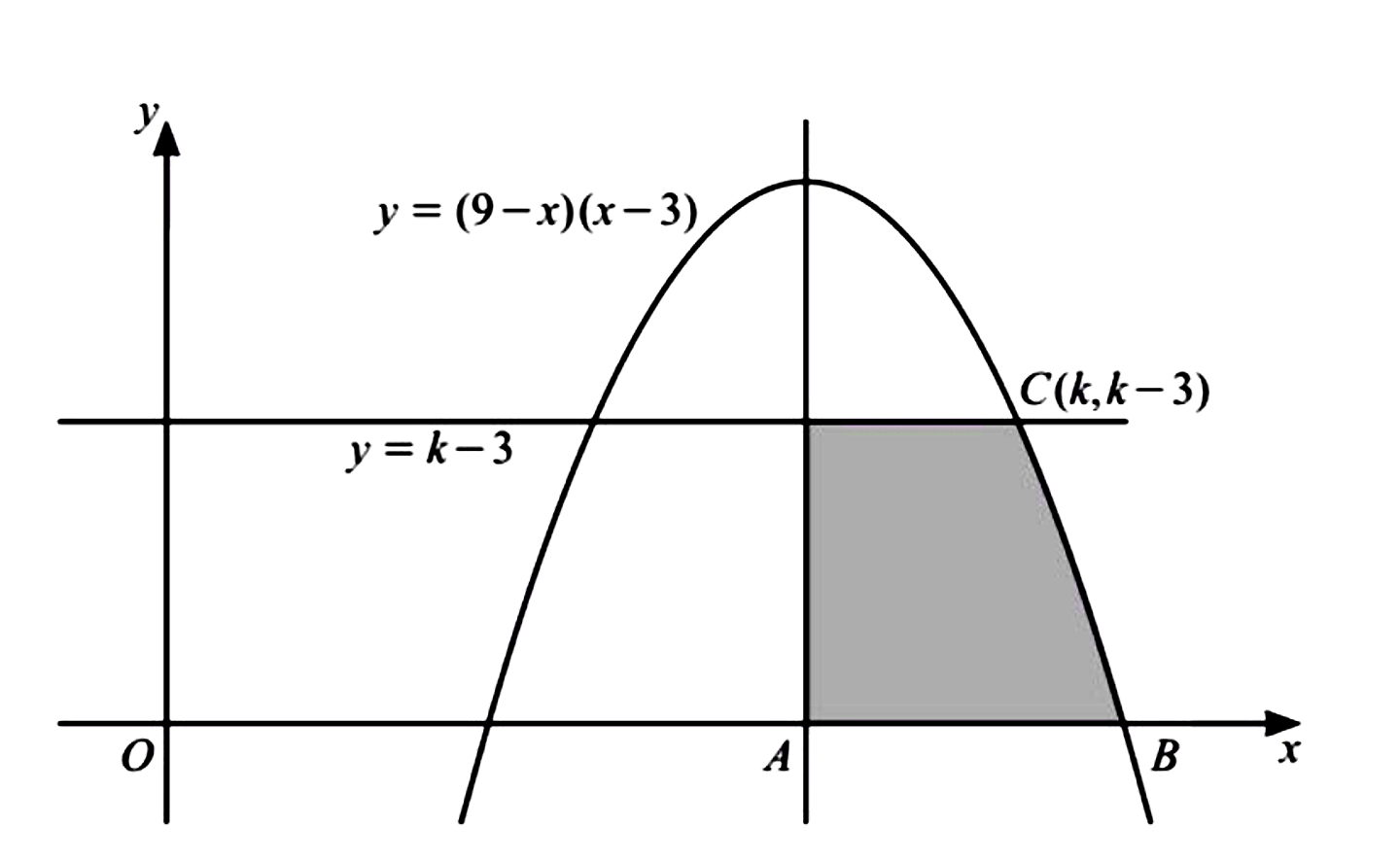
The diagram shows part of the curve $\displaystyle y = (9-x)(x-3)$ and the line $\displaystyle y = k-3$, where $\displaystyle k > 3$. The line through the maximum point of the curve, parallel to the $y$-axis, meets the $x$-axis at $\displaystyle A$. The curve meets the $x$-axis at $\displaystyle B$, and the line $\displaystyle y=k-3$ meets the curve at the point $\displaystyle C(k, k-3)$. Find the area of the shaded region. [9]
\(\displaystyle \begin{aligned} & y = (9-x)(x-3) = 9x - 27 - x^2 + 3x = -x^2 + 12x - 27 \\[2mm] & \text{Find the maximum point } A: \quad \frac{dy}{dx} = -2x + 12 = 0 \implies x = 6 \\[2mm] & \text{So, the vertical line is } x = 6. \\[2mm] & \text{Point } C(k, k-3) \text{ lies on the curve:} \\[2mm] & (9-k)(k-3) = k - 3 \\[2mm] & \text{Since } k > 3, \text{ divide both sides by } (k-3): \\[2mm] & 9 - k = 1 \implies k = 8 \\[2mm] & \text{So, the horizontal line is } y = 8 - 3 = 5. \text{ Point } C \text{ is } (8, 5). \\[2mm] & \text{Curve meets } x\text{-axis at } B: \quad (9-x)(x-3) = 0 \implies x=3, x=9. \text{ Thus, } B \text{ is at } x=9. \\[2mm] & \text{The shaded region is divided into a rectangle } (x \text{ from } 6 \text{ to } 8) \text{ and the area under the curve } (x \text{ from } 8 \text{ to } 9). \\[2mm] & \text{Area of Rectangle } = \text{width} \times \text{height} = (8 - 6) \times 5 = 10 \\[2mm] & \text{Area under curve } = \int_8^9 (-x^2 + 12x - 27) \, dx \\[2mm] & = \left[ -\frac{x^3}{3} + 6x^2 - 27x \right]_8^9 \\[2mm] & = \left(-\frac{729}{3} + 6(81) - 27(9)\right) - \left(-\frac{512}{3} + 6(64) - 27(8)\right) \\[2mm] & = (-243 + 486 - 243) - \left(-\frac{512}{3} + 384 - 216\right) \\[2mm] & = 0 - \left(-\frac{512}{3} + 168\right) = 0 - \left(\frac{-512 + 504}{3}\right) = \frac{8}{3} \\[2mm] & \text{Total Shaded Area } = 10 + \frac{8}{3} = \frac{38}{3} \end{aligned}\) -
[Problem 11]
The expansion of $\displaystyle \left(a + \frac{x}{a}\right)^n$ in ascending powers of $\displaystyle x$ begins $\displaystyle b^4 + 48b^3x$, where $\displaystyle n$, $\displaystyle a$ and $\displaystyle b$ are positive integers.
- Show that $\displaystyle a^{\frac{n}{2} - 4} = \left(\frac{48}{n}\right)^2$. [4]
\(\displaystyle \begin{aligned} \textbf{(a)} \quad & \text{Using Binomial Expansion:} \\[2mm] & \left(a + \frac{x}{a}\right)^n = a^n + \binom{n}{1} a^{n-1} \left(\frac{x}{a}\right)^1 + \dots \\[2mm] & = a^n + n a^{n-2} x + \dots \\[2mm] & \text{Comparing with the given expansion } b^4 + 48b^3x: \\[2mm] & a^n = b^4 \implies b = a^{\frac{n}{4}} \quad \text{--- (Eq 1)} \\[2mm] & n a^{n-2} = 48b^3 \quad \text{--- (Eq 2)} \\[2mm] & \text{Substitute (Eq 1) into (Eq 2):} \\[2mm] & n a^{n-2} = 48 \left(a^{\frac{n}{4}}\right)^3 \\[2mm] & n a^{n-2} = 48 a^{\frac{3n}{4}} \\[2mm] & \frac{a^{n-2}}{a^{\frac{3n}{4}}} = \frac{48}{n} \\[2mm] & a^{n - 2 - \frac{3n}{4}} = \frac{48}{n} \\[2mm] & a^{\frac{n}{4} - 2} = \frac{48}{n} \\[2mm] & \text{Squaring both sides:} \\[2mm] & \left( a^{\frac{n}{4} - 2} \right)^2 = \left( \frac{48}{n} \right)^2 \\[2mm] & a^{\frac{n}{2} - 4} = \left(\frac{48}{n}\right)^2 \quad \text{(shown)} \end{aligned}\)
إرسال تعليق