www.targetmathematics.org
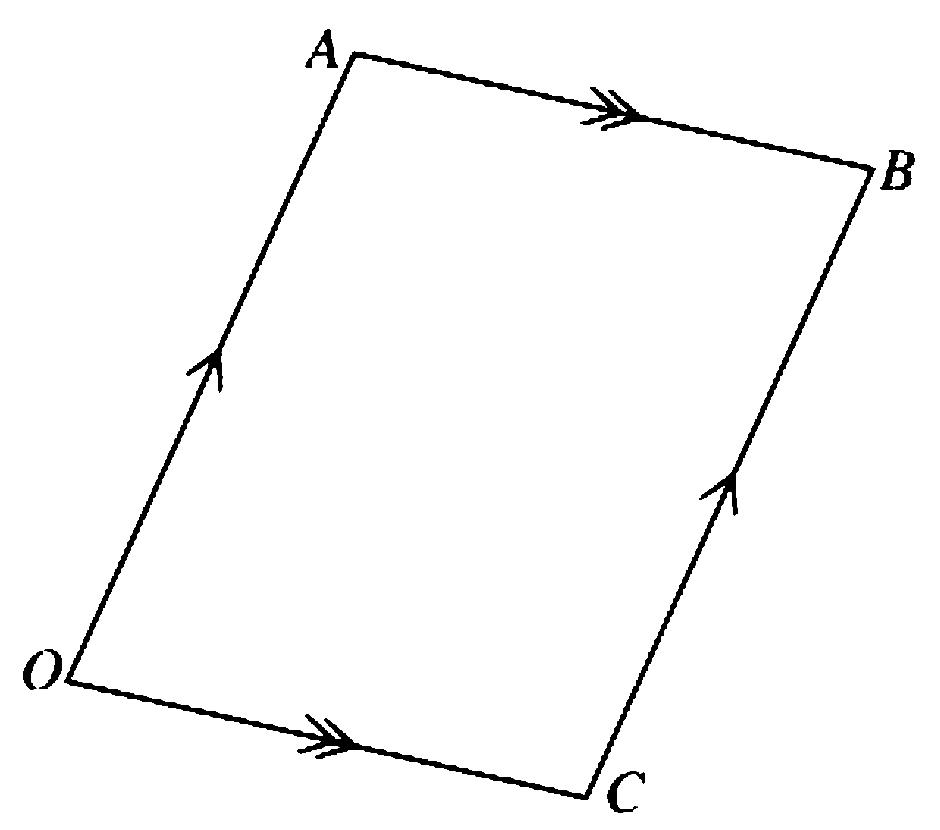
The diagram shows the parallelogram $O A B C$. Given that $\overrightarrow{O A}=\mathbf{i}+3 \mathbf{j}+3 \mathbf{k}$ and $\overrightarrow{O C}=3 \mathbf{i}-\mathbf{j}+\mathbf{k}$, find
- the unit vector in the direction of $\overrightarrow{O B}$, [3]
- the acute angle between the diagonals of the parallelogram, [5]
- the perimeter of the parallelogram, correct to 1 decimal place. [3]
Show Solution
Hide Solution
$$
\begin{aligned}
\textbf{(a) } & \overrightarrow{O A}=\mathbf{i}+3 \mathbf{j}+3 \mathbf{k}=\left(\begin{array}{c}
1 \\
3 \\
3
\end{array}\right) ,\quad \overrightarrow{O C}=3 \mathbf{i}-\mathbf{j}+\mathbf{k}=\left(\begin{array}{c}
3 \\
-1 \\
1
\end{array}\right) \\
& \overrightarrow{O B}=\overrightarrow{O A}+\overrightarrow{O C}=\left(\begin{array}{c}
1 \\
3 \\
3
\end{array}\right)+\left(\begin{array}{c}
3 \\
-1 \\
1
\end{array}\right)=\left(\begin{array}{l}
4 \\
2 \\
4
\end{array}\right) \\
& |\overrightarrow{O B}|=\sqrt{16+4+16}=6 \\
&\text { unit vector in the direction of } \overrightarrow{O B}=\frac{1}{6}\left(\begin{array}{l}
4 \\
2 \\
4
\end{array}\right)
\end{aligned}
$$
$$
\begin{aligned}
\textbf{(b) } & \overrightarrow{C A}=\overrightarrow{O A}-\overrightarrow{O C}=\left(\begin{array}{l}
1 \\
3 \\
3
\end{array}\right)-\left(\begin{array}{c}
3 \\
-1 \\
1
\end{array}\right)=\left(\begin{array}{c}
-2 \\
4 \\
2
\end{array}\right) \\
& |\overrightarrow{C A}|=\sqrt{4+16+4}=2 \sqrt{6} \\
& \overrightarrow{O B} \cdot \overrightarrow{C A}=\left(\begin{array}{l}
4 \\
2 \\
4
\end{array}\right) \cdot\left(\begin{array}{c}
-2 \\
4 \\
2
\end{array}\right)=-8+8+8=8 \\
&\text { Let the required angle be } \theta.\\
&\cos \theta =\frac{\overrightarrow{O B} \cdot \overrightarrow{C A}}{|\overrightarrow{O B}||\overrightarrow{C A}|}=\frac{8}{12 \sqrt{6}} \implies
\theta =74.2^\circ
\end{aligned}
$$
$$
\begin{aligned}
\textbf{(c) } \text { perimeter } & =2(|\overrightarrow{O A}|+|\overrightarrow{O C}|) \\
& =2(\sqrt{1+9+9}+\sqrt{9+1+1}) \\
& =2(\sqrt{19}+\sqrt{11}) \\
& =15.4
\end{aligned}
$$
Relative to an origin $O$, the position vectors of the points $A, B$ and $C$ are given by
$\overrightarrow{O A}=\mathbf{i}-2 \mathbf{j}+4 \mathbf{k}, \quad \overrightarrow{O B}=3 \mathbf{i}+2 \mathbf{j}+8 \mathbf{k}, \quad \overrightarrow{O C}=-\mathbf{i}-2 \mathbf{j}+10 \mathbf{k}$
- Use a scalar product to find angle $A B C$. [6]
- Find the perimeter of triangle $A B C$, giving your answer correct to 2 decimal places. [2]
Show Solution
Hide Solution
$$
\begin{aligned}
\textbf{(a)}\quad
& \overrightarrow{OA} = \begin{pmatrix} 1 \\ -2 \\ 4 \end{pmatrix},\quad
\overrightarrow{OB} = \begin{pmatrix} 3 \\ 2 \\ 8 \end{pmatrix},\quad
\overrightarrow{OC} = \begin{pmatrix} -1 \\ -2 \\ 10 \end{pmatrix} \\[4pt]
& \overrightarrow{BA} = \overrightarrow{OA} - \overrightarrow{OB} = \begin{pmatrix} -2 \\ -4 \\ -4 \end{pmatrix},\quad
\overrightarrow{BC} = \overrightarrow{OC} - \overrightarrow{OB} = \begin{pmatrix} -4 \\ -4 \\ 2 \end{pmatrix} \\[4pt]
& \overrightarrow{BA} \cdot \overrightarrow{BC} = (-2)(-4) + (-4)(-4) + (-4)(2) = 8 + 16 - 8 = 16 \\[4pt]
& |\overrightarrow{BA}| = \sqrt{(-2)^2 + (-4)^2 + (-4)^2} = \sqrt{36} = 6 \\[4pt]
& |\overrightarrow{BC}| = \sqrt{(-4)^2 + (-4)^2 + 2^2} = \sqrt{36} = 6 \\[4pt]
& \cos\angle ABC = \frac{16}{6 \cdot 6} = \frac{4}{9} \\[4pt]
& \angle ABC = \cos^{-1}\left( \frac{4}{9} \right) \approx 63.6^\circ
\end{aligned}
$$
$$
\begin{aligned}
\textbf{(b)}\quad
& |\overrightarrow{AB}| = |\overrightarrow{BA}| = 6,\quad |\overrightarrow{BC}| = 6 \\[4pt]
& \overrightarrow{AC} = \overrightarrow{OC} - \overrightarrow{OA} = \begin{pmatrix} -2 \\ 0 \\ 6 \end{pmatrix} \\[4pt]
& |\overrightarrow{AC}| = \sqrt{(-2)^2 + 0^2 + 6^2} = \sqrt{40} \approx 6.32 \\[4pt]
& \text{Perimeter} = |\overrightarrow{AB}| + |\overrightarrow{BC}| + |\overrightarrow{AC}| = 6 + 6 + 6.32 = 18.32
\end{aligned}
$$
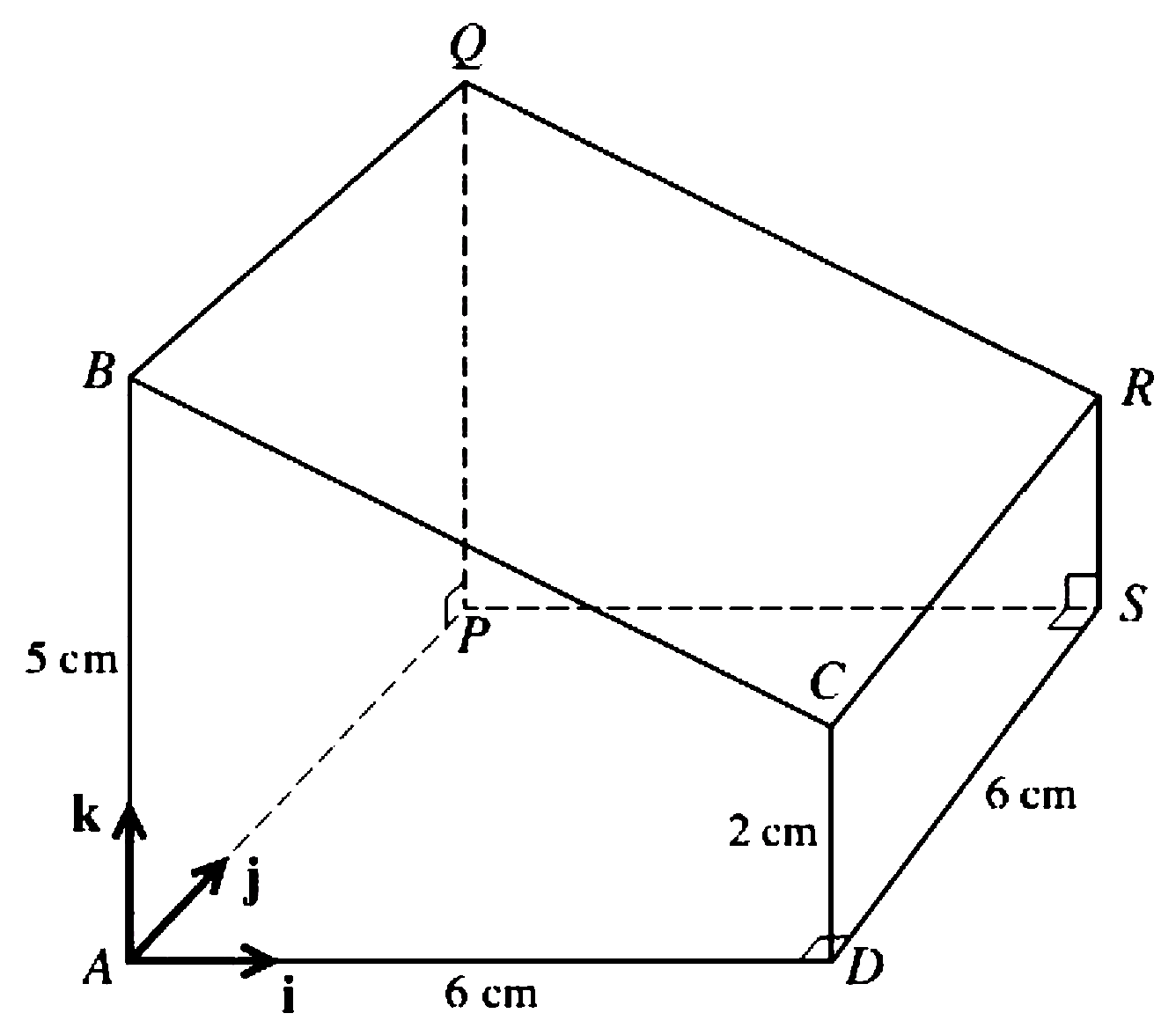
The diagram shows a prism $A B C D P Q R S$ with a horizontal square base $A P S D$ with sides of length 6 cm . The cross-section $A B C D$ is a trapezium and is such that the vertical edges $A B$ and $D C$ are of lengths 5 cm and 2 cm respectively. Unit vectors $\mathbf{i}, \mathbf{j}$ and $\mathbf{k}$ are parallel to $A D, A P$ and $A B$ respectively.
- Express each of the vectors $\overrightarrow{C P}$ and $\overrightarrow{C Q}$ in terms of $\mathbf{i}, \mathbf{j}$ and $\mathbf{k}$. [2]
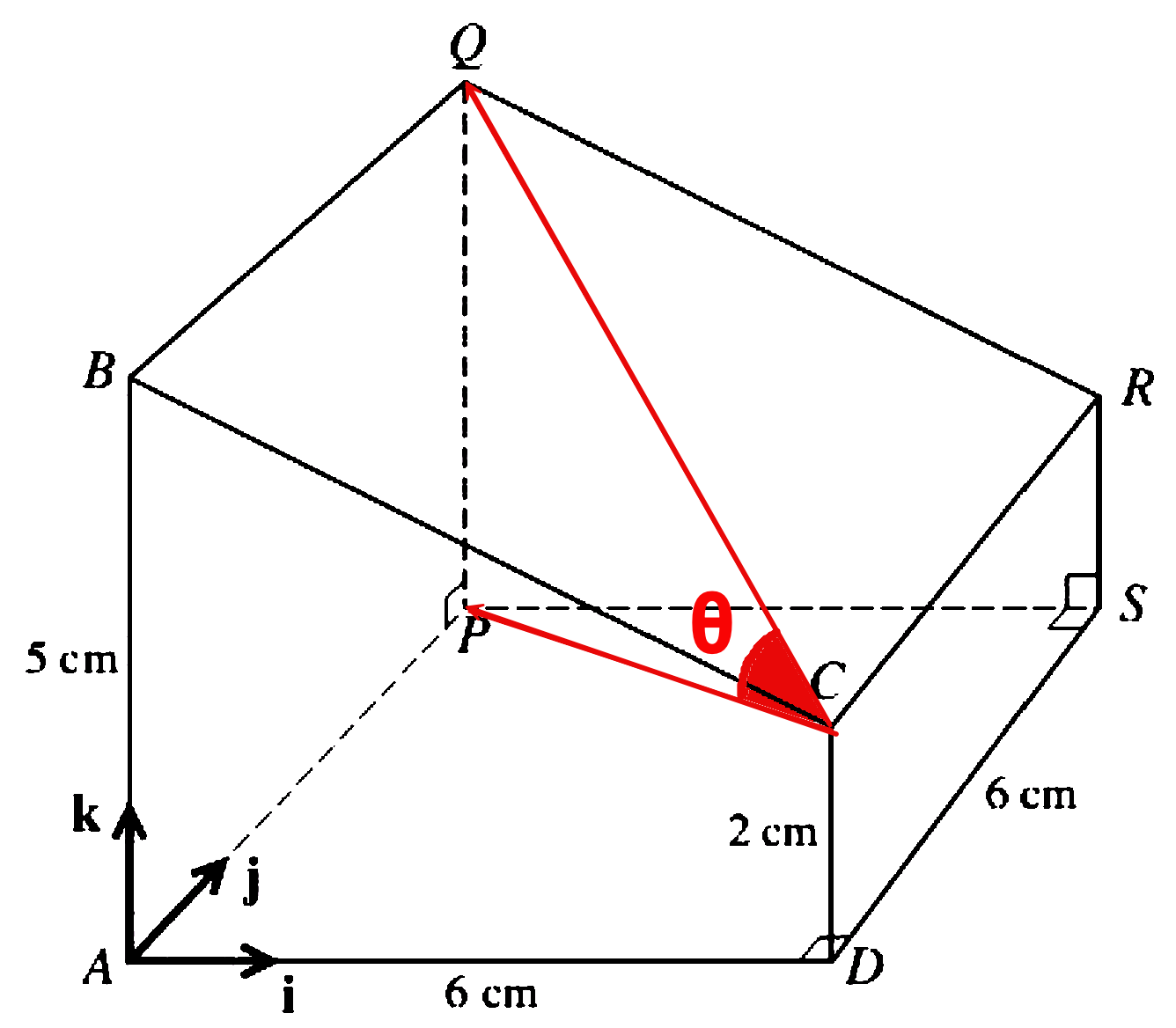
- Use a scalar product to calculate angle $P C Q$. [4]
Show Solution
Hide Solution
$$
\begin{aligned}
\textbf{(a)}\quad
&\overrightarrow{CP} = -6\mathbf{i} + 6\mathbf{j} -2\mathbf{k} \\
&\overrightarrow{CQ} = -6\mathbf{i} + 6\mathbf{j} +3\mathbf{k}
\end{aligned}
$$
$$
\begin{aligned}
\textbf{(b)}\quad
&\overrightarrow{CP} \cdot\overrightarrow{CQ} = 36 + 36 -6 = 66 \\
& |\overrightarrow{CP}| = \sqrt{76},\quad |\overrightarrow{CQ}| = \sqrt{81} = 9 \\
&\text{Let } \angle PCQ=\theta.\\
& \cos\theta = \frac{66}{\sqrt{76} \times 9} \\
& \theta = \cos^{-1}\left( \frac{66}{9\sqrt{76}} \right) \approx 32.7^\circ
\end{aligned}
$$
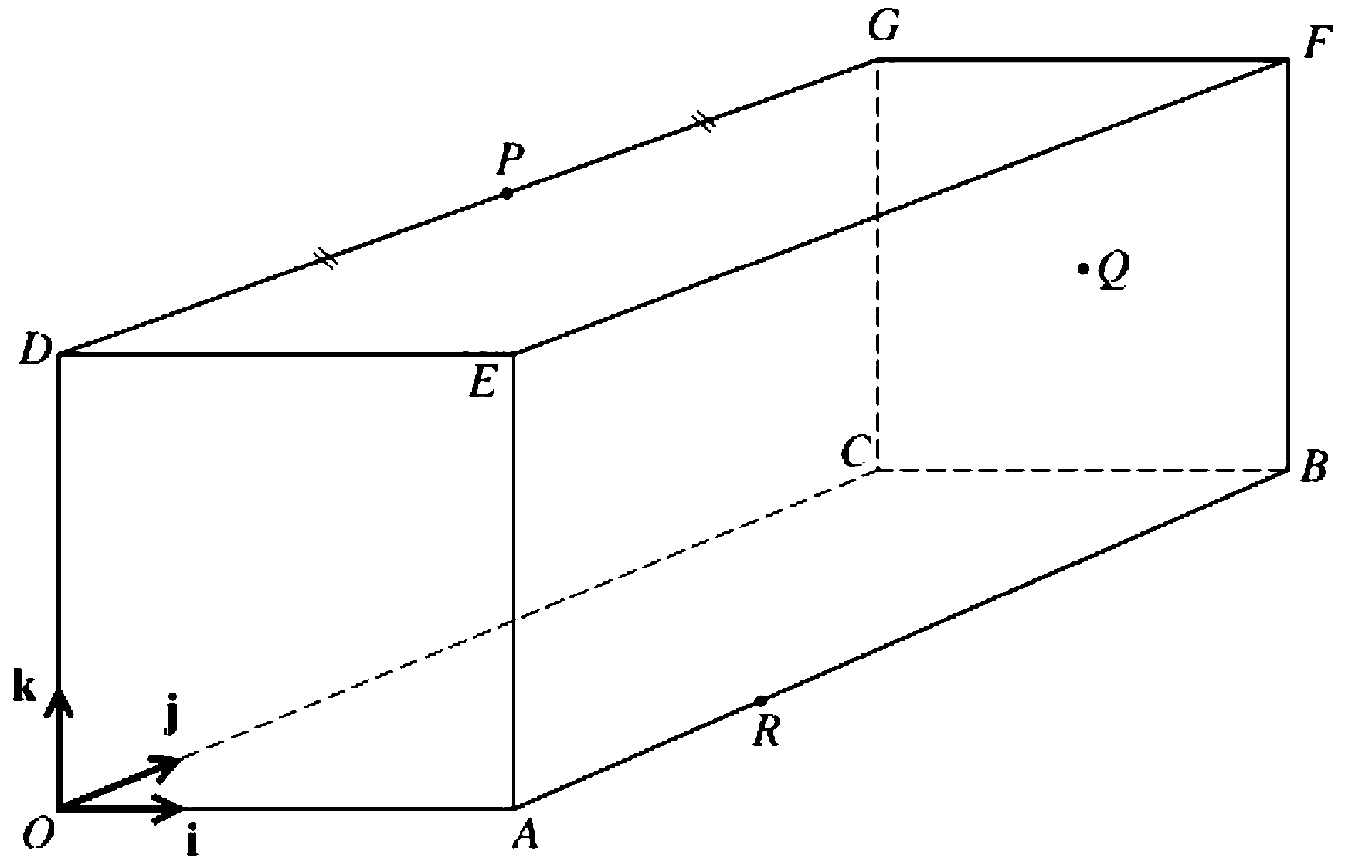
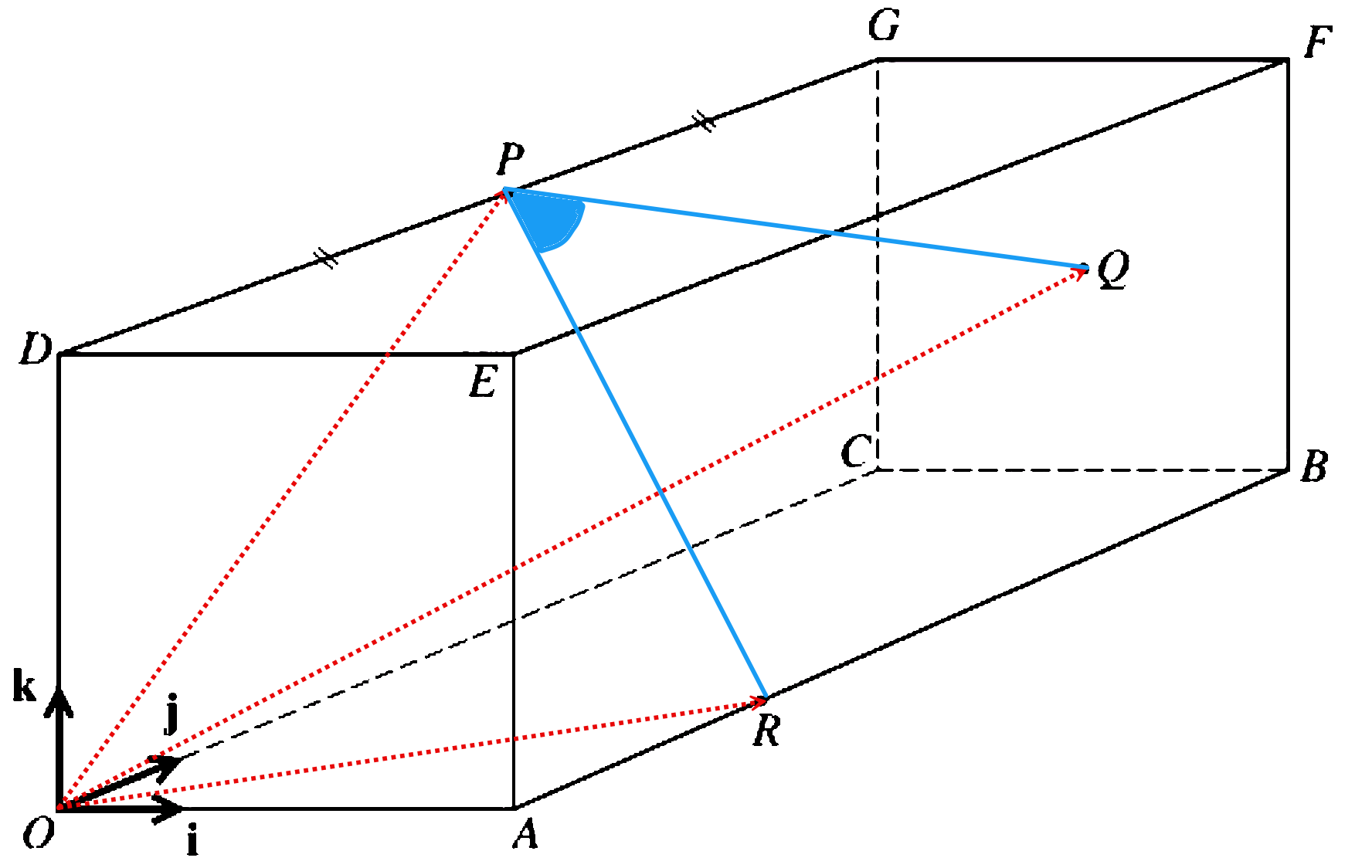
In the diagram, $O A B C D E F G$ is a rectangular block in which $O A=O D=6 \mathrm{~cm}$ and $A B=12 \mathrm{~cm}$. The unit vectors $\mathbf{i}, \mathbf{j}$ and $\mathbf{k}$ are parallel to $\overrightarrow{O A}, \overrightarrow{O C}$ and $\overrightarrow{O D}$ respectively. The point $P$ is the mid-point of $D G, Q$ is the centre of the square face $C B F G$ and $R$ lies on $A B$ such that $A R=4 \mathrm{~cm}$.
- Express each of the vectors $\overrightarrow{P Q}$ and $\overrightarrow{R Q}$ in terms of $\mathbf{i}, \mathbf{j}$ and $\mathbf{k}$. [3]
- Use a scalar product to find angle $R Q P$. [4]
Show Solution
Hide Solution
$$
\begin{aligned}
\textbf{(a)}\quad& \overrightarrow{O P}=6\mathbf{j}+6\mathbf{k}\\
& \overrightarrow{O Q}=3 \mathbf{i}+12 \mathbf{j}+3\mathbf{k} \\
& \overrightarrow{O R}=6 \mathbf{i}+4 \mathbf{j}\\
& \overrightarrow{PQ} = 3\mathbf{i} + 6\mathbf{j} -3\mathbf{k} \\
& \overrightarrow{RQ} = -3\mathbf{i} + 8\mathbf{j} +3\mathbf{k}
\end{aligned}
$$
$$
\begin{aligned}
\textbf{(b)}\quad
& \overrightarrow{PQ} \cdot \overrightarrow{RQ} = 30 \\
& |\overrightarrow{PQ}| = 3\sqrt{6},\quad |\overrightarrow{RQ}| = \sqrt{82} \\
& \cos\angle RQP = \frac{30}{3\sqrt{6}\times\sqrt{82}} = \frac{5}{\sqrt{123}} \\
& \angle RQP \approx 63.2^\circ
\end{aligned}
$$
Two vectors $\mathbf{u}$ and $\mathbf{v}$ are such that $\mathbf{u}=\left(\begin{array}{c}p^2 \\ -2 \\ 6\end{array}\right)$ and $\mathbf{v}=\left(\begin{array}{c}2 \\ p-1 \\ 2 p+1\end{array}\right)$, where $p$ is a constant.
- Find the values of $p$ for which $\mathbf{u}$ is perpendicular to $\mathbf{v}$. [3]
- For the case where $p=1$, find the angle between the directions of $\mathbf{u}$ and $\mathbf{v}$. [4]
Show Solution
Hide Solution
$$
\begin{aligned}
\textbf{(a)}\quad & \mathbf{u}\cdot\mathbf{v}=0 \\
&\left(\begin{array}{c}p^2 \\ -2 \\ 6\end{array}\right)\cdot\left(\begin{array}{c}2 \\ p-1 \\ 2 p+1\end{array}\right)=0\\
&p^2\times2 + (-2)\times(p-1) + 6\times(2p+1) = 0 \\
& 2p^2 -2(p-1) +6(2p+1)=0 \\
& 2p^2 -2p +2 +12p +6=0 \\
& 2p^2 +10p +8=0 \\
& p^2 +5p +4=0 \\
& (p+4)(p+1)=0 \\
& p=-4\text{ or }p=-1
\end{aligned}
$$
$$
\begin{aligned}
\textbf{(b)}\quad & p=1\\
& \mathbf{u}=\begin{pmatrix}1\\-2\\6\end{pmatrix},\quad \mathbf{v}=\begin{pmatrix}2\\0\\3\end{pmatrix} \\
& \mathbf{u}\cdot\mathbf{v} = 1\times2 + (-2)\times0 +6\times3 =2+0+18=20 \\
& |\mathbf{u}|=\sqrt{1^2+(-2)^2+6^2}=\sqrt{1+4+36}=\sqrt{41} \\
& |\mathbf{v}|=\sqrt{2^2+0^2+3^2}=\sqrt{4+0+9}=\sqrt{13} \\
& \cos\theta =\frac{20}{\sqrt{41}\times\sqrt{13}} \\
& \theta=\cos^{-1}\left(\frac{20}{\sqrt{41\times13}}\right)=30^{\circ}
\end{aligned}
$$
Relative to an origin $O$, the position vectors of the points $A, B$ and $C$ are given by
$
\overrightarrow{O A}=\left(\begin{array}{r}
2 \\
-1 \\
4
\end{array}\right), \quad \overrightarrow{O B}=\left(\begin{array}{r}
4 \\
2 \\
-2
\end{array}\right) \quad \text { and } \quad \overrightarrow{O C}=\left(\begin{array}{l}
1 \\
3 \\
p
\end{array}\right)
$
Find
- the unit vector in the direction of $\overrightarrow{A B}$, [3]
- the value of the constant $p$ for which angle $B O C=90^{\circ}$. [2]
Show Solution
Hide Solution
$$
\begin{aligned}
\textbf{(a)}\quad & \overrightarrow{AB} = \overrightarrow{OB} - \overrightarrow{OA} = \begin{pmatrix} 4 \\ 2 \\ -2 \end{pmatrix} - \begin{pmatrix} 2 \\ -1 \\ 4 \end{pmatrix} = \begin{pmatrix} 2 \\ 3 \\ -6 \end{pmatrix} \\
& |\overrightarrow{AB}| = \sqrt{2^2+3^2+(-6)^2} = \sqrt{4+9+36} = \sqrt{49}=7 \\
& \text{Unit vector} = \frac{1}{7}\begin{pmatrix} 2 \\ 3 \\ -6 \end{pmatrix}
\end{aligned}
$$
$$
\begin{aligned}
\textbf{(b)}\quad & \text{Given } \overrightarrow{OB} = \begin{pmatrix} 4 \\ 2 \\ -2 \end{pmatrix}, \overrightarrow{OC} = \begin{pmatrix} 1 \\ 3 \\ p \end{pmatrix} \\
& \overrightarrow{OB} \cdot \overrightarrow{OC} = 0 \\
&\left(\begin{array}{r}
4 \\
2 \\
-2
\end{array}\right)\cdot\left(\begin{array}{l}
1 \\
3 \\
p
\end{array}\right)=0\\
& (4)(1) + (2)(3) + (-2)(p) = 0 \\
& 4 + 6 - 2p = 0 \\
& 10 - 2p = 0 \\
& 10 = 2p \\
& p = 5
\end{aligned}
$$
Relative to an origin $O$, the position vectors of three points, $A, B$ and $C$, are given by
$\overrightarrow{O A}=\mathbf{i}+2 p \mathbf{j}+q \mathbf{k}, \quad \overrightarrow{O B}=q \mathbf{j}-2 p \mathbf{k} \quad \text { and } \quad \overrightarrow{O C}=-\left(4 p^2+q^2\right) \mathbf{i}+2 p \mathbf{j}+q \mathbf{k},$
where $p$ and $q$ are constants.
- Show that $\overrightarrow{O A}$ is perpendicular to $\overrightarrow{O C}$ for all non-zero values of $p$ and $q$. [2]
- Find the magnitude of $\overrightarrow{C A}$ in terms of $p$ and $q$. [2]
- For the case where $p=3$ and $q=2$, find the unit vector parallel to $\overrightarrow{B A}$. [3]
Show Solution
Hide Solution
$$
\begin{aligned}
\textbf{(a)}\quad & \overrightarrow{OA} = \begin{pmatrix}1\\2p\\q\end{pmatrix},\quad \overrightarrow{OC} = \begin{pmatrix}-(4p^2+q^2)\\2p\\q\end{pmatrix} \\
& \overrightarrow{OA} \cdot \overrightarrow{OC} = 1\times(-4p^2-q^2) + 2p\times2p + q\times q = -4p^2 - q^2 + 4p^2 + q^2 = 0\\[4pt]
&\text{Hence, $\overrightarrow{OA}$ is perpendicular to $\overrightarrow{OC}$.}
\end{aligned}
$$
$$
\begin{aligned}
\textbf{(b)}\quad & \overrightarrow{CA} = \overrightarrow{OA} - \overrightarrow{OC} = \begin{pmatrix}1\\2p\\q\end{pmatrix} - \begin{pmatrix}-(4p^2+q^2)\\2p\\q\end{pmatrix} = \begin{pmatrix}4p^2+q^2+1\\0\\0\end{pmatrix} \\[4pt]
& |\overrightarrow{CA}| = \sqrt{(4p^2+q^2+1)^2} = 4p^2+q^2+1
\end{aligned}
$$
$$
\begin{aligned}
\textbf{(c)}\quad & p=3,\ q=2 \\
& \overrightarrow{OA} = \begin{pmatrix}1\\6\\2\end{pmatrix},\quad \overrightarrow{OB} = \begin{pmatrix}0\\2\\-6\end{pmatrix} \\
& \overrightarrow{BA} = \overrightarrow{OA} - \overrightarrow{OB} = \begin{pmatrix}1\\6\\2\end{pmatrix} - \begin{pmatrix}0\\2\\-6\end{pmatrix} = \begin{pmatrix}1\\4\\8\end{pmatrix} \\
& |\overrightarrow{BA}| = \sqrt{1^2 + 4^2 + 8^2} = \sqrt{1 + 16 + 64} = \sqrt{81} = 9 \\
& \text{Unit vector} = \frac{1}{9}\begin{pmatrix}1\\4\\8\end{pmatrix}
\end{aligned}
$$
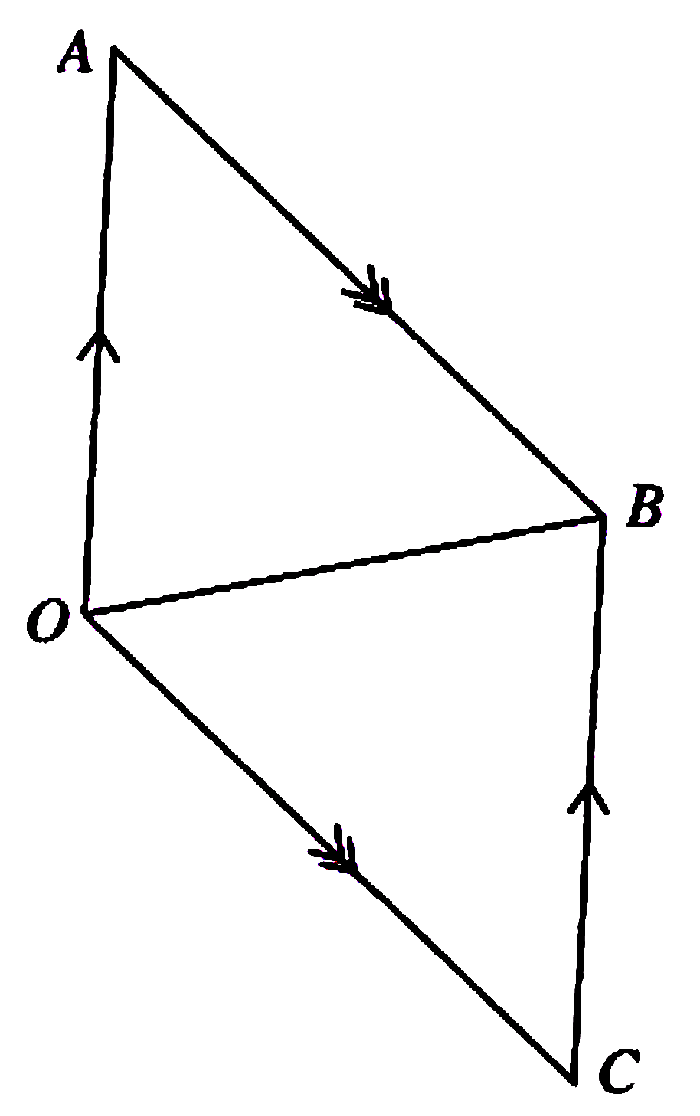
The diagram shows a parallelogram $O A B C$ in which
$\overrightarrow{O A}=\left(\begin{array}{r}
3 \\
3 \\
-4
\end{array}\right) \quad \text { and } \quad \overrightarrow{O B}=\left(\begin{array}{l}
5 \\
0 \\
2
\end{array}\right)$
- Use a scalar product to find angle $B O C$. [6]
- Find a vector which has magnitude 35 and is parallel to the vector $\overrightarrow{O C}$. [2]
Show Solution
Hide Solution
$$
\begin{aligned}
\textbf{(a)}\quad & \overrightarrow{OC} = \overrightarrow{OA} + \overrightarrow{AB} = \overrightarrow{OA} + \overrightarrow{CB} = \overrightarrow{OA} + (\overrightarrow{OB} - \overrightarrow{OC}) \implies \overrightarrow{OC} = \overrightarrow{OB} - \overrightarrow{OA} \\
& \overrightarrow{OC} = \begin{pmatrix}5\\0\\2\end{pmatrix} - \begin{pmatrix}3\\3\\-4\end{pmatrix} = \begin{pmatrix}2\\-3\\6\end{pmatrix} \\[4pt]
& \overrightarrow{OB} = \begin{pmatrix}5\\0\\2\end{pmatrix},\quad \overrightarrow{OC} = \begin{pmatrix}2\\-3\\6\end{pmatrix} \\
& \overrightarrow{OB} \cdot \overrightarrow{OC} = 5 \cdot 2 + 0 \cdot (-3) + 2 \cdot 6 = 10 + 0 + 12 = 22 \\
& |\overrightarrow{OB}| = \sqrt{5^2 + 0^2 + 2^2} = \sqrt{25 + 0 + 4} = \sqrt{29} \\
& |\overrightarrow{OC}| = \sqrt{2^2 + (-3)^2 + 6^2} = \sqrt{4 + 9 + 36} = \sqrt{49} = 7 \\
& \cos \angle BOC = \frac{22}{\sqrt{29} \cdot 7} = \frac{22}{7\sqrt{29}} \\
& \angle BOC = \cos^{-1}\left(\frac{22}{7\sqrt{29}}\right)=54.3^{\circ}
\end{aligned}
$$
$$
\begin{aligned}
\textbf{(b)}\quad & \text{Unit vector parallel to } \overrightarrow{OC} = \frac{1}{7} \begin{pmatrix}2\\-3\\6\end{pmatrix} \\
& \text{Required vector} = \pm ~35 \times \frac{1}{7} \begin{pmatrix}2\\-3\\6\end{pmatrix} =\pm \begin{pmatrix}10\\-15\\30\end{pmatrix}
\end{aligned}
$$
Relative to an origin $O$, the position vectors of the points $A, B$ and $C$ are given by
$\overrightarrow{O A}=\left(\begin{array}{r}
2 \\
3 \\
-6
\end{array}\right), \quad \overrightarrow{O B}=\left(\begin{array}{r}
0 \\
-6 \\
8
\end{array}\right) \quad \text { and } \quad \overrightarrow{O C}=\left(\begin{array}{r}
-2 \\
5 \\
-2
\end{array}\right)$
- Find angle $A O B$. [4]
- Find the vector which is in the same direction as $\overrightarrow{A C}$ and has magnitude 30 . [3]
- Find the value of the constant $p$ for which $\overrightarrow{O A}+p \overrightarrow{O B}$ is perpendicular to $\overrightarrow{O C}$. [3]
Show Solution
Hide Solution
$$
\begin{aligned}
\textbf{(a)}\quad & \overrightarrow{OA} = \begin{pmatrix}2\\3\\-6\end{pmatrix},\quad \overrightarrow{OB} = \begin{pmatrix}0\\-6\\8\end{pmatrix} \\
& \overrightarrow{OA} \cdot \overrightarrow{OB} = 2 \cdot 0 + 3 \cdot (-6) + (-6) \cdot 8 = 0 -18 -48 = -66 \\
& |\overrightarrow{OA}| = \sqrt{2^2 + 3^2 + (-6)^2} = \sqrt{4 + 9 + 36} = \sqrt{49} = 7 \\
& |\overrightarrow{OB}| = \sqrt{0^2 + (-6)^2 + 8^2} = \sqrt{36 + 64} = \sqrt{100} = 10 \\
& \cos \angle AOB = \frac{-66}{7 \cdot 10} = -\frac{33}{35} \\
& \angle AOB = \cos^{-1}\left(-\frac{33}{35}\right)=160.5^{\circ}
\end{aligned}
$$
$$
\begin{aligned}
\textbf{(b)}\quad & \overrightarrow{AC} = \overrightarrow{OC} - \overrightarrow{OA} = \begin{pmatrix}-2\\5\\-2\end{pmatrix} - \begin{pmatrix}2\\3\\-6\end{pmatrix} = \begin{pmatrix}-4\\2\\4\end{pmatrix} \\
& |\overrightarrow{AC}| = \sqrt{(-4)^2 + 2^2 + 4^2} = \sqrt{16 + 4 + 16} = \sqrt{36} = 6 \\
& \text{Unit vector} = \frac{1}{6} \begin{pmatrix}-4\\2\\4\end{pmatrix} \\
& \text{Required vector} = 30 \cdot \frac{1}{6} \begin{pmatrix}-4\\2\\4\end{pmatrix} = \begin{pmatrix}-20\\10\\20\end{pmatrix}
\end{aligned}
$$
$$
\begin{aligned}
\textbf{(c)}\quad & \overrightarrow{OA} + p\overrightarrow{OB} = \begin{pmatrix}2\\3\\-6\end{pmatrix} + p \begin{pmatrix}0\\-6\\8\end{pmatrix} = \begin{pmatrix}2\\3 - 6p\\-6 + 8p\end{pmatrix} \\
& \left(\overrightarrow{OA} + p\overrightarrow{OB}\right)\cdot \overrightarrow{OC} =0\\
& \begin{pmatrix}2\\3 - 6p\\-6 + 8p\end{pmatrix} \cdot \begin{pmatrix}-2\\5\\-2\end{pmatrix} = 0\\
& -4 + 15 - 30p + 12 - 16p = 0 \implies 23 - 46p = 0 \implies p = \frac{23}{46} = \frac{1}{2}
\end{aligned}
$$
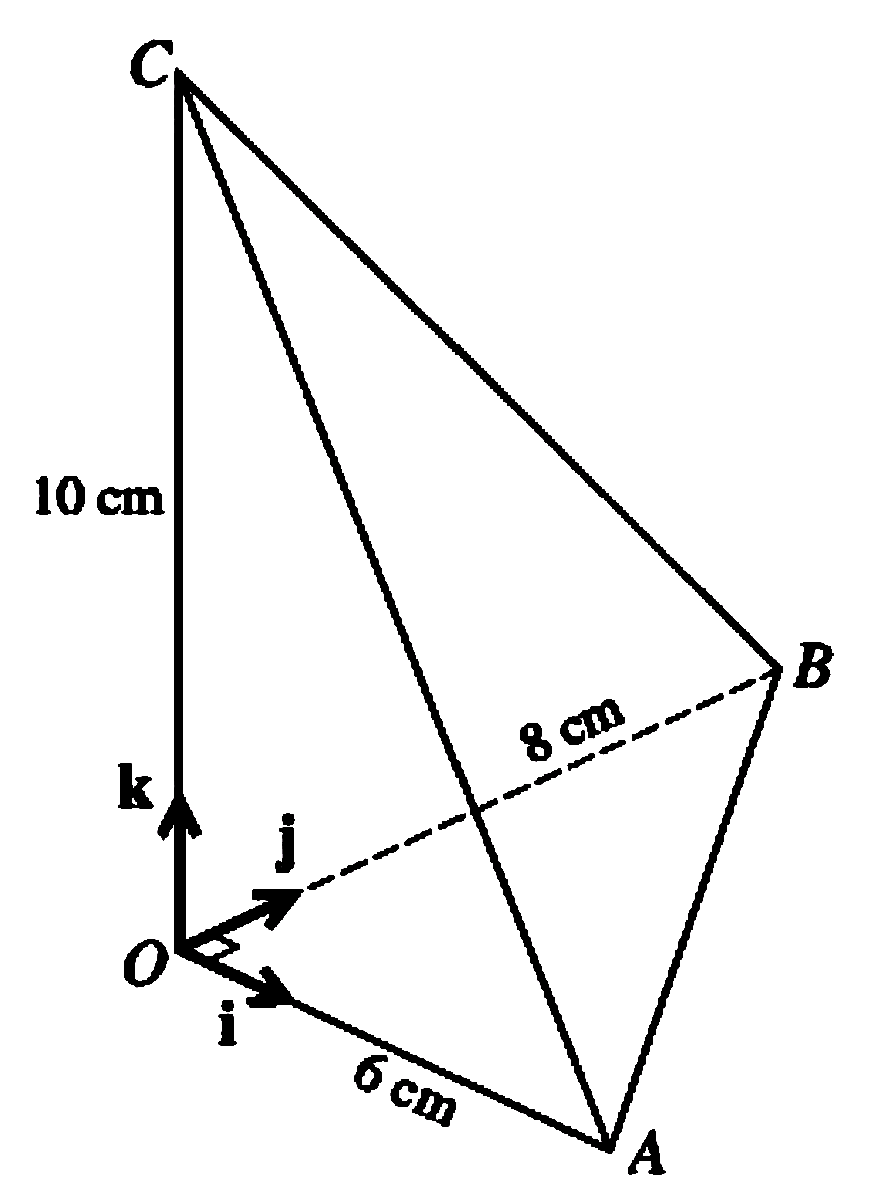
The diagram shows a pyramid $O A B C$ with a horizontal base $O A B$ where $O A=6 \mathrm{~cm},$ $O B=8 \mathrm{~cm}$ and angle $A O B=90^{\circ}$. The point $C$ is vertically above $O$ and $O C=10 \mathrm{~cm}$. Unit vectors $\mathbf{i}, \mathbf{j}$ and $\mathbf{k}$ are parallel to $O A, O B$ and $O C$ as shown. Use a scalar product to find angle $A C B$. [6]
Show Solution
Hide Solution
$$
\begin{aligned}
& \overrightarrow{OA} = 6\mathbf{i},\quad \overrightarrow{OB} = 8\mathbf{j},\quad \overrightarrow{OC} = 10\mathbf{k} \\
& \overrightarrow{AC} = \overrightarrow{OC} - \overrightarrow{OA} = -6\mathbf{i} + 10\mathbf{k} \quad \text{and} \quad \overrightarrow{BC} = \overrightarrow{OC} - \overrightarrow{OB} = -8\mathbf{j} + 10\mathbf{k}\\
&\overrightarrow{AC} \cdot \overrightarrow{BC} = (-6\mathbf{i} + 10\mathbf{k}) \cdot (-8\mathbf{j} + 10\mathbf{k}) = 0 + 0 + 100 = 100 \\
& |\overrightarrow{AC}| = \sqrt{(-6)^2 + 0^2 + 10^2} = \sqrt{36 + 100} = \sqrt{136} \\
& |\overrightarrow{BC}| = \sqrt{0^2 + (-8)^2 + 10^2} = \sqrt{64 + 100} = \sqrt{164} \\
& \cos \angle ACB = \frac{100}{\sqrt{136} \cdot \sqrt{164}} = \frac{100}{\sqrt{22208}} \implies \angle ACB = \cos^{-1} \left(\frac{100}{\sqrt{22208}}\right)=47.9^{\circ}
\end{aligned}
$$
The lines $l$ and $m$ have vector equations
$\mathbf{r}=\mathbf{i}+\mathbf{j}+\mathbf{k}+s(\mathbf{i}-\mathbf{j}+2 \mathbf{k}) \quad \text { and } \quad \mathbf{r}=4 \mathbf{i}+6 \mathbf{j}+\mathbf{k}+t(2 \mathbf{i}+2 \mathbf{j}+\mathbf{k})$
respectively.
- Show that $l$ and $m$ intersect. [4]
- Calculate the acute angle between the lines. [3]
- Find the equation of the plane containing $l$ and $m$, giving your answer in the form $a x+b y+c z=d$. [5]
Show Solution
Hide Solution
$$
\begin{aligned}
\textbf{(a)}\quad
& \mathbf{r}_1 = \begin{pmatrix}1\\1\\1\end{pmatrix} + s\begin{pmatrix}1\\-1\\2\end{pmatrix},\quad
\mathbf{r}_2 = \begin{pmatrix}4\\6\\1\end{pmatrix} + t\begin{pmatrix}2\\2\\1\end{pmatrix} \\
& \text{Equating: } \begin{pmatrix}1 + s\\1 - s\\1 + 2s\end{pmatrix} = \begin{pmatrix}4 + 2t\\6 + 2t\\1 + t\end{pmatrix} \\
& 1 + s = 4 + 2t \quad \textbf{\ldots(1)}\\
& 1 - s = 6 + 2t \quad \textbf{\ldots(2)} \\
& 1 + 2s = 1 + t \quad \textbf{\ldots(3)} \\[4pt]
& \text{From (1): } s = 3 + 2t \\
& \text{Sub into (2): } 1 - (3 + 2t) = 6 + 2t \implies -4t = 8 \implies t = -2 \\
& \text{Then } s = 3 + 2(-2) = -1 \\[4pt]
& \text{Therefore, } \mathbf{r}_1 = \begin{pmatrix}1\\1\\1\end{pmatrix} + (-1)\begin{pmatrix}1\\-1\\2\end{pmatrix} = \begin{pmatrix}0\\2\\-1\end{pmatrix} , \quad \mathbf{r}_2 = \begin{pmatrix}4\\6\\1\end{pmatrix} + (-2)\begin{pmatrix}2\\2\\1\end{pmatrix} = \begin{pmatrix}0\\2\\-1\end{pmatrix} \\
& \text{Hence, lines intersect at } (0, 2, -1).\\
\textbf{(b)}\quad & \text{Direction vectors: } \overrightarrow{l} = \begin{pmatrix}1\\-1\\2\end{pmatrix},\quad \overrightarrow{m} = \begin{pmatrix}2\\2\\1\end{pmatrix} \\
& \overrightarrow{l} \cdot \overrightarrow{m} = 1\cdot2 + (-1)\cdot2 + 2\cdot1 = 2 - 2 + 2 = 2 \\
& |\overrightarrow{l}| = \sqrt{1^2 + (-1)^2 + 2^2} = \sqrt{6},\quad |\overrightarrow{m}| = \sqrt{2^2 + 2^2 + 1^2} = \sqrt{9} = 3 \\
& \cos\theta = \frac{2}{\sqrt{6} \cdot 3} = \frac{2}{3\sqrt{6}}\implies \theta = \cos^{-1}\left(\frac{2}{3\sqrt{6}}\right)=74.2^{\circ}
\end{aligned}
$$
$$
\begin{aligned}
\textbf{(c)}\quad & \text{Two direction vectors in plane: } \overrightarrow{l} = \begin{pmatrix}1\\-1\\2\end{pmatrix},\ \overrightarrow{m} = \begin{pmatrix}2\\2\\1\end{pmatrix} \\
& \text{Normal vector } \mathbf{n} = \overrightarrow{l} \times \overrightarrow{m}= \begin{pmatrix}1\\-1\\2\end{pmatrix}\times\begin{pmatrix}2\\2\\1\end{pmatrix}=\begin{pmatrix}-5\\3\\4\end{pmatrix}\\
& \text{Plane: } -5(x - 0) + 3(y - 2) + 4(z + 1) = 0 \implies 5x - 3y - 4z = -2
\end{aligned}
$$
The straight line $l$ has equation $\mathbf{r}=2 \mathbf{i}-\mathbf{j}-4 \mathbf{k}+\lambda(\mathbf{i}+2 \mathbf{j}+2 \mathbf{k})$. The plane $p$ has equation $3 x-y+2 z=9$. The line $l$ intersects the plane $p$ at the point $A$.
- Find the position vector of $A$. [3]
- Find the acute angle between $l$ and $p$. [4]
- Find an equation for the plane which contains $l$ and is perpendicular to $p$, giving your answer in the form $a x+b y+c z=d$. [5]
Show Solution
Hide Solution
$$
\begin{aligned}
\textbf{(a)}\quad & \text{Line } l: \mathbf{r} = \begin{pmatrix}2\\-1\\-4\end{pmatrix} + \lambda \begin{pmatrix}1\\2\\2\end{pmatrix} \quad \text{Plane } p: 3 x-y+2 z=9\\[-2mm]
& \text{Let the point of intersection of the line and plane be } (2+\lambda, -1+2\lambda, -4+2\lambda). \\
& 3(2+\lambda) - (-1+2\lambda) + 2(-4+2\lambda) = 9 \\
& 6 + 3\lambda + 1 - 2\lambda - 8 + 4\lambda = 9 \implies \lambda = 2 \\
\therefore\quad & \overrightarrow{OA} = \begin{pmatrix}2 + 2\\-1 + 4\\-4 + 4\end{pmatrix} = \begin{pmatrix}4\\3\\0\end{pmatrix}\\[-2mm]
\textbf{(b)}\quad & \text{Direction of line } \overrightarrow{d} = \begin{pmatrix}1\\2\\2\end{pmatrix},\quad \text{Normal to plane } \overrightarrow{n} = \begin{pmatrix}3\\-1\\2\end{pmatrix} \\
& \overrightarrow{d} \cdot \overrightarrow{n} = 1\cdot3 + 2\cdot(-1) + 2\cdot2 = 3 - 2 + 4 = 5 \\
& |\overrightarrow{d}| = \sqrt{1^2 + 2^2 + 2^2} = \sqrt{9} = 3,\quad |\overrightarrow{n}| = \sqrt{3^2 + (-1)^2 + 2^2} = \sqrt{14} \\
&\text{Let $\theta$ be the angle between the line and normal vector of plane.}\\
\therefore\quad& \cos\theta = \frac{|\overrightarrow{d} \cdot \overrightarrow{n}|}{|\overrightarrow{d}||\overrightarrow{n}|} = \frac{5}{3\sqrt{14}} \implies\theta = \cos^{-1}\left(\frac{5}{3\sqrt{14}}\right) \approx 64.5^\circ\\
\therefore\quad &\text{the acute angle between line and plane } =90^\circ-64.5^\circ=25.5^\circ.
\end{aligned}
$$
$$
\begin{aligned}
\textbf{(c)}\quad & \text{Plane contains line } l \text{ and is perpendicular to plane } p \\
& \text{Direction vector of line: } \overrightarrow{d} = \begin{pmatrix}1\\2\\2\end{pmatrix},\quad \text{Normal to plane } p: \overrightarrow{n}_1 = \begin{pmatrix}3\\-1\\2\end{pmatrix} \\[-3mm]
& \text{Normal of required plane } = \overrightarrow{d} \times \overrightarrow{n}_1 =\begin{pmatrix}1\\2\\2\end{pmatrix}\times\begin{pmatrix}3\\-1\\2\end{pmatrix}=\begin{pmatrix}6\\4\\-7\end{pmatrix}\\[-2mm]
& \text{Since $(4, 3, 0)$ lies on the required plane, } \\
& 6(x - 4) + 4(y - 3) - 7(z - 0) = 0 \\
& 6x - 24 + 4y - 12 - 7z = 0 \Rightarrow 6x + 4y - 7z = 36
\end{aligned}
$$
With respect to the origin $O$, the lines $l$ and $m$ have vector equations $\mathbf{r}=2 \mathbf{i}+\mathbf{k}+\lambda(\mathbf{i}-\mathbf{j}+2 \mathbf{k})$ and $\mathbf{r}=2 \mathbf{j}+6 \mathbf{k}+\mu(\mathbf{i}+2 \mathbf{j}-2 \mathbf{k})$ respectively.
- Prove that $l$ and $m$ do not intersect. [4]
- Calculate the acute angle between the directions of $l$ and $m$. [3]
- Find the equation of the plane which is parallel to $l$ and contains $m$, giving your answer in the form $a x+b y+c z=d$. [5]
Show Solution
Hide Solution
$$
\begin{aligned}
\textbf{(a)}\quad & \text{Let line } l: \mathbf{r} = \begin{pmatrix}2\\0\\1\end{pmatrix} + \lambda \begin{pmatrix}1\\-1\\2\end{pmatrix},\quad \text{and } m: \mathbf{r} = \begin{pmatrix}0\\2\\6\end{pmatrix} + \mu \begin{pmatrix}1\\2\\-2\end{pmatrix} \\[-2mm]
& \text{Equating: } \begin{pmatrix}2 + \lambda \\ -\lambda \\ 1 + 2\lambda\end{pmatrix} = \begin{pmatrix}\mu \\ 2 + 2\mu \\ 6 - 2\mu\end{pmatrix} \implies \begin{cases}
2 + \lambda = \mu \quad\textbf{\ldots(1)} \\
-\lambda = 2 + 2\mu \quad\textbf{\ldots(2)}\\
1 + 2\lambda = 6 - 2\mu \quad\textbf{\ldots(3)}
\end{cases} \\
& \text{Sub: (1) into (2): } -\lambda = 2 + 2(2 + \lambda) \implies-3\lambda = 6 \implies \lambda = -2,\ \mu = 2 + (-2) = 0 \\
& \text{Now check (3): } 1 + 2(-2) = -3 \quad\text{vs.}\quad 6 - 2(0) = 6 \quad \implies -3\ne6 \\
\therefore\quad & \text{lines } l \text{ and } m \text{ do not intersect.}\\
\textbf{(b)}\quad & \text{Direction vectors: } \overrightarrow{d}_1 = \begin{pmatrix}1\\-1\\2\end{pmatrix},\quad \overrightarrow{d}_2 = \begin{pmatrix}1\\2\\-2\end{pmatrix} \implies \overrightarrow{d}_1 \cdot \overrightarrow{d}_2 = 1 - 2 - 4 = -5 \\
& |\overrightarrow{d}_1| = \sqrt{1^2 + (-1)^2 + 2^2} = \sqrt{6},\quad |\overrightarrow{d}_2| = \sqrt{1^2 + 2^2 + (-2)^2} = \sqrt{9} = 3 \\
& \cos\theta = \frac{|\overrightarrow{d}_1 \cdot \overrightarrow{d}_2|}{|\overrightarrow{d}_1||\overrightarrow{d}_2|} = \frac{5}{3\sqrt{6}} \implies \theta = \cos^{-1}\left(\frac{5}{3\sqrt{6}}\right) \approx 47.1^\circ
\end{aligned}
$$
$$
\begin{aligned}
\textbf{(c)}\quad & \text{Plane is parallel to } l \text{ and contains line } m \\
& \text{Direction vectors: } \overrightarrow{d}_1 = \begin{pmatrix}1\\-1\\2\end{pmatrix},\quad \overrightarrow{d}_2 = \begin{pmatrix}1\\2\\-2\end{pmatrix} \\
& \text{Normal vector to plane } = \overrightarrow{d}_1 \times \overrightarrow{d}_2 = \begin{pmatrix}1\\-1\\2\end{pmatrix} \times \begin{pmatrix}1\\2\\-2\end{pmatrix} = \begin{pmatrix}-2\\4\\3\end{pmatrix} \\
& \text{Since }(0, 2, 6) \text{ lies on the plane }, \\
&\text{Plane equation: } -2(x - 0) + 4(y - 2) + 3(z - 6) = 0 \implies -2x + 4y + 3z = 26
\end{aligned}
$$
The points $P$ and $Q$ have position vectors, relative to the origin $O$, given by
$\overrightarrow{O P}=7 \mathbf{i}+7 \mathbf{j}-5 \mathbf{k} \quad \text { and } \quad \overrightarrow{O Q}=-5 \mathbf{i}+\mathbf{j}+\mathbf{k}$
The mid-point of $P Q$ is the point $A$. The plane $\Pi$ is perpendicular to the line $P Q$ and passes through $A$.
- Find the equation of $\Pi$, giving your answer in the form $a x+b y+c z=d$. [4]
- The straight line through $P$ parallel to the $x$-axis meets $\Pi$ at the point $B$. Find the distance $A B$, correct to 3 significant figures. [5]
Show Solution
Hide Solution
$$
\begin{aligned}
\textbf{(a)}\quad & \overrightarrow{OP} = \begin{pmatrix} 7\\7\\-5 \end{pmatrix},\quad \overrightarrow{OQ} = \begin{pmatrix} -5\\1\\1 \end{pmatrix} \implies \overrightarrow{PQ} = \overrightarrow{OQ} - \overrightarrow{OP} = \begin{pmatrix} -5\\1\\1 \end{pmatrix} - \begin{pmatrix} 7\\7\\-5 \end{pmatrix} = \begin{pmatrix} -12\\-6\\6 \end{pmatrix} \\[-2mm]
& \overrightarrow{OA} = \frac{1}{2}(\overrightarrow{OP} + \overrightarrow{OQ}) = \frac{1}{2} \begin{pmatrix} 2\\8\\-4 \end{pmatrix} = \begin{pmatrix} 1\\4\\-2 \end{pmatrix} \\[-4mm]
& \text{Plane } \Pi \text{ is perpendicular to line } PQ \text{, so normal vector } \overrightarrow{n} = \begin{pmatrix} -12\\-6\\6 \end{pmatrix} \\
& \text{Equation of plane: } -12(x - 1) -6(y - 4) + 6(z + 2) = 0 \implies 2x+y-z=8\\
\textbf{(b)}\quad & \text{Let the line through $P$ parallel to $x$-axis be } l. \text{ So the direction vector of }l: \hat{\mathrm{i}}\\
& \text{ Equation of } l: \begin{pmatrix} 7\\7\\-5 \end{pmatrix}+ \lambda\begin{pmatrix} 1\\0\\0 \end{pmatrix} \hspace{1cm} \text{where }\begin{pmatrix} 1\\0\\0 \end{pmatrix} =\hat{\mathrm{i}}
\end{aligned}
$$
$$
\begin{aligned}
& \text{Let $B$ have coordinates } (7+\lambda, 7, -5) .\text{ Since $B$ lies on } \Pi, \text{ we have, } \\
& 2(7+\lambda) + 7 - (-5) = 8\implies \lambda = -9 \\
& \text{So } \overrightarrow{OB} = \begin{pmatrix} 7 - 9 \\ 7 \\ -5 \end{pmatrix} = \begin{pmatrix} -2 \\ 7 \\ -5 \end{pmatrix} \text{ and } \overrightarrow{AB} = \begin{pmatrix} -2 - 1 \\ 7 - 4 \\ -5 + 2 \end{pmatrix} = \begin{pmatrix} -3\\3\\-3 \end{pmatrix} \\[2mm]
& |AB| = \sqrt{(-3)^2 + 3^2 + (-3)^2} = \sqrt{27} = 3\sqrt{3} \approx 5.20
\end{aligned}
$$
The straight line $l$ passes through the points with coordinates $(-5,3,6)$ and $(5,8,1)$. The plane $p$ has equation $2 x-y+4 z=9$.
- Find the coordinates of the point of intersection of $l$ and $p$. [4]
- Find the acute angle between $l$ and $p$. [4]
Show Solution
Hide Solution
$$
\begin{aligned}
\textbf{(a)}\quad & \begin{pmatrix}5\\8\\1\end{pmatrix}-\begin{pmatrix}-5\\3\\6\end{pmatrix}=\begin{pmatrix}10\\5\\-5\end{pmatrix}=5\begin{pmatrix}2\\1\\-1\end{pmatrix}\\[-4mm]
& \text{Let the direction vector of } l \text{ be } \overrightarrow{d}, \text{then } \overrightarrow{d} = \begin{pmatrix}2\\1\\-1\end{pmatrix}\\[-4mm]
& \text{Equation of line: } \mathbf{r} = \begin{pmatrix}-5\\3\\6\end{pmatrix} + \lambda \begin{pmatrix}2\\1\\-1\end{pmatrix}\\
& \text{Let } (x, y, z) = (-5+2\lambda,\ 3+\lambda,\ 6-\lambda) \text{ be a point on the line.} \\
& \text{Substitute into plane equation } 2x - y + 4z = 9: \\
& 2(-5+2\lambda) - (3+\lambda) + 4(6 - \lambda) = 9\implies \lambda = 2\\
& \text{So, the point of intersection of $l$ and $p$ is } (-1,\ 5,\ 4).\\
\textbf{(b)}\quad & \text{Direction vector of line: } \overrightarrow{d} = \begin{pmatrix}2\\1\\-1\end{pmatrix},\quad \text{Normal vector of plane: } \overrightarrow{n} = \begin{pmatrix}2\\-1\\4\end{pmatrix} \\
& \overrightarrow{d} \cdot \overrightarrow{n} = 4 -1 -4 = -1 \\
& |\overrightarrow{d}| = \sqrt{2^2 + 1^2 + (-1)^2} = \sqrt{6} \text{ and } |\overrightarrow{n}| = \sqrt{2^2 + (-1)^2 + 4^2} = \sqrt{21}
\end{aligned}
$$
$$
\begin{aligned}
& \cos\theta = \left| \frac{\overrightarrow{d} \cdot \overrightarrow{n}}{|\overrightarrow{d}||\overrightarrow{n}|} \right| = \left| \frac{-1}{\sqrt{6}\sqrt{21}} \right| \implies\theta = \cos^{-1}\left( \frac{1}{\sqrt{6}\sqrt{21}} \right) \approx 84.9^\circ \\
\therefore\quad & \text{Acute angle between line and plane } = 90^\circ - 84.9^\circ = 5.1^\circ
\end{aligned}
$$


Post a Comment