

Complex Numbers - IAL FP2 Exercises
1.
The curve $C$ has equation $|z+3|=3|z-5|, z \in \mathbb{C}$.
- Show that $C$ is a circle with equation $x^2+y^2-12 x+27=0$
- Sketch $C$ on an Argand diagram.
- The point $z_1$ lies on $C$ such that $\arg z_1=\frac{\pi}{6}$. Express $z_1$ in the form $r(\cos \theta+\mathrm{i} \sin \theta)$.
(a)
Let $z = x + \mathrm{i}y$, $$ \begin{aligned} &|x+3+\mathrm{i} y| = 3|x-5+\mathrm{i} y| \\ &\sqrt{(x+3)^2+y^2} = 3 \sqrt{(x-5)^2+y^2} \\ &x^2+6 x+9+y^2 = 9\left(x^2-10 x+25+y^2\right) \\ &x^2+6 x+9+y^2 = 9 x^2-90 x+225+9 y^2 \\ &8 x^2+8 y^2-96 x+216 = 0 \\ &x^2+y^2-12 x+27 = 0 \\ &\left(x^2-12 x+36\right)+y^2 = 9 \quad \text{or}\quad (x-6)^2+y^2=3^2 \end{aligned} $$ $\therefore\quad$ The locus of $z$ is a circle with centre $(6,0)$ and radius $3$.
(b)
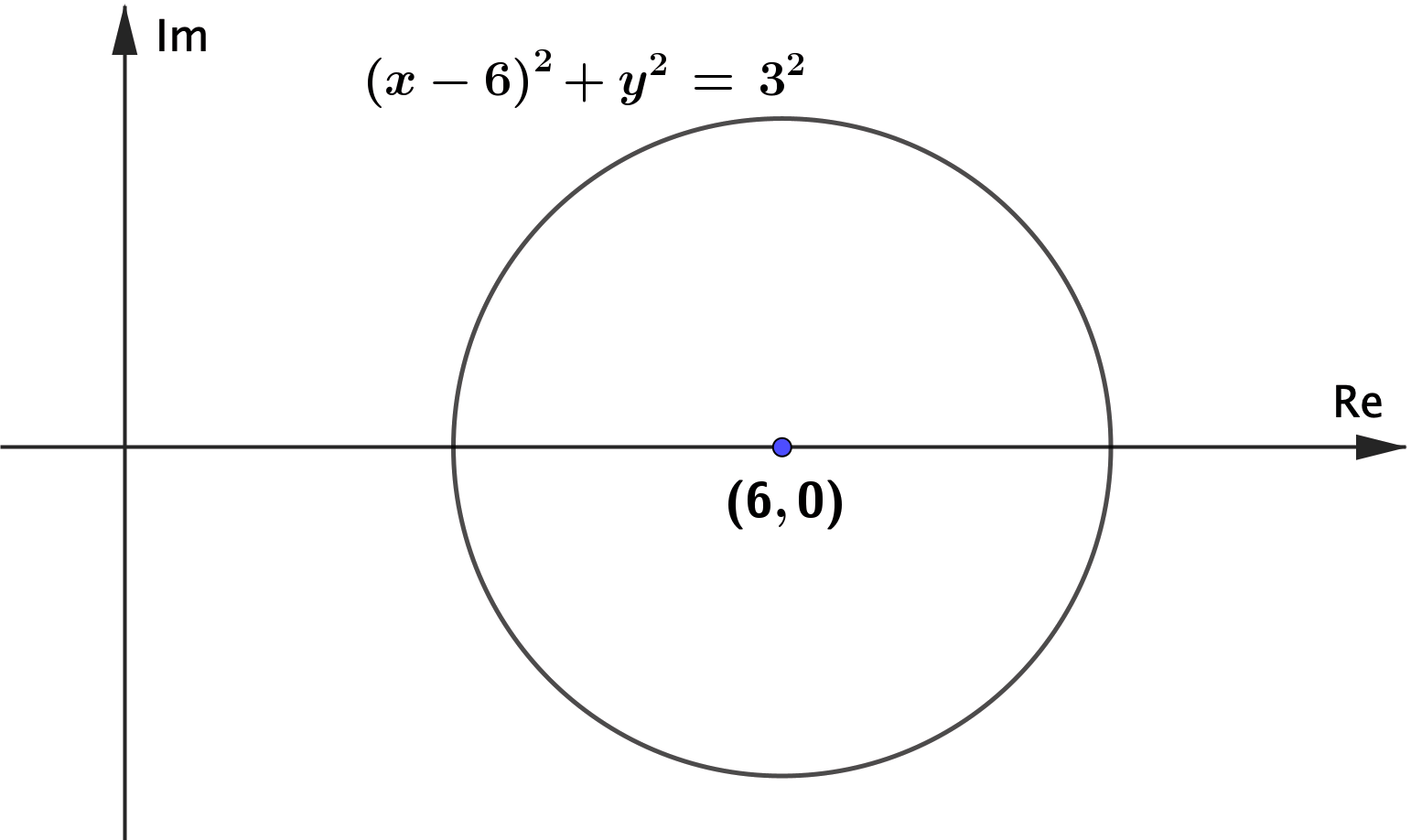
(c)
$\arg z_1 = \frac{\pi}{6}$ $$ \begin{aligned} \therefore \quad & z_1 = r\left(\cos \frac{\pi}{6}+\mathrm{i} \sin \frac{\pi}{6}\right) = r\left(\frac{\sqrt{3}}{2}+\frac{1}{2} \mathrm{i}\right) = \frac{\sqrt{3} r}{2}+\frac{r}{2} \mathrm{i} \\ &\text{Since } z_1 \text{ lies on } C, \\ &\left(\frac{\sqrt{3} r}{2}-6\right)^2+\frac{r^2}{4} = 9 \\ &r^2-6 \sqrt{3} r+27 = 0 \\ &(r-3 \sqrt{3})^2 = 0 \\ &r = 3 \sqrt{3} \\ \therefore\quad & z_1 = 3 \sqrt{3}\left(\cos \frac{\pi}{6}+\mathrm{i} \sin \frac{\pi}{6}\right) \end{aligned} $$
2.
In an Argand diagram, points $A$ and $B$ represent the numbers $6\mathrm{i}$ and $3$ respectively. As $z$ varies, the locus of points $P$ satisfying the equation $\left|z-z_1\right|=k\left|z-z_2\right|$, where $z_1, z_2 \in \mathbb{C}$ and $k \in \mathbb{R}$, is the circle $C$ such that each point $P$ on the circle is twice the distance from point $A$ than it is from point $B$.
- Write down the complex numbers $z_1$ and $z_2$, and the value of $k$.
- Show that the Cartesian equation of circle $C$ is $x^2+y^2-8 x+4 y=0$
- Find the value of $\alpha$.
- Find the exact coordinates of $Q$.
(a)
$A P=2 B P \Rightarrow|z-6 \mathrm{i}|=2|z-3| \Rightarrow z_1=6 \mathrm{i}, z_2=3 \text{ and } k=2$
(b)
$|z-6 \mathrm{i}|=2|z-3|$ $$ \begin{aligned} &x^2+(y-6)^2 = 4\left[(x-3)^2+y^2\right] \text{ where } z=x+\mathrm{i} y \\ &x^2+y^2-12 y+36 = 4\left(x^2-6 x+9\right)+4 y^2 \\ &x^2+y^2-12 y+36 = 4 x^2-24 x+36+4 y^2 \\ &3 x^2+3 y^2-24 x+12 y = 0 \\ &x^2+y^2-8 x+4 y = 0 \\ &(x-4)^2+(y+2)^2 = 20 \end{aligned} $$
(c)
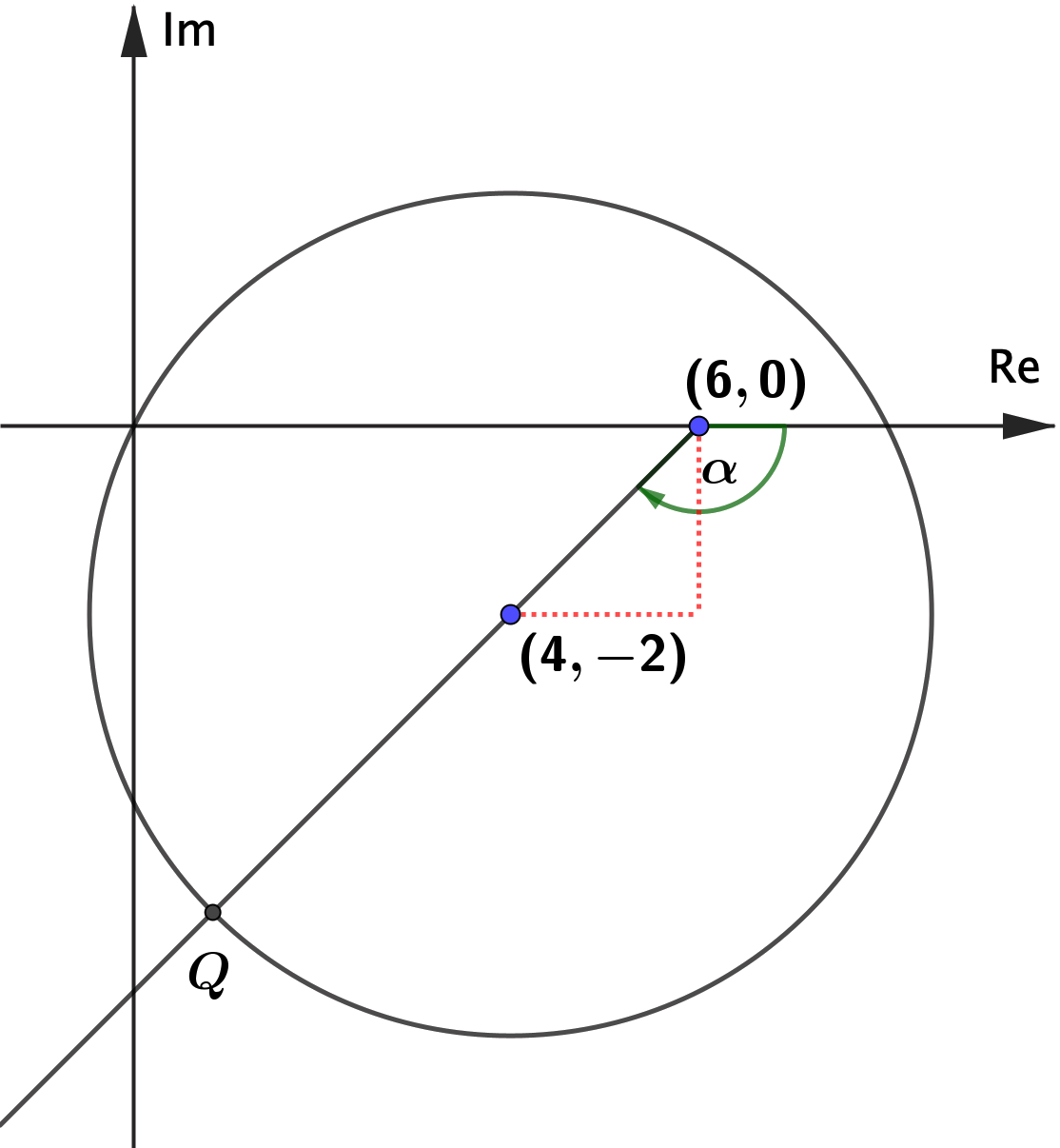
$\arg (w-6)=\alpha$
Since $w-6$ passes through the point $(4,-2)$, $$ \begin{aligned} &\alpha = -\left[\pi-\tan ^{-1}\left(\frac{0-(-2)}{6-4}\right)\right]=-\frac{3 \pi}{4} \\ &\text{gradient of half-line} = \tan \left(-\frac{3 \pi}{4}\right) = 1 \\ &\text{equation of half-line:} \quad y=x-6, \quad y<0 \end{aligned} $$
Since $w-6$ passes through the point $(4,-2)$, $$ \begin{aligned} &\alpha = -\left[\pi-\tan ^{-1}\left(\frac{0-(-2)}{6-4}\right)\right]=-\frac{3 \pi}{4} \\ &\text{gradient of half-line} = \tan \left(-\frac{3 \pi}{4}\right) = 1 \\ &\text{equation of half-line:} \quad y=x-6, \quad y<0 \end{aligned} $$
(d)
At the point $Q$, $$ \begin{aligned} &(x-4)^2+(x-6+2)^2 = 20 \\ &2(x-4)^2 = 20 \implies (x-4)^2 = 10 \\ &x-4 = \pm \sqrt{10} \Rightarrow x=4 \pm \sqrt{10} \\ &\text{Since } x_Q < 4, \quad x_Q = 4-\sqrt{10} \\ \therefore \quad&y_Q = 4-\sqrt{10}-6 = -2-\sqrt{10} \\ \therefore \quad &Q \text{ has coordinates} \quad (4-\sqrt{10}, -2-\sqrt{10}) \end{aligned} $$
3.
The point $P$ represents the complex number $z$ that satisfies the equation
$\quad \quad \arg (z-1)-\arg (z+3)=\frac{3 \pi}{4}, z \neq-3$
Use a geometric approach to find the Cartesian equation of the locus of $P$.
$\quad \quad \arg (z-1)-\arg (z+3)=\frac{3 \pi}{4}, z \neq-3$
Use a geometric approach to find the Cartesian equation of the locus of $P$.
$\arg (z-1)-\arg (z+3)=\frac{3 \pi}{4}$
Let $\arg (z-1)=\theta$ and $\arg (z+3)=\phi$
$\therefore \quad \theta-\phi=\frac{3 \pi}{4}$
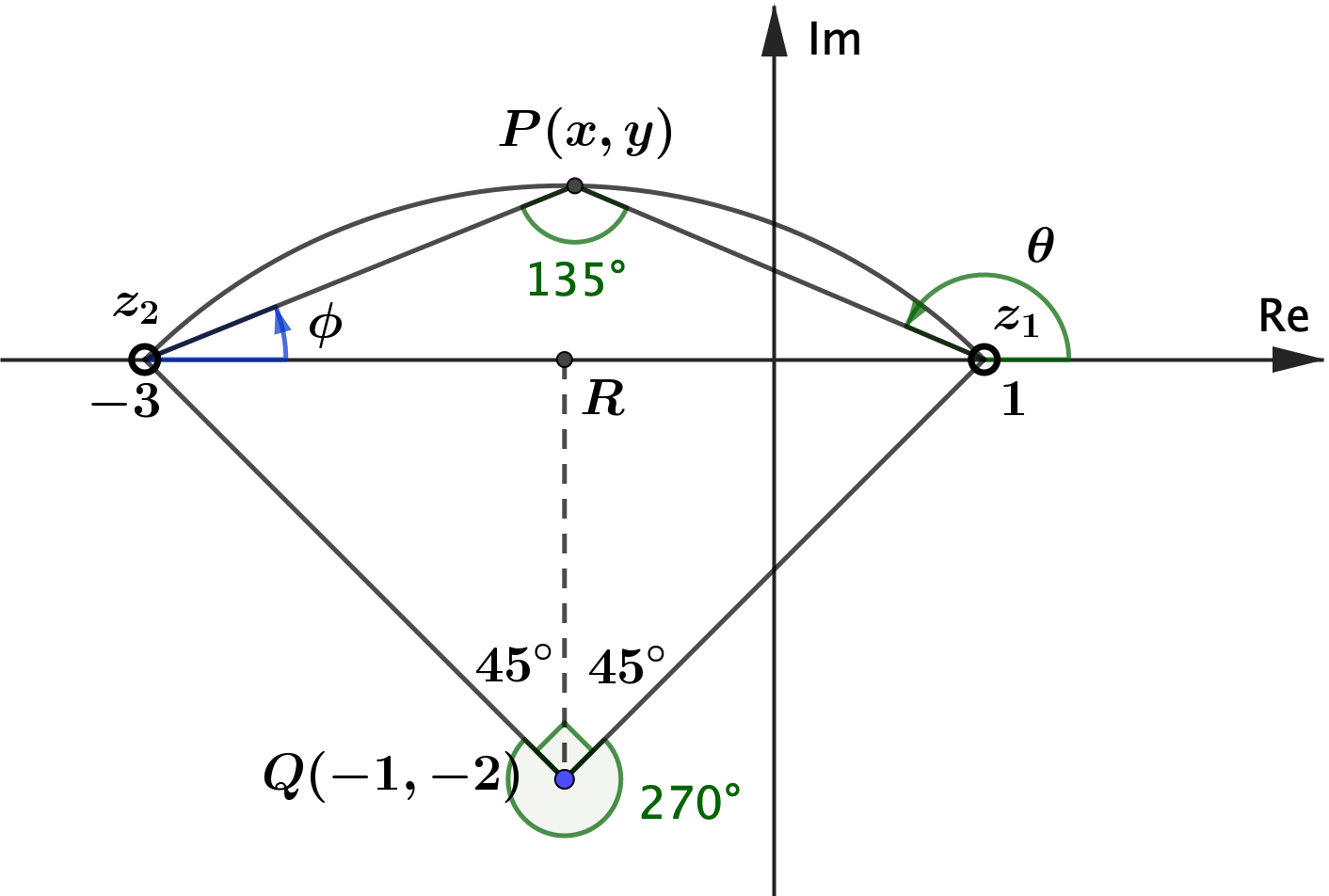
Let the point which represents $z_1=1$ be $A$ and the point which represents $z_2=-3$ be $B$.
midpoint of $A B=(-1,0)$.
The locus of $z$ is a circular arc $A P B$. $$ \begin{aligned} \therefore\quad& \angle A P B=135^{\circ} \text{ and central angle} =270^{\circ} \\ \therefore \quad & \angle A Q B=90^{\circ} \text { and } 2 r^2=16 \Rightarrow r^2=8 \Rightarrow r=2 \sqrt{2} \\ & Q R=\sqrt{8-2^2}=2 \end{aligned} $$ $Q$ coordinates $(-1,-2)$ since $Q$ lies in the third quadrant. $$ \begin{aligned} \therefore \quad &\text{The cartesian equation of } P(x, y) \text{ is} \\ &(x+1)^2+(y+2)^2=8 \text { where }-30. \end{aligned} $$
Let $\arg (z-1)=\theta$ and $\arg (z+3)=\phi$
$\therefore \quad \theta-\phi=\frac{3 \pi}{4}$
Let the point which represents $z_1=1$ be $A$ and the point which represents $z_2=-3$ be $B$.
midpoint of $A B=(-1,0)$.
The locus of $z$ is a circular arc $A P B$. $$ \begin{aligned} \therefore\quad& \angle A P B=135^{\circ} \text{ and central angle} =270^{\circ} \\ \therefore \quad & \angle A Q B=90^{\circ} \text { and } 2 r^2=16 \Rightarrow r^2=8 \Rightarrow r=2 \sqrt{2} \\ & Q R=\sqrt{8-2^2}=2 \end{aligned} $$ $Q$ coordinates $(-1,-2)$ since $Q$ lies in the third quadrant. $$ \begin{aligned} \therefore \quad &\text{The cartesian equation of } P(x, y) \text{ is} \\ &(x+1)^2+(y+2)^2=8 \text { where }-3
4.
The complex number $z=x+\mathrm{i} y$ satisfies the equation $|z+1+\mathrm{i}|=2|z+4-2 \mathrm{i}|$.
The complex number $z$ is represented by the point $P$ on the Argand diagram.
The complex number $z$ is represented by the point $P$ on the Argand diagram.
- Show that the locus of $P$ is a circle with centre $(-5,3)$.
- Find the exact radius of this circle.
(a)
$$ \begin{aligned} & |x+1+\mathrm{i}| = 2|z+4-2 \mathrm{i}| \\ & |(x+1)+\mathrm{i}(y+1)| = 2|(x+4)+\mathrm{i}(y-2)| \\ & (x+1)^2+(y+1)^2 = 4\left[(x+4)^2+(y-2)^2\right] \\ & x^2+2 x+y^2+2 y+2 = 4 x^2+32 x+4 y^2-16 y+80 \\ & 3 x^2+3 y^2+30 x-18 y+78 = 0 \\ & x^2+y^2+10 x-6 y+26 = 0 \Rightarrow(x+5)^2+(y-3)^2=8 \end{aligned} $$ $\therefore\quad$ The locus of $P(x, y)$ is a circle with centre $(-5,3)$
(b)
$$ \text{radius} = \sqrt{8} = 2\sqrt{2} $$
5.
The point $P$ represents a complex number $z$ in an Argand diagram.
Given that $\arg z-\arg (z+4)=\frac{\pi}{4}$ is a locus of points $P$ lying on an arc of a circle $C$,
Given that $\arg z-\arg (z+4)=\frac{\pi}{4}$ is a locus of points $P$ lying on an arc of a circle $C$,
- sketch the locus of points $P$
- find the coordinates of the centre of $C$
- find the radius of $C$
- find a Cartesian equation for the circle $C$
- find the finite area bounded by the locus of $P$ and the $x$-axis.
(a)
(b)
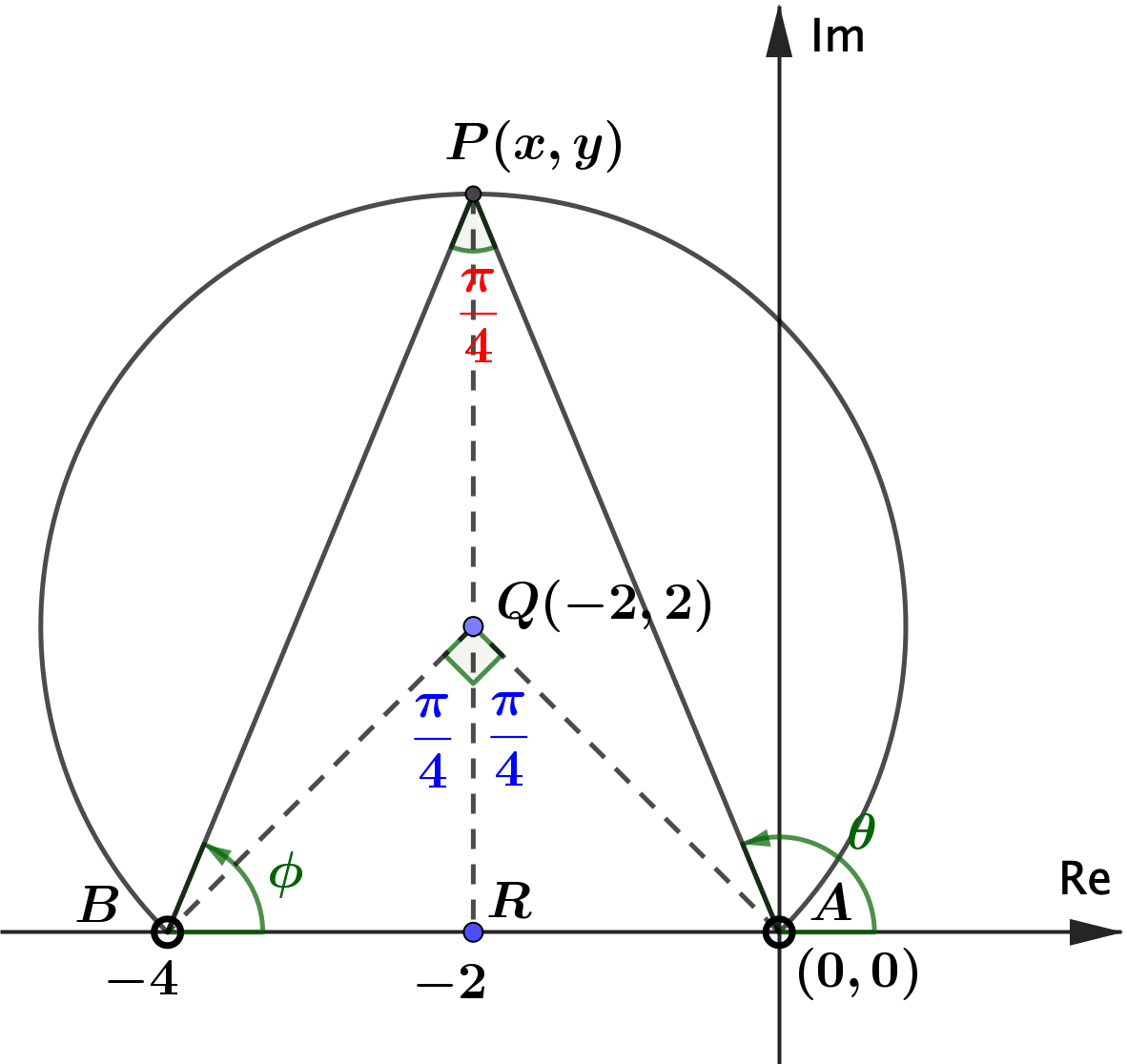
Let $\arg(z) = \theta$ and $\arg(z+4) = \phi$
Let the point which represents $z_1 = 0$ be $A$
and the point which represents $z_2 = -4$ be $B$. $$ \begin{aligned} & \text{midpoint of } AB = \left( \frac{0 + (-4)}{2}, 0 \right) = (-2, 0) \\ \therefore\quad & \theta - \phi = \frac{\pi}{4} \Rightarrow \angle APB = \frac{\pi}{4} \Rightarrow \angle AQB = \frac{\pi}{2} \\ \therefore\quad &\text{Both } \triangle AQR \text{ and } \triangle BQR \text{ are isosceles right-angled triangles.} \\ \therefore\quad & QR = 2 \Rightarrow \text{centre of } C : (-2, 2) \end{aligned} $$
Let the point which represents $z_1 = 0$ be $A$
and the point which represents $z_2 = -4$ be $B$. $$ \begin{aligned} & \text{midpoint of } AB = \left( \frac{0 + (-4)}{2}, 0 \right) = (-2, 0) \\ \therefore\quad & \theta - \phi = \frac{\pi}{4} \Rightarrow \angle APB = \frac{\pi}{4} \Rightarrow \angle AQB = \frac{\pi}{2} \\ \therefore\quad &\text{Both } \triangle AQR \text{ and } \triangle BQR \text{ are isosceles right-angled triangles.} \\ \therefore\quad & QR = 2 \Rightarrow \text{centre of } C : (-2, 2) \end{aligned} $$
(c)
$$ \text{radius of } C = 2\sqrt{2} $$
(d)
$$ C: (x+2)^2+(y-2)^2 = 8 $$
(e)
$$ \begin{aligned} \text{required area} &= 2 \left[ \text{area of sector } AQP + \text{ area of } \triangle AQR \right] \\ &= 2 \left[ \frac{1}{2} \times 8 \times \frac{3\pi}{4} + \frac{1}{2} \times 2 \times 2 \right] \\ &= 6\pi + 4 \end{aligned} $$
6.
A curve $S$ is described by the equation $\arg \left(\frac{w-8 \mathrm{i}}{w+6}\right)=\frac{\pi}{2}, w \in \mathbb{C}$.
- Sketch $S$ on an Argand diagram.
- Find the Cartesian equation for $S$.
- Given that $z$ lies on $S$, find the largest value of $a$ and the smallest value of $b$ that satisfy $a<\arg (z)
- State the range of possible values of $\operatorname{Re}(z)$.
(a)
(b)
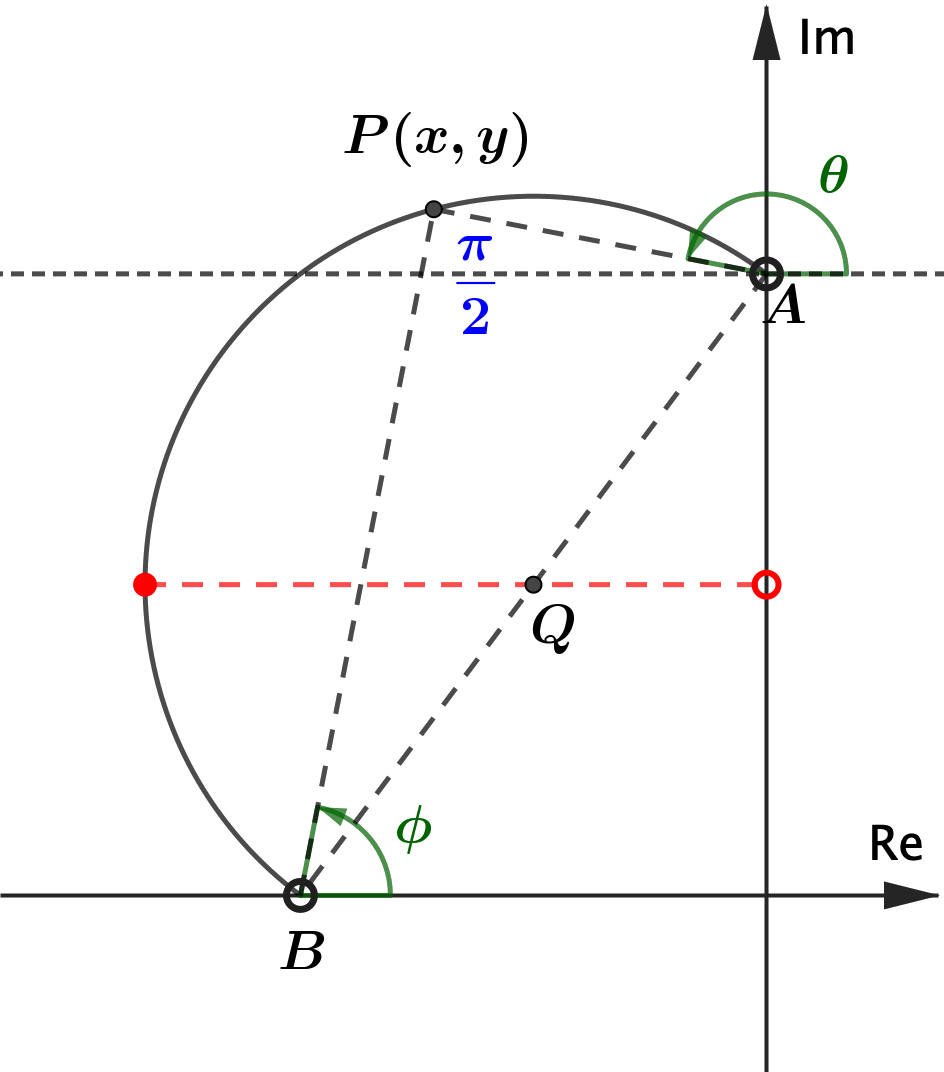
$$ \begin{aligned} & \arg(w-8\mathrm{i})-\arg(w+6)=\frac{\pi}{2}, \\ & \text{Let } \arg(w-8\mathrm{i})=\theta \text{ and } \arg(w+6)=\phi, \\ & \text{Let the points which represent } z_1=8\mathrm{i} \text{ and } z_2=-6 \text{ be } A \text{ and } B \text{ respectively.} \\ & \theta-\phi=\frac{\pi}{2} \implies \angle APB=\frac{\pi}{2}, \\ & S \text{ is a semicircle with diameter } AB, \\ & AB = \sqrt{(-6)^2+8^2} = 10 \implies \text{radius} = \frac{AB}{2} = 5, \\ & \text{centre: } \left(-\frac{6}{2}, \frac{8}{2}\right) = (-3,4), \\ & S: (x+3)^2+(y-4)^2=25, \end{aligned} $$
(c)
From the diagram, $z$ varies between $\frac{\pi}{2}$ and $\pi$.
$$ \therefore\quad a=\frac{\pi}{2} \text{ and } b=\pi, $$
$$ \therefore\quad a=\frac{\pi}{2} \text{ and } b=\pi, $$
(d)
From the diagram, $\operatorname{Re}(z)<0$ and $\operatorname{Re}(z)\ge -8$.
$ \therefore\quad -8\le\operatorname{Re}(z)<0. $
$ \therefore\quad -8\le\operatorname{Re}(z)<0. $
7.
In an Argand diagram the loci $C_1$ and $C_2$ are given by
$\quad \quad |z|=2 \quad \text{ and } \quad \arg z=\frac{1}{3} \pi$
respectively.
$\quad \quad |z|=2 \quad \text{ and } \quad \arg z=\frac{1}{3} \pi$
respectively.
- Sketch, on a single Argand diagram, the loci $C_1$ and $C_2$.
- Hence find, in the form $x+\mathrm{i} y$, the complex number representing the point of intersection of $C_1$ and $C_2$.
(a)
$C_1:|z|=2 \Rightarrow$ circle with centre at $(0,0)$ and radius $2$.
$C_2: \arg z=\frac{\pi}{3} \Rightarrow$ a half line which makes an angle $\frac{\pi}{3}$ radian with positive $x$-axis and vertex at $(0,0)$.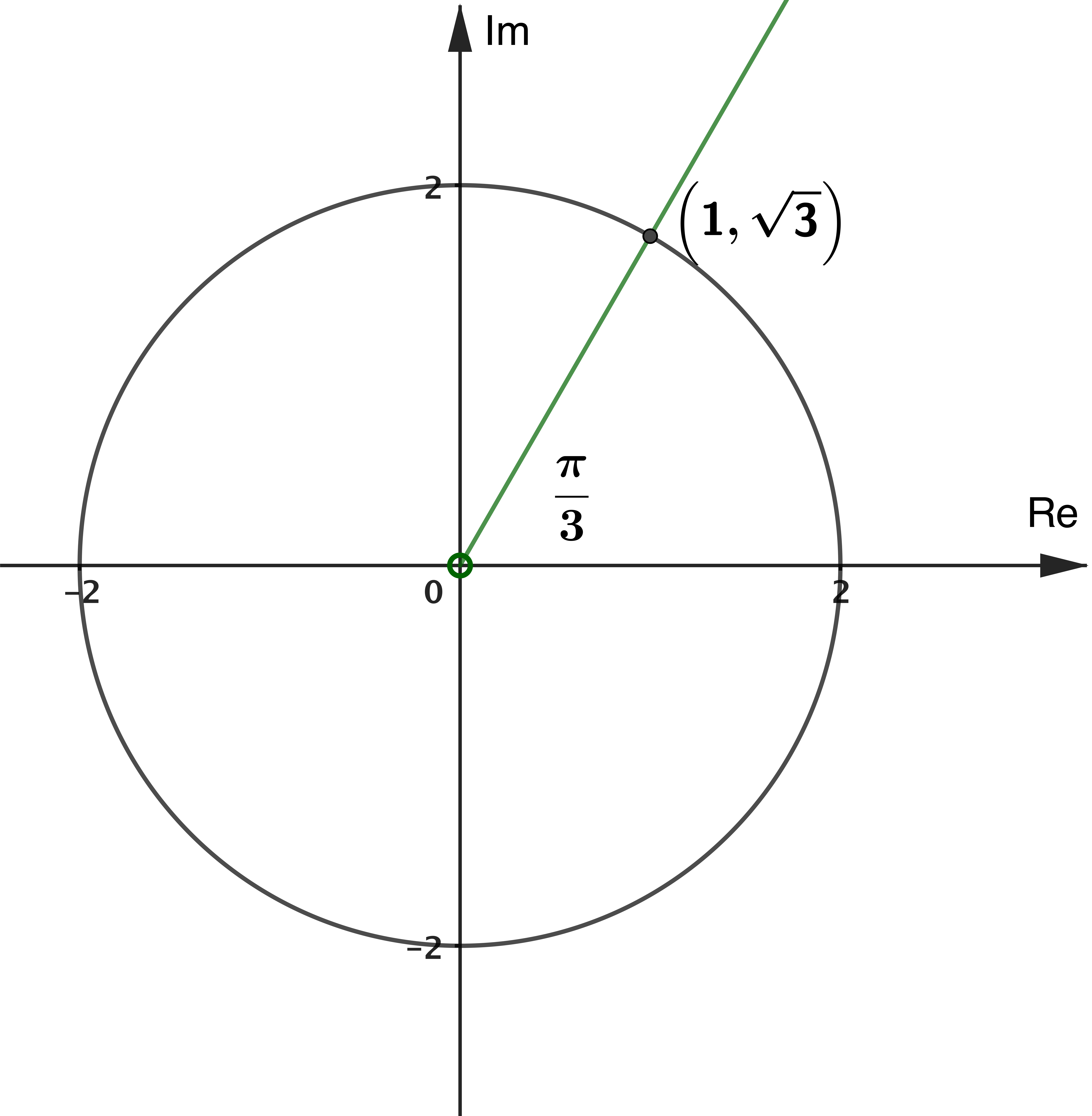
$C_2: \arg z=\frac{\pi}{3} \Rightarrow$ a half line which makes an angle $\frac{\pi}{3}$ radian with positive $x$-axis and vertex at $(0,0)$.
(b)
$$ C_1: x^2+y^2=4 \quad \text{and} \quad C_2: y=\sqrt{3} x, ~ x>0 $$ At the point of intersection of $C_1$ and $C_2$, $$ \begin{aligned} & x^2+(\sqrt{3} x)^2=4 \Rightarrow 4 x^2=4 \Rightarrow x=1 \\ \therefore\quad & y=\sqrt{3}(1)=\sqrt{3} \\ \therefore\quad & z=1+\mathrm{i} \sqrt{3} \end{aligned} $$
8.
A complex number $z=x+\mathrm{i} y$ is represented by the point $P$ in an Argand diagram.
Given that
$\quad\quad|z-3|=4|z+1|$
Given that
$\quad\quad|z-3|=4|z+1|$
- show that the locus of $P$ has equation
$\quad\quad15 x^2+15 y^2+38 x+7=0$ - Hence find the maximum value of $|z|$
(a)
$$ \begin{aligned} & |z-3|=4|z+1| \\ & |x-3+\mathrm{i} y|=4|x+1+\mathrm{i} y| \\ & \sqrt{(x-3)^2+y^2}=4 \sqrt{(x+1)^2+y^2} \\ & x^2-6 x+9+y^2=16\left(x^2+2 x+1+y^2\right) \\ & x^2-6 x+9+y^2=16 x^2+32 x+16+16 y^2 \\ & 15 x^2+15 y^2+38 x+7=0 \end{aligned} $$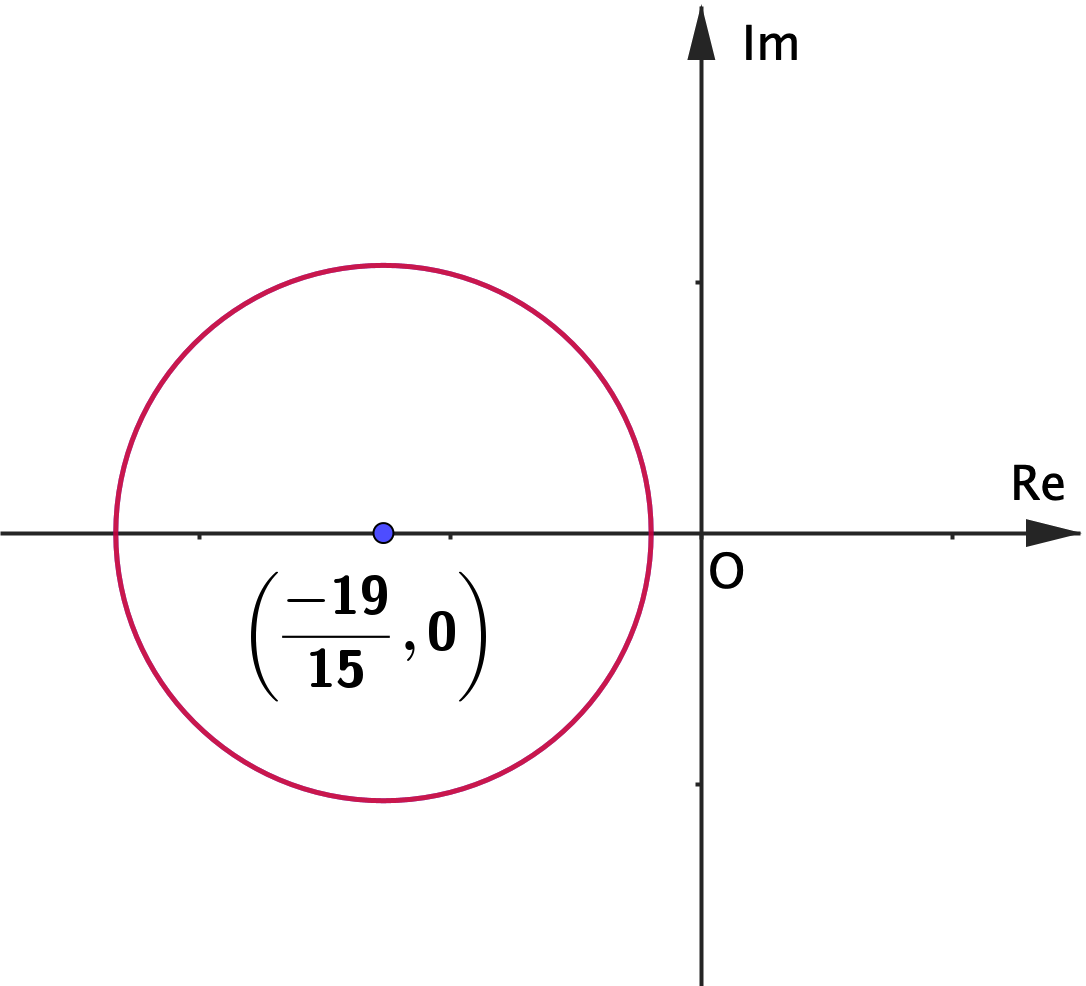
(b)
$$ \begin{aligned} & x^2+y^2+\frac{38}{15} x=-\frac{7}{15} \\ & \left(x^2+\frac{38}{15} x+\left(\frac{19}{15}\right)^2\right)+y^2=-\frac{7}{15}+\left(\frac{19}{15}\right)^2 \\ & \left(x+\frac{19}{15}\right)^2+y^2=\left(\frac{16}{15}\right)^2 \end{aligned} $$ Hence the locus of $P$ is a circle with centre $\left(-\frac{19}{15}, 0\right)$ radius $\frac{16}{15}$.
$\therefore\quad\text{maximum value of }|z|=\frac{19}{15}+\frac{16}{15}=\frac{7}{3}$
$\therefore\quad\text{maximum value of }|z|=\frac{19}{15}+\frac{16}{15}=\frac{7}{3}$
9.
A complex number $z$ is represented by the point $P$ in the complex plane.
Given that $z$ satisfies
$\quad\quad|z-6|=2|z+3 \mathrm{i}|$
Given that $z$ satisfies
$\quad\quad|z-6|=2|z+3 \mathrm{i}|$
- show that the locus of $P$ passes through the origin and the points $-4$ and $-8\mathrm{i}$
- Sketch on an Argand diagram the locus of $P$ as $z$ varies.
- On your sketch, shade the region which satisfies both
$\quad\quad|z-6| \geqslant 2|z+3 \mathrm{i}| \text { and }|z| \leqslant 4$
(a)
$$ \begin{aligned} & x^2-12 x+36+y^2=4\left(x^2+y^2+6 y+9\right) \\ & x^2-12 x+36+y^2=4 x^2+4 y^2+24 y+36 \\ & 3 x^2+3 y^2+12 x+24 y=0 \\ & x^2+y^2+4 x+8 y=0 \end{aligned} $$ At the point $(0,0)$,
$0^2+0^2+4(0)+8(0)=0$
At the point $(-4,0)$,
$(-4)^2+0^2+4(-4)+8(0)=0$
At the point $(0,-8)$,
$(0)^2+(-8)^2+4(0)+8(-8)=0$
$\therefore\quad$ The locus of $P$ passes through the origin and the points $-4$ and $-8\mathrm{i}$.
$0^2+0^2+4(0)+8(0)=0$
At the point $(-4,0)$,
$(-4)^2+0^2+4(-4)+8(0)=0$
At the point $(0,-8)$,
$(0)^2+(-8)^2+4(0)+8(-8)=0$
$\therefore\quad$ The locus of $P$ passes through the origin and the points $-4$ and $-8\mathrm{i}$.
(b)
$$ \begin{aligned} & x^2+y^2+4 x+8 y=0 \\ & \left(x^2+4 x+4\right)+\left(y^2+8 y+16\right)=20 \\ & (x+2)^2+(y+4)^2=20 \end{aligned} $$ Hence, the locus of $P$ is a circle with centre $(-2,-4)$ and radius $\sqrt{20}$.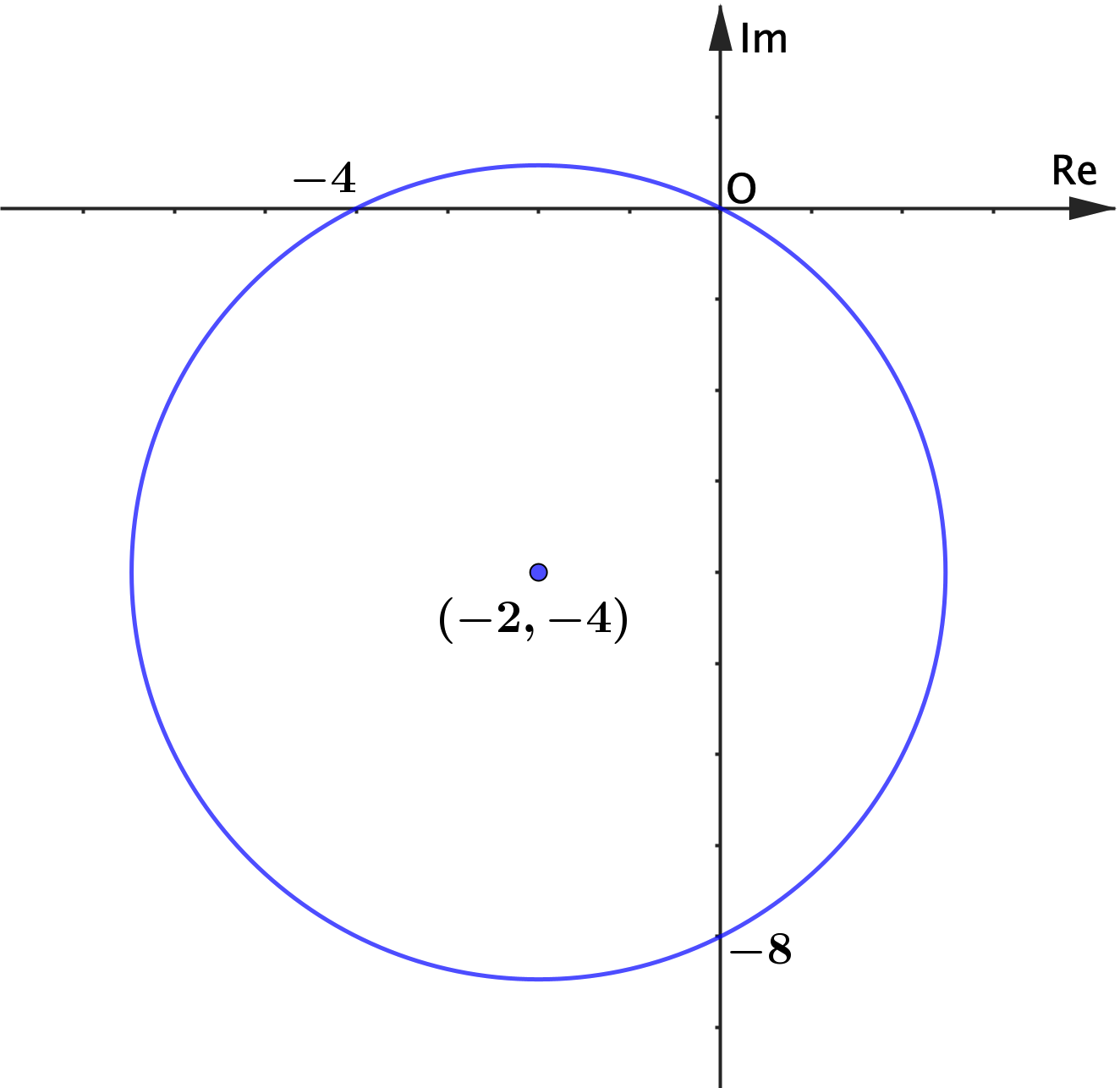
(c)
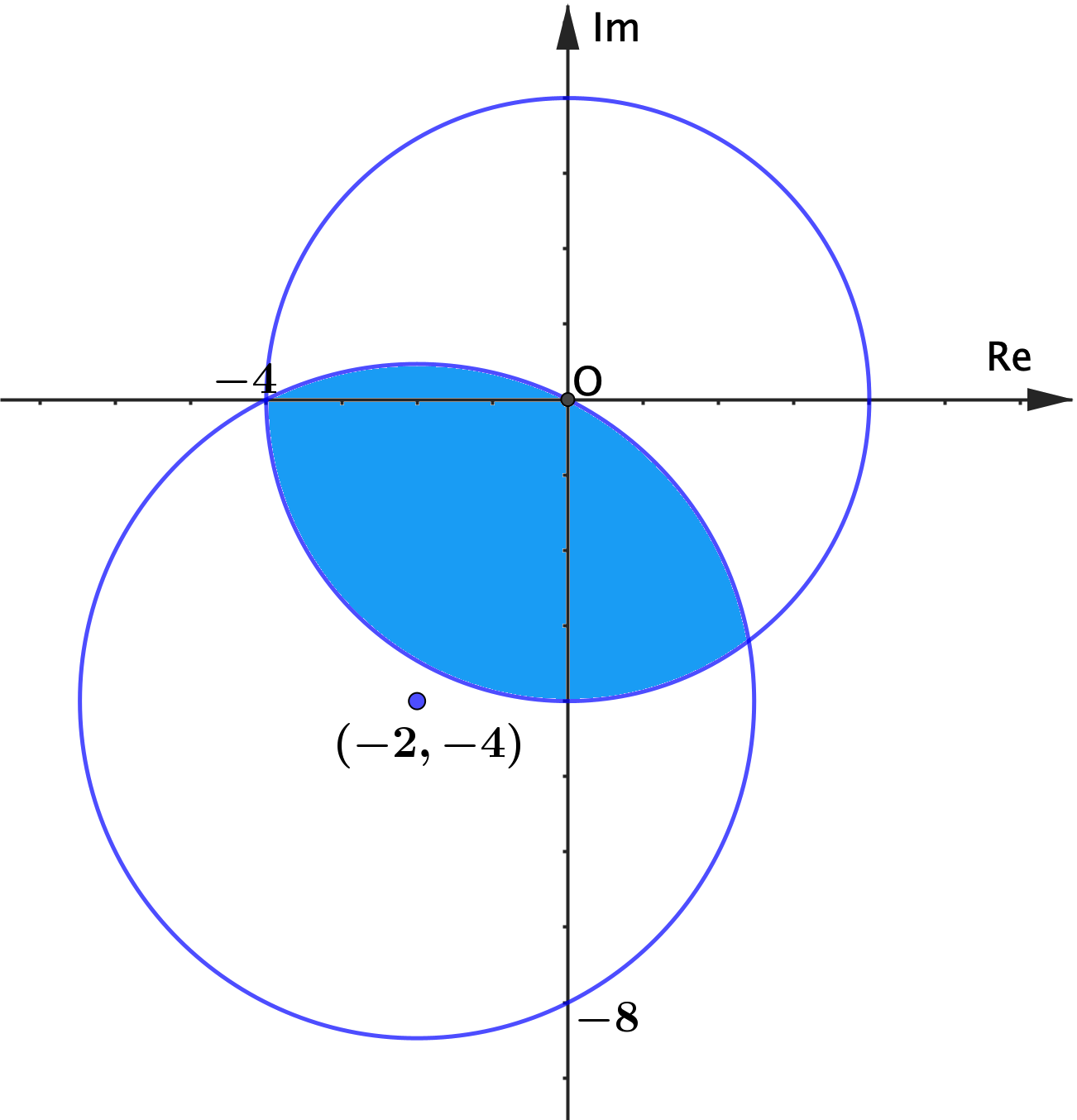
$|-2-6|=8 \text { and } 2|-2+3 \mathrm{i}|=2 \sqrt{13}$
Since $8 > 2 \sqrt{13}$, the required region must be inside and on the circumference of the circle $(x+2)^2+(y+4)^2=20$.
Hence the required region must be the intersection of the discs $|z-6| \geqslant 2|z+3 \mathrm{i}|$ and $|z| \leqslant 4$.
10.
A complex number $z$ is represented by the point $P$ in the Argand diagram.
- Given that $|z-6|=|z|$, sketch the locus of $P$.
- Find the complex numbers $z$ which satisfy both $|z-6|=|z|$ and $|z-3-4 \mathrm{i}|=5$.
- Show that $T$ maps $|z-6|=|z|$ onto a circle in the $w$-plane and give the cartesian equation of this circle.
(a)
$|z-6| = |z|$
locus: A perpendicular bisector of the segment joining $(0,0)$ and $(6,0)$
cartesian equation: $x=3$.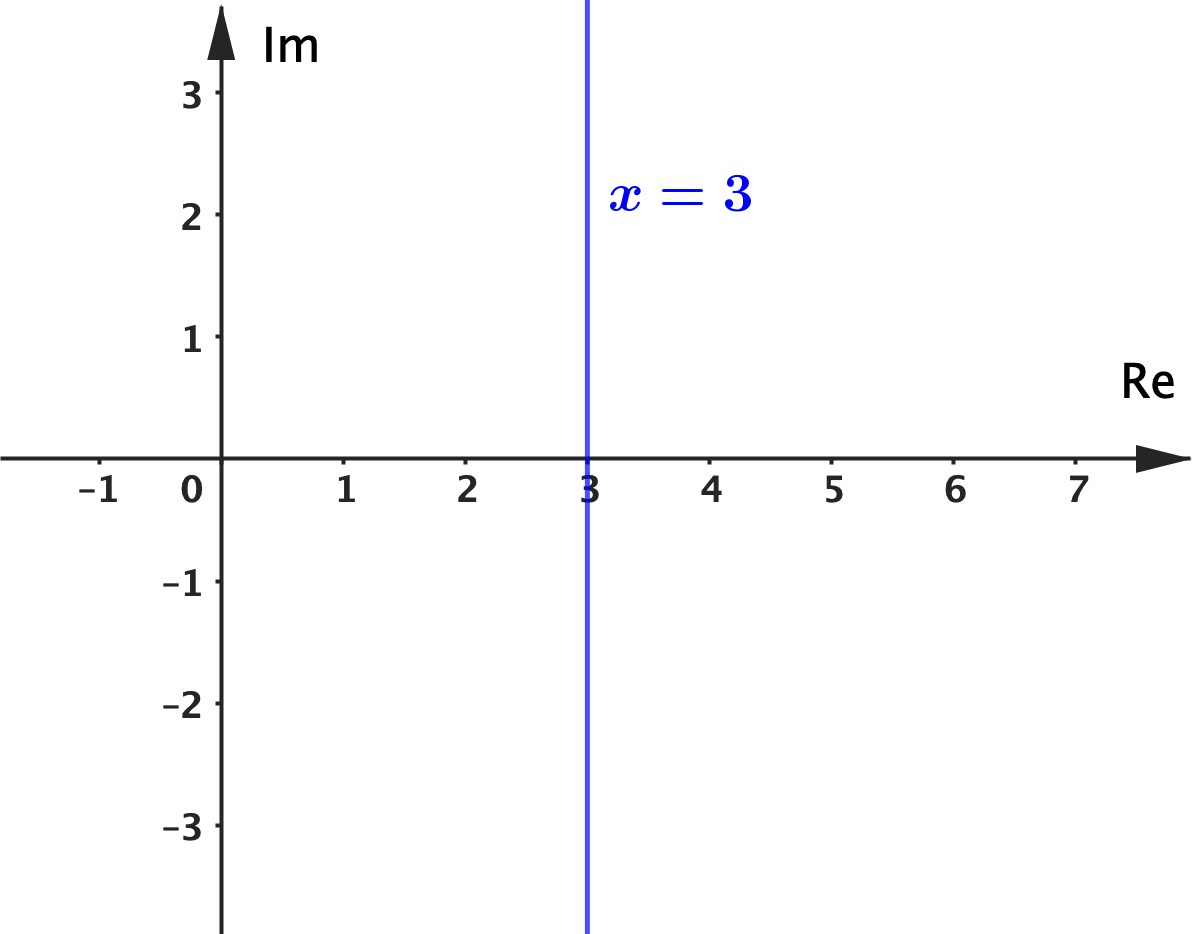
locus: A perpendicular bisector of the segment joining $(0,0)$ and $(6,0)$
cartesian equation: $x=3$.
(b)
$|z-3-4\mathrm{i}| = 5$
locus: A circle with centre $(3,4)$ and radius $5$.
cartesian equation: $(x-3)^2 + (y-4)^2 = 25$.
At the point of intersection,
$$ \begin{aligned} & (3-3)^2 + (y-4)^2 = 25 \\ & y-4 = \pm 5 \\ & y = 4-5 = -1, \quad y = 4+5 = 9 \end{aligned} $$ $\therefore \quad$ The complex numbers which satisfy both $|z-6|=|z|$ and $|z-3-4\mathrm{i}|=5$
are $z_1 = 3-\mathrm{i}$ and $z_2 = 3+9\mathrm{i}$.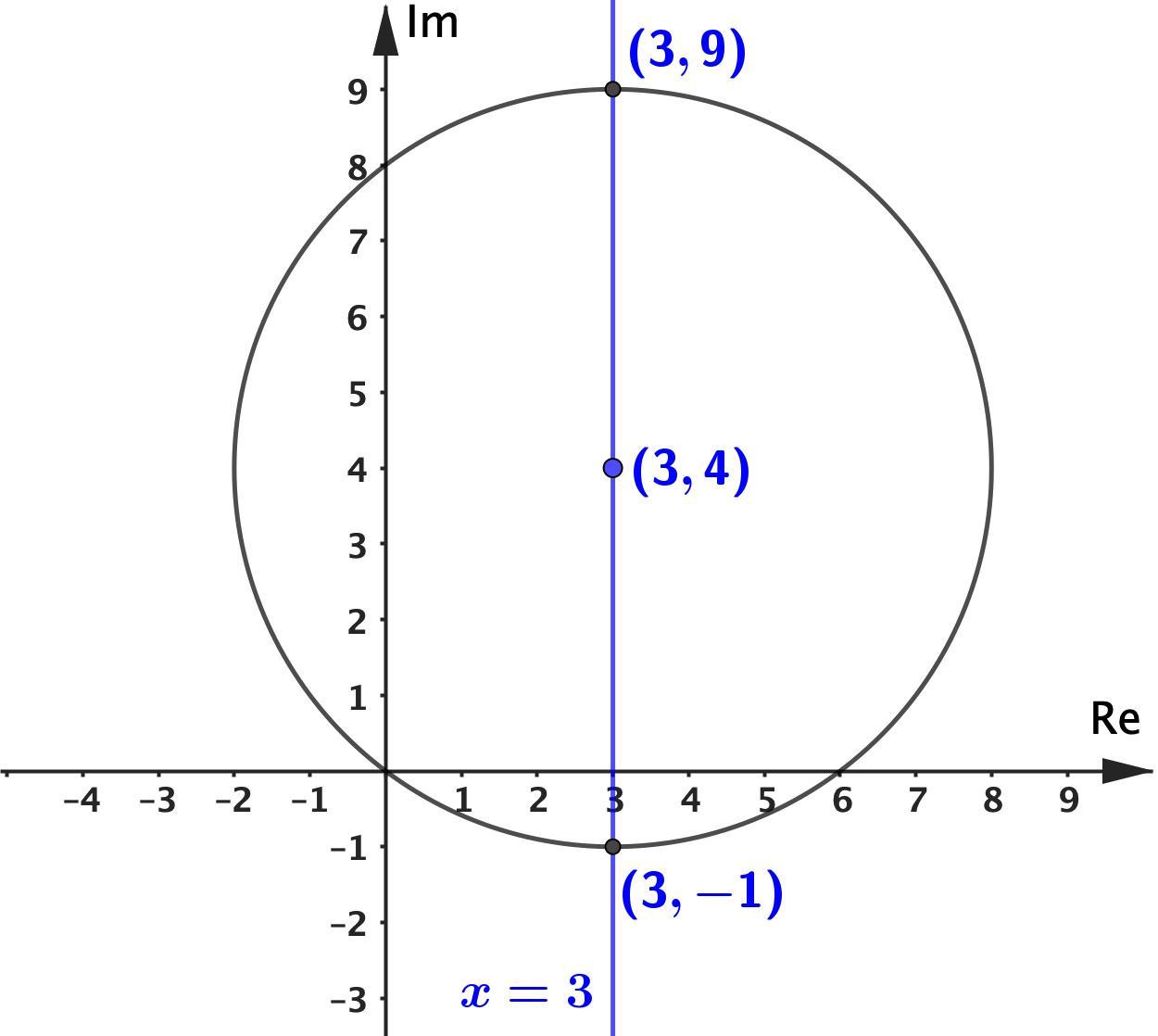
locus: A circle with centre $(3,4)$ and radius $5$.
cartesian equation: $(x-3)^2 + (y-4)^2 = 25$.
At the point of intersection,
$$ \begin{aligned} & (3-3)^2 + (y-4)^2 = 25 \\ & y-4 = \pm 5 \\ & y = 4-5 = -1, \quad y = 4+5 = 9 \end{aligned} $$ $\therefore \quad$ The complex numbers which satisfy both $|z-6|=|z|$ and $|z-3-4\mathrm{i}|=5$
are $z_1 = 3-\mathrm{i}$ and $z_2 = 3+9\mathrm{i}$.
(c)
$|z-6| = |z|, \quad w = \frac{30}{z} \;\Rightarrow\; z = \frac{30}{w}$ $$ \begin{aligned} \therefore \quad & \left| \frac{30}{w} - 6 \right| = \left| \frac{30}{w} \right| \Rightarrow\left| \frac{30-6w}{w} \right| = \left| \frac{30}{w} \right| \Rightarrow|30-6w| = |30| \Rightarrow|w-5| = 5 \end{aligned} $$ locus: A circle with centre $(5,0)$ and radius $5$.
cartesian equation: $(u-5)^2 + v^2 = 25$.
cartesian equation: $(u-5)^2 + v^2 = 25$.
11.
The point $P$ represents a complex number $z$ on an Argand diagram such that
$\quad\quad|z-6 \mathrm{i}|=2|z-3|$
$\quad\quad\arg (z-6)=-\frac{3 \pi}{4}$
$\quad\quad|z-6 \mathrm{i}|=2|z-3|$
- Show that, as $z$ varies, the locus of $P$ is a circle, stating the radius and the coordinates of the centre of this circle.
$\quad\quad\arg (z-6)=-\frac{3 \pi}{4}$
- Sketch, on the same Argand diagram, the locus of $P$ and the locus of $Q$ as $z$ varies.
- Find the complex number for which both $|z-6 \mathrm{i}|=2|z-3|$ and $\arg (z-6)=-\frac{3 \pi}{4}$
(a)
$$ \begin{aligned} & |z-6\mathrm{i}| = 2|z-3| \\ & \sqrt{x^2+(y-6)^2} = 2\sqrt{(x-3)^2+y^2} \\ & x^2+y^2-12y+36 = 4\bigl[x^2-6x+9+y^2\bigr] \\ & x^2+y^2-12y+36 = 4x^2-24x+36+4y^2 \\ & 3x^2+3y^2-24x+12y=0 \\ & x^2+y^2-8x+4y=0 \\ & (x^2-8x+16)+(y^2+4y+4)=20 \\ & (x-4)^2+(y+2)^2=20 \end{aligned} $$ $\therefore\quad$ The locus of $P$ is a circle with centre $(4,-2)$ and radius $2\sqrt{5}$.
(b)
$\arg(z-6) = -\frac{3\pi}{4}$
locus: A half line making angle $-\frac{3\pi}{4}$ radian with positive x-axis and vertex at $(6,0)$
cartesian equation: $y = \tan\!\left(-\frac{3\pi}{4}\right)(x-6) \Rightarrow y = x-6, \quad x<6,\; y<0$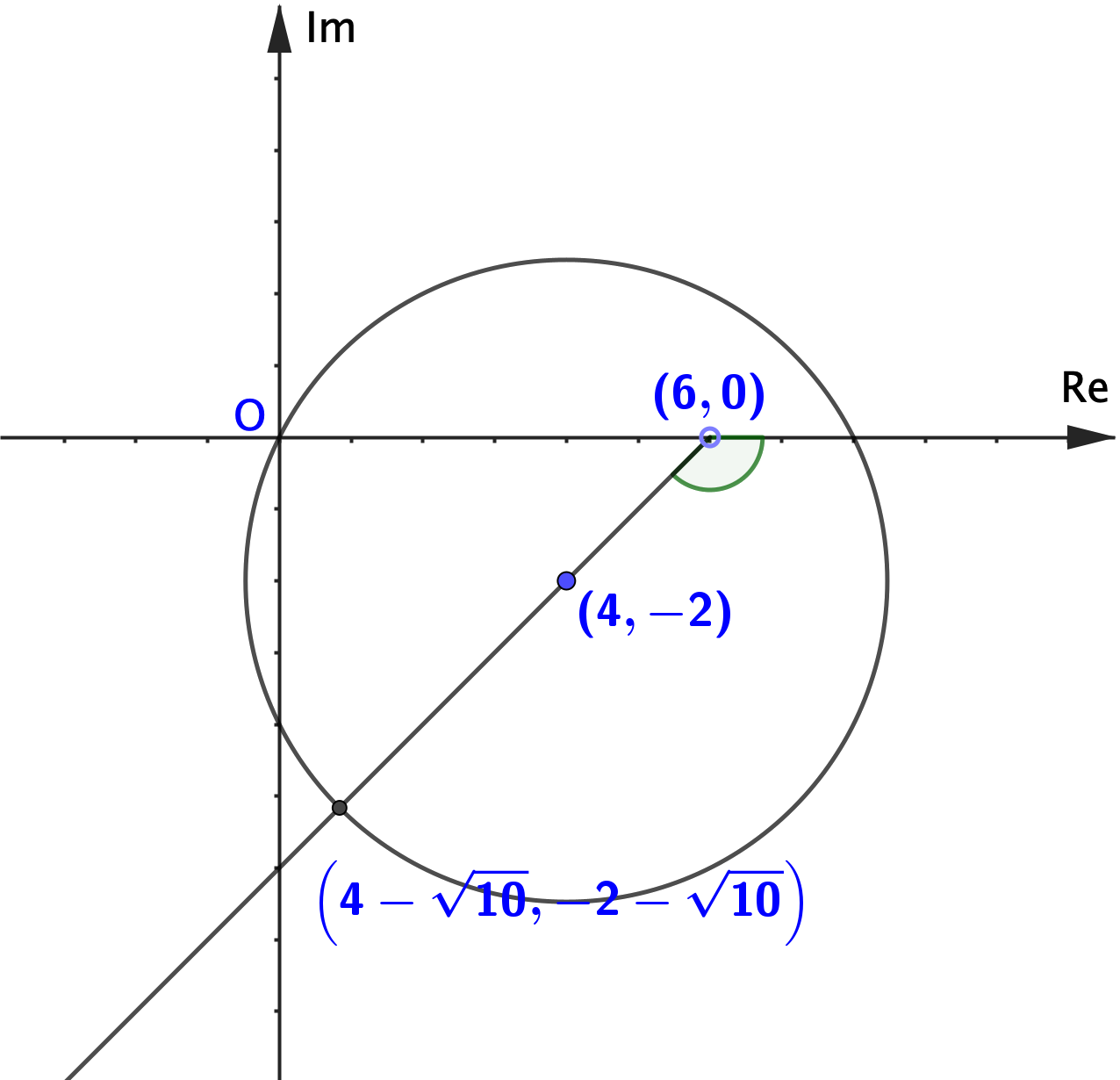
locus: A half line making angle $-\frac{3\pi}{4}$ radian with positive x-axis and vertex at $(6,0)$
cartesian equation: $y = \tan\!\left(-\frac{3\pi}{4}\right)(x-6) \Rightarrow y = x-6, \quad x<6,\; y<0$
(c)
At the point of intersection of the circle and line, $$ \begin{aligned} & (x-4)^2+(x-6+2)^2=20 \\ & 2(x-4)^2=20 \\ & (x-4)^2=10 \\ & x=4-\sqrt{10} \quad (\because ~ x<6) \\ & y=4-\sqrt{10}-6=-2-\sqrt{10} \end{aligned} $$ $\therefore\quad$ The point of intersection is $4-\sqrt{10}-\mathrm{i}(2+\sqrt{10})$.
12.
The complex number $z_1$ is defined as
$\quad\quad z_1=\frac{\left(\cos \frac{5 \pi}{12}+\mathrm{i} \sin \frac{5 \pi}{12}\right)^4}{\left(\cos \frac{\pi}{3}-\mathrm{i} \sin \frac{\pi}{3}\right)^3}$
$\quad\quad z_1=\frac{\left(\cos \frac{5 \pi}{12}+\mathrm{i} \sin \frac{5 \pi}{12}\right)^4}{\left(\cos \frac{\pi}{3}-\mathrm{i} \sin \frac{\pi}{3}\right)^3}$
- Without using your calculator show that
$\quad\quad z_1=\cos \frac{2 \pi}{3}+\mathrm{i} \sin \frac{2 \pi}{3}$ - Shade, on a single Argand diagram, the region $R$ defined by
$\quad\quad \left|z-z_1\right| \leqslant 1 \quad \text { and } \quad 0 \leqslant \arg \left(z-z_1\right) \leqslant \frac{3 \pi}{4}$
- determine the smallest possible positive value of $\arg z$
(a)
$$ \begin{aligned} z_1 &= \frac{\bigl(\cos \frac{5\pi}{12} +\mathrm{ i} \sin \frac{5\pi}{12}\bigr)^4}{\bigl(\cos \frac{\pi}{3} - \mathrm{i} \sin \frac{\pi}{3}\bigr)^3} \\ &= \frac{\cos \frac{20\pi}{12} + \mathrm{i} \sin \frac{20\pi}{12}}{\cos \pi - \mathrm{i} \sin \pi} \\ &= \frac{\cos \frac{5\pi}{3} + \mathrm{i} \sin \frac{5\pi}{3}}{\cos(-\pi) + \mathrm{i} \sin(-\pi)} \\ &= \cos \frac{8\pi}{3} + \mathrm{i}\sin \frac{8\pi}{3} \\ &= \cos \!\left(2\pi + \frac{2\pi}{3}\right) + \mathrm{i} \sin \!\left(2\pi + \frac{2\pi}{3}\right) \\ &= \cos \frac{2\pi}{3} + \mathrm{i} \sin \frac{2\pi}{3} \end{aligned} $$ $z_1 = -\frac{1}{2} + \frac{\sqrt{3}}{2} \mathrm{i}$
(b)
$|z-z_1| = 1$
locus: A circle with centre $\Bigl(-\frac{1}{2}, \frac{\sqrt{3}}{2}\Bigr)$ and radius $1$
$|z-z_1| \leq 1 \;\Rightarrow\;$ The set of all points inside and on the circle.
$\arg(z-z_1) = \frac{3\pi}{4}$
locus: A half-line which makes an angle $\frac{3\pi}{4}$ radian with positive $x$-direction and vertex at $\Bigl(-\frac{1}{2}, \frac{\sqrt{3}}{2}\Bigr)$.
cartesian equation: $y-\frac{\sqrt{3}}{2} = -(x+\frac{1}{2}) \Rightarrow y = -x + \frac{-1+\sqrt{3}}{2} , x < -\frac{1}{2}$
$\arg(z-z_1) \leq \frac{3\pi}{4}$
A region containing points including the half lines $y=\frac{\sqrt{3}}{2}$ and $y=-x+\frac{-1+\sqrt{3}}{2}$ and between these two lines.
$R = \left\{ |z-z_1|\leq 1 \;\cap\; \arg(z-z_1) \leq \frac{3\pi}{4} \right\}$
The set of all points of the sector bound by the circle and the lines.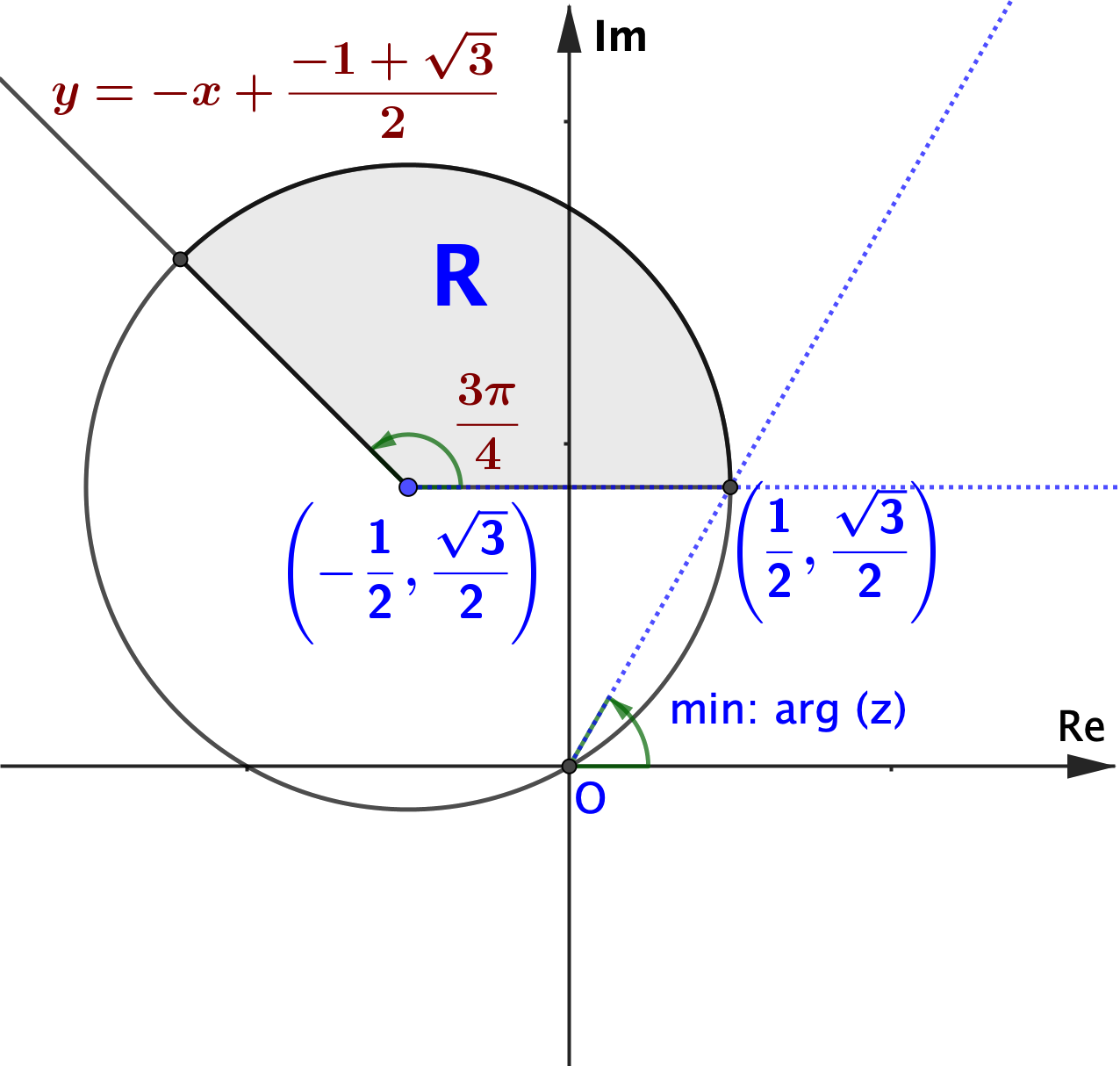
locus: A circle with centre $\Bigl(-\frac{1}{2}, \frac{\sqrt{3}}{2}\Bigr)$ and radius $1$
$|z-z_1| \leq 1 \;\Rightarrow\;$ The set of all points inside and on the circle.
$\arg(z-z_1) = \frac{3\pi}{4}$
locus: A half-line which makes an angle $\frac{3\pi}{4}$ radian with positive $x$-direction and vertex at $\Bigl(-\frac{1}{2}, \frac{\sqrt{3}}{2}\Bigr)$.
cartesian equation: $y-\frac{\sqrt{3}}{2} = -(x+\frac{1}{2}) \Rightarrow y = -x + \frac{-1+\sqrt{3}}{2} , x < -\frac{1}{2}$
$\arg(z-z_1) \leq \frac{3\pi}{4}$
A region containing points including the half lines $y=\frac{\sqrt{3}}{2}$ and $y=-x+\frac{-1+\sqrt{3}}{2}$ and between these two lines.
$R = \left\{ |z-z_1|\leq 1 \;\cap\; \arg(z-z_1) \leq \frac{3\pi}{4} \right\}$
The set of all points of the sector bound by the circle and the lines.
(c)
$$ \min \arg (z)=\tan ^{-1}\left(\frac{\sqrt{3} / 2}{1 / 2}\right)=\frac{\pi}{3} $$
13.
- Sketch, on an Argand diagram, the locus given by $|z-1+\mathrm{i}|=\sqrt{2}$.
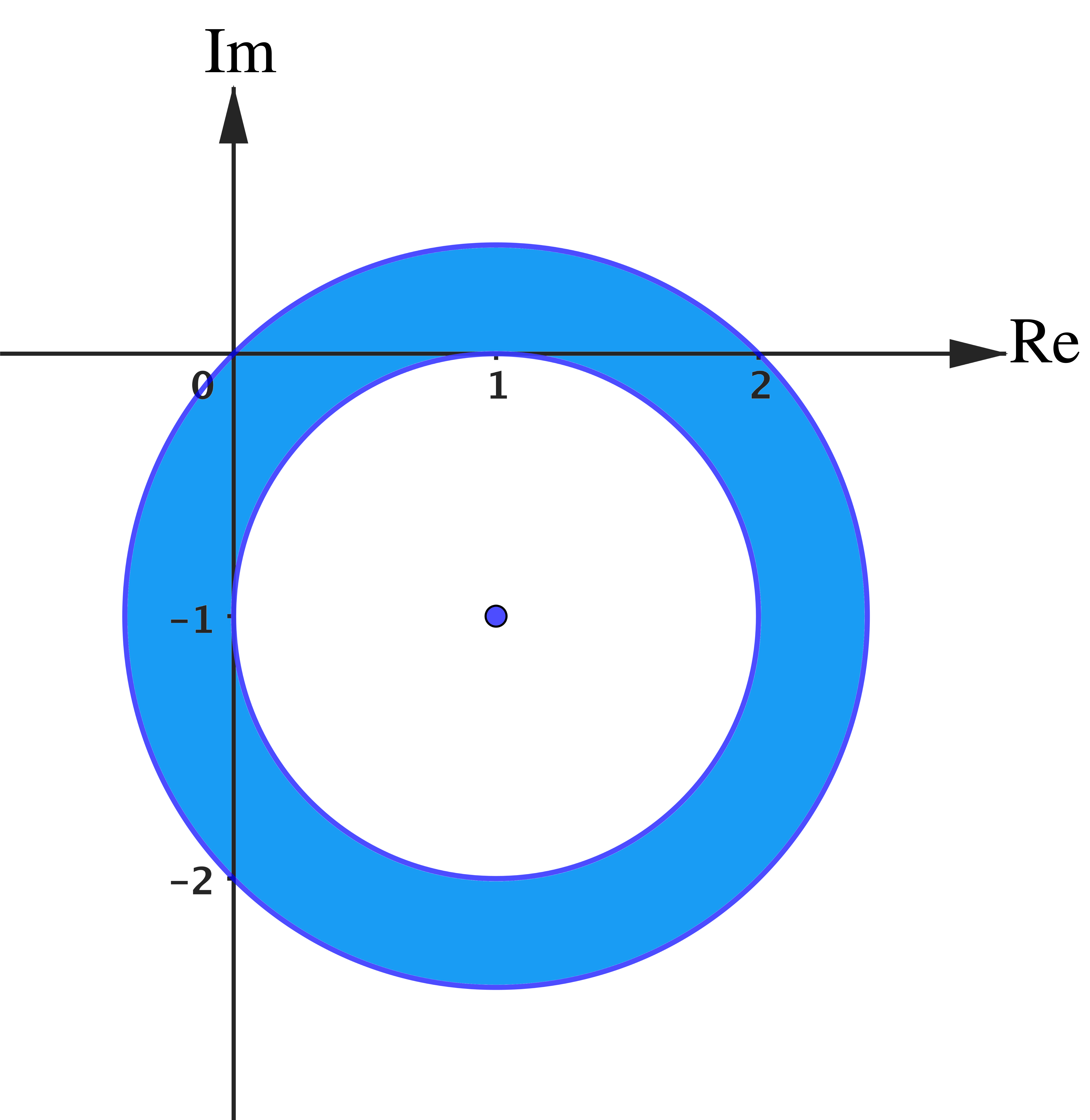
- Shade on your diagram the region given by $1 \leqslant|z-1+\mathrm{i}| \leqslant \sqrt{2}$.
(a)
$|z-1+\mathrm{i}|=\sqrt{2}$
A circle with centre $(1,-1)$ and radius $\sqrt{2}$
A circle with centre $(1,-1)$ and radius $\sqrt{2}$
(b)
14.
[N24/I/3]
The equation $z^3+a z^2+b z+c=0$, where $a, b$ and $c$ are constants, has roots 3 and $w$ where $w$ is a complex number.
The equation $z^3+a z^2+b z+c=0$, where $a, b$ and $c$ are constants, has roots 3 and $w$ where $w$ is a complex number.
- State a condition on $a, b$ and $c$ for the third root to be $w^*$. [1]
- Given that the condition in part (a) holds, and that $w=-1+2 \mathrm{i}$, find the values of $a, b$ and $c$. [3]
(a)
For a polynomial to have complex roots occurring in conjugate pairs ($w$ and $w^*$), all its coefficients must be real.
$\therefore\quad a, b \text{ and } c \text{ must be real numbers.}$
$\therefore\quad a, b \text{ and } c \text{ must be real numbers.}$
(b)
$$ \begin{aligned} & \text{The roots are } \alpha = 3, \beta = -1+2\mathrm{i}, \gamma = -1-2\mathrm{i} \\ & \text{Sum of roots } (\alpha+\beta+\gamma) = 3 + (-1+2\mathrm{i}) + (-1-2\mathrm{i}) = 1 \\ & \therefore\quad -a = 1 \implies a = -1 \\ & \text{Sum of products in pairs } (\alpha\beta + \beta\gamma + \gamma\alpha) \\ & \quad = 3(-1+2\mathrm{i}) + (-1+2\mathrm{i})(-1-2\mathrm{i}) + 3(-1-2\mathrm{i}) \\ & \quad = -3 + 6\mathrm{i} + (1+4) - 3 - 6\mathrm{i} = -6 + 5 = -1 \\ & \therefore\quad b = -1 \\ & \text{Product of roots } (\alpha\beta\gamma) = 3(-1+2\mathrm{i})(-1-2\mathrm{i}) = 3(1+4) = 15 \\ & \therefore\quad -c = 15 \implies c = -15 \\ & \text{Hence, } a = -1, b = -1, c = -15. \end{aligned} $$
15.
[N24/II/1]
Do not use a calculator in answering this question.
The complex number $-2+\mathrm{i}$ is denoted by $z$.
Do not use a calculator in answering this question.
The complex number $-2+\mathrm{i}$ is denoted by $z$.
- Find the real numbers $a$ and $b$ such that $z=a z^*+b$.
- Without using a calculator, evaluate $w z-\frac{w}{z}$. Give your answer in the form $c+d \mathrm{i}$, where $c$ and $d$ are real numbers.
(a)
$$ \begin{aligned} & z = -2+\mathrm{i} \implies z^* = -2-\mathrm{i} \\ & z = a z^* + b \implies -2+\mathrm{i} = a(-2-\mathrm{i}) + b \\ & -2+\mathrm{i} = (-2a+b) - a\mathrm{i} \\ & \text{Equating imaginary parts: } 1 = -a \implies a = -1 \\ & \text{Equating real parts: } -2 = -2a+b \implies -2 = 2+b \implies b = -4 \\ & \therefore\quad a = -1, b = -4 \end{aligned} $$
(b)
$$ \begin{aligned} & w z = (1-3\mathrm{i})(-2+\mathrm{i}) = -2 + \mathrm{i} + 6\mathrm{i} - 3\mathrm{i}^2 = -2 + 7\mathrm{i} + 3 = 1+7\mathrm{i} \\ & \frac{w}{z} = \frac{1-3\mathrm{i}}{-2+\mathrm{i}} = \frac{(1-3\mathrm{i})(-2-\mathrm{i})}{(-2)^2+1^2} = \frac{-2-\mathrm{i}+6\mathrm{i}+3\mathrm{i}^2}{5} = \frac{-5+5\mathrm{i}}{5} = -1+\mathrm{i} \\ & \therefore\quad w z - \frac{w}{z} = (1+7\mathrm{i}) - (-1+\mathrm{i}) = 2+6\mathrm{i} \end{aligned} $$
16.
[N23/I/8]
Do not use a calculator in answering this question.
Do not use a calculator in answering this question.
- Express $z$, where $z=-1+\sqrt{3} \mathrm{i}$, in the form $r \mathrm{e}^{\mathrm{i} \theta}$, where $r>0$ and $-\pi<\theta \leqslant \pi$. [2]
- Find the smallest positive integer value of $n$ such that $\frac{z^n}{\mathrm{i} z^*}$ is purely imaginary. [3]
- Find the complex numbers $v$ and $w$ which satisfy the following simultaneous equations.
$\quad\quad 2 v+|w|=1$
$\quad\quad 3 v-\mathrm{i} w=-3+4 \mathrm{i}$
Give your answers in the form $a+\mathrm{i} b$, where $a$ and $b$ are real numbers. [5]
(a)(i)
$$ \begin{aligned} & r = |-1+\sqrt{3}\mathrm{i}| = \sqrt{(-1)^2+(\sqrt{3})^2} = \sqrt{4} = 2 \\ & \theta = \pi - \tan^{-1}\left(\frac{\sqrt{3}}{1}\right) = \pi - \frac{\pi}{3} = \frac{2\pi}{3} \\ & \therefore\quad z = 2\mathrm{e}^{\mathrm{i}\frac{2\pi}{3}} \end{aligned} $$
(a)(ii)
$$ \begin{aligned} & z^* = 2\mathrm{e}^{-\mathrm{i}\frac{2\pi}{3}}, \quad \mathrm{i} = \mathrm{e}^{\mathrm{i}\frac{\pi}{2}} \\ & \frac{z^n}{\mathrm{i}z^*} = \frac{2^n \mathrm{e}^{\mathrm{i}\frac{2n\pi}{3}}}{\mathrm{e}^{\mathrm{i}\frac{\pi}{2}} 2\mathrm{e}^{-\mathrm{i}\frac{2\pi}{3}}} = 2^{n-1} \mathrm{e}^{\mathrm{i}\left( \frac{2n\pi}{3} - \frac{\pi}{2} + \frac{2\pi}{3} \right)} = 2^{n-1} \mathrm{e}^{\mathrm{i}\left( \frac{2(n+1)\pi}{3} - \frac{\pi}{2} \right)} \\ & \text{For purely imaginary, the argument must be } \frac{\pi}{2} + m\pi \text{ where } m \in \mathbb{Z} \\ & \frac{2(n+1)\pi}{3} - \frac{\pi}{2} = \frac{\pi}{2} + m\pi \\ & \frac{2(n+1)}{3} - \frac{1}{2} = m + \frac{1}{2} \implies \frac{2(n+1)}{3} = m + 1 \\ & 2n + 2 = 3m + 3 \implies 2n = 3m + 1 \\ & \text{For smallest positive integer } n, \text{ let } m=1 \implies 2n = 4 \implies n = 2. \end{aligned} $$
(b)
$$ \begin{aligned} & 2v + |w| = 1 \implies 2v = 1 - |w| \\ & \text{Since } |w| \text{ is real, } v \text{ must be real. Let } v = x \text{ (real).} \\ & 3x - \mathrm{i}w = -3 + 4\mathrm{i} \implies \mathrm{i}w = 3x + 3 - 4\mathrm{i} \\ & w = \frac{3x+3-4\mathrm{i}}{\mathrm{i}} = -4 - \mathrm{i}(3x+3) \\ & |w|^2 = (-4)^2 + (-(3x+3))^2 = 16 + (3x+3)^2 \\ & \text{From first equation, } |w| = 1 - 2x. \text{ Since } |w| \geqslant 0, x \leqslant \frac{1}{2}. \\ & (1-2x)^2 = 16 + (3x+3)^2 \\ & 1 - 4x + 4x^2 = 16 + 9x^2 + 18x + 9 \\ & 5x^2 + 22x + 24 = 0 \\ & (5x+12)(x+2) = 0 \implies x = -\frac{12}{5} \text{ or } x = -2 \quad (\text{Both are } \leqslant \frac{1}{2}) \\ & \text{If } v = -2, w = -4 - \mathrm{i}(3(-2)+3) = -4 + 3\mathrm{i} \\ & \text{If } v = -\frac{12}{5}, w = -4 - \mathrm{i}\left(3\left(-\frac{12}{5}\right)+3\right) = -4 - \mathrm{i}\left(-\frac{21}{5}\right) = -4 + \frac{21}{5}\mathrm{i} \\ & \therefore\quad v = -2, w = -4+3\mathrm{i} \quad \text{or} \quad v = -\frac{12}{5}, w = -4+\frac{21}{5}\mathrm{i} \end{aligned} $$
17.
[N22/I/1]
Do not use a calculator in answering this question.
The complex numbers $z$ and $w$ satisfy the following equations.
$\quad\quad \mathrm{i} z+2 w =-1$
$\quad\quad (2-\mathrm{i}) z+\mathrm{i} w =6$
Find $z$ and $w$, giving your answers in the form $a+i b$ where $a$ and $b$ are real numbers. [4]
Do not use a calculator in answering this question.
The complex numbers $z$ and $w$ satisfy the following equations.
$\quad\quad \mathrm{i} z+2 w =-1$
$\quad\quad (2-\mathrm{i}) z+\mathrm{i} w =6$
Find $z$ and $w$, giving your answers in the form $a+i b$ where $a$ and $b$ are real numbers. [4]
$$ \begin{aligned} & \mathrm{i}z + 2w = -1 \implies 2w = -1 - \mathrm{i}z \\ & (2-\mathrm{i})z + \mathrm{i}w = 6 \implies 2(2-\mathrm{i})z + \mathrm{i}(2w) = 12 \\ & 2(2-\mathrm{i})z + \mathrm{i}(-1-\mathrm{i}z) = 12 \\ & (4-2\mathrm{i})z - \mathrm{i} - \mathrm{i}^2z = 12 \\ & (4-2\mathrm{i})z + z = 12 + \mathrm{i} \\ & (5-2\mathrm{i})z = 12 + \mathrm{i} \\ & z = \frac{12+\mathrm{i}}{5-2\mathrm{i}} = \frac{(12+\mathrm{i})(5+2\mathrm{i})}{(5)^2 + (-2)^2} = \frac{60 + 24\mathrm{i} + 5\mathrm{i} - 2}{29} = \frac{58+29\mathrm{i}}{29} = 2+\mathrm{i} \\ & 2w = -1 - \mathrm{i}(2+\mathrm{i}) = -1 - 2\mathrm{i} - \mathrm{i}^2 = -1 - 2\mathrm{i} + 1 = -2\mathrm{i} \\ & \therefore\quad w = -\mathrm{i} \\ & \text{Hence, } z = 2+\mathrm{i} \text{ and } w = -\mathrm{i}. \end{aligned} $$
18.
[N21/II/1]
One of the roots of the equation $x^3+2 x^2+a x+b=0$, where $a$ and $b$ are real, is $1+\frac{1}{2} \mathrm{i}$. Find the other roots of the equation and the values of $a$ and $b$. [5]
One of the roots of the equation $x^3+2 x^2+a x+b=0$, where $a$ and $b$ are real, is $1+\frac{1}{2} \mathrm{i}$. Find the other roots of the equation and the values of $a$ and $b$. [5]
$$ \begin{aligned} & \text{Since } a \text{ and } b \text{ are real, roots occur in conjugate pairs.} \\ & \text{One root is } 1+\frac{1}{2}\mathrm{i}, \text{ so another root is } 1-\frac{1}{2}\mathrm{i}. \\ & \text{Let the third root be } \alpha. \\ & \text{Sum of roots: } \left(1+\frac{1}{2}\mathrm{i}\right) + \left(1-\frac{1}{2}\mathrm{i}\right) + \alpha = -2 \\ & 2 + \alpha = -2 \implies \alpha = -4 \\ & \text{The other roots are } 1-\frac{1}{2}\mathrm{i} \text{ and } -4. \\ & \text{Sum of roots taken two at a time: } a = \left(1+\frac{1}{2}\mathrm{i}\right)\left(1-\frac{1}{2}\mathrm{i}\right) + (-4)\left(1+\frac{1}{2}\mathrm{i}\right) + (-4)\left(1-\frac{1}{2}\mathrm{i}\right) \\ & a = \left(1 + \frac{1}{4}\right) - 4 - 2\mathrm{i} - 4 + 2\mathrm{i} = \frac{5}{4} - 8 = -\frac{27}{4} \\ & \text{Product of roots: } -b = \left(1+\frac{1}{2}\mathrm{i}\right)\left(1-\frac{1}{2}\mathrm{i}\right)(-4) = \left(\frac{5}{4}\right)(-4) = -5 \implies b = 5 \\ & \therefore\quad a = -\frac{27}{4}, \quad b = 5. \end{aligned} $$
19.
[N20/I/6]
The complex number $z$ satisfies the equation
$\quad\quad z^2(2+\mathrm{i})-8 \mathrm{i} z+t=0$
where $t$ is a real number. It is given that one root is of the form $k+k \mathrm{i}$, where $k$ is real and non-zero. Find $t$ and $k$, and the other root of the equation. [8]
The complex number $z$ satisfies the equation
$\quad\quad z^2(2+\mathrm{i})-8 \mathrm{i} z+t=0$
where $t$ is a real number. It is given that one root is of the form $k+k \mathrm{i}$, where $k$ is real and non-zero. Find $t$ and $k$, and the other root of the equation. [8]
$$ \begin{aligned} & \text{Substitute } z = k(1+\mathrm{i}) \text{ into the equation:} \\ & k^2(1+\mathrm{i})^2(2+\mathrm{i}) - 8\mathrm{i}k(1+\mathrm{i}) + t = 0 \\ & k^2(2\mathrm{i})(2+\mathrm{i}) - 8k\mathrm{i} - 8k\mathrm{i}^2 + t = 0 \\ & k^2(4\mathrm{i}-2) - 8k\mathrm{i} + 8k + t = 0 \\ & (-2k^2 + 8k + t) + \mathrm{i}(4k^2 - 8k) = 0 \\ & \text{Equating imaginary parts: } 4k^2 - 8k = 0 \implies 4k(k-2) = 0 \\ & \text{Since } k \neq 0, \text{ we have } k = 2. \\ & \text{Equating real parts: } -2k^2 + 8k + t = 0 \implies -2(4) + 8(2) + t = 0 \\ & -8 + 16 + t = 0 \implies t = -8. \\ & \text{Let the roots be } z_1 \text{ and } z_2. \text{ We know } z_1 = 2+2\mathrm{i}. \\ & \text{Sum of roots: } z_1 + z_2 = \frac{8\mathrm{i}}{2+\mathrm{i}} = \frac{8\mathrm{i}(2-\mathrm{i})}{5} = \frac{16\mathrm{i} + 8}{5} = \frac{8}{5} + \frac{16}{5}\mathrm{i} \\ & z_2 = \left(\frac{8}{5} + \frac{16}{5}\mathrm{i}\right) - (2+2\mathrm{i}) = \left(\frac{8}{5} - \frac{10}{5}\right) + \mathrm{i}\left(\frac{16}{5} - \frac{10}{5}\right) = -\frac{2}{5} + \frac{6}{5}\mathrm{i} \\ & \therefore\quad k = 2, \quad t = -8, \quad \text{Other root } = -0.4 + 1.2\mathrm{i} \end{aligned} $$
20.
[N19/I/1]
The function $\mathrm{f}$ is defined by $\mathrm{f}(z)=a z^3+b z^2+c z+d$, where $a, b, c$ and $d$ are real numbers. Given that $2+\mathrm{i}$ and $-3$ are roots of $\mathrm{f}(z)=0$, find $b, c$ and $d$ in terms of $a$. [4]
The function $\mathrm{f}$ is defined by $\mathrm{f}(z)=a z^3+b z^2+c z+d$, where $a, b, c$ and $d$ are real numbers. Given that $2+\mathrm{i}$ and $-3$ are roots of $\mathrm{f}(z)=0$, find $b, c$ and $d$ in terms of $a$. [4]
$$ \begin{aligned} & \text{Since coefficients are real, the complex roots must appear in conjugate pairs.} \\ & \text{Therefore, the three roots are } 2+\mathrm{i}, 2-\mathrm{i}, \text{ and } -3. \\ & \text{Sum of roots: } -\frac{b}{a} = (2+\mathrm{i}) + (2-\mathrm{i}) + (-3) = 4 - 3 = 1 \implies b = -a \\ & \text{Sum of products in pairs: } \frac{c}{a} = (2+\mathrm{i})(2-\mathrm{i}) + (-3)(2+\mathrm{i}) + (-3)(2-\mathrm{i}) \\ & \quad = (4+1) - 6 - 3\mathrm{i} - 6 + 3\mathrm{i} = 5 - 12 = -7 \implies c = -7a \\ & \text{Product of roots: } -\frac{d}{a} = (2+\mathrm{i})(2-\mathrm{i})(-3) = (5)(-3) = -15 \implies d = 15a \\ & \therefore\quad b = -a, \quad c = -7a, \quad d = 15a. \end{aligned} $$
21.
[N18/II/2(a), (b)(i)]
- One of the roots of the equation $4 x^4-20 x^3+s x^2-56 x+t=0$, where $s$ and $t$ are real, is $2-3 \mathrm{i}$. Find the other roots of the equation and the values of $s$ and $t$. [5]
- The complex number $w$ is such that $w^3=27$.
Given that one possible value of $w$ is 3 , use a non-calculator method to find the other possible values of $w$. Give your answers in the form $a+\mathrm{i} b$, where $a$ and $b$ are exact values. [3]
(a)
$$ \begin{aligned} & \text{Since coefficients are real, } 2+3\mathrm{i} \text{ is also a root.} \\ & \text{Sum of these two roots } = 4, \quad \text{Product } = 2^2 + 3^2 = 13. \\ & \text{Quadratic factor is } x^2 - 4x + 13. \\ & \text{Let the other quadratic factor be } 4x^2 + px + q. \\ & (x^2 - 4x + 13)(4x^2 + px + q) = 4x^4 - 20x^3 + sx^2 - 56x + t \\ & \text{Comparing coefficients of } x^3: p - 16 = -20 \implies p = -4. \\ & \text{Comparing coefficients of } x: -4q + 13p = -56 \implies -4q - 52 = -56 \implies -4q = -4 \implies q = 1. \\ & \text{The other roots are found from } 4x^2 - 4x + 1 = 0 \implies (2x-1)^2 = 0 \implies x = \frac{1}{2} \text{ (repeated).} \\ & \text{Comparing coefficients of } x^2: s = q - 4p + 52 = 1 - 4(-4) + 52 = 69. \\ & \text{Comparing constant terms: } t = 13q = 13. \\ & \therefore\quad \text{Other roots: } 2+3\mathrm{i}, \frac{1}{2}, \frac{1}{2} \quad \text{and} \quad s = 69, t = 13. \end{aligned} $$
(b)
$$ \begin{aligned} & w^3 - 27 = 0 \\ & (w-3)(w^2 + 3w + 9) = 0 \\ & \text{The other values of } w \text{ come from } w^2 + 3w + 9 = 0 \\ & w = \frac{-3 \pm \sqrt{3^2 - 4(1)(9)}}{2} = \frac{-3 \pm \sqrt{9 - 36}}{2} = \frac{-3 \pm \sqrt{-27}}{2} \\ & w = -\frac{3}{2} \pm \frac{3\sqrt{3}}{2}\mathrm{i} \end{aligned} $$
22.
[N17/I/8]
Do not use a calculator in answering this question.
Do not use a calculator in answering this question.
- Find the roots of the equation $z^2(1-\mathrm{i})-2 z+(5+5 \mathrm{i})=0$, giving your answers in cartesian form $a+\mathrm{i} b$. [3]
- Given that $w=1-\mathrm{i}$, find $w^2, w^3$ and $w^4$ in cartesian form. Given also that
$\quad\quad w^4+p w^3+39 w^2+q w+58=0$
where $p$ and $q$ are real, find $p$ and $q$. [4] - Using the values of $p$ and $q$ in part (b)(i), express $w^4+p w^3+39 w^2+q w+58$ as the product of two quadratic factors. [3]
- Given that $w=1-\mathrm{i}$, find $w^2, w^3$ and $w^4$ in cartesian form. Given also that
(a)
$$ \begin{aligned} & z = \frac{2 \pm \sqrt{(-2)^2 - 4(1-\mathrm{i})(5+5\mathrm{i})}}{2(1-\mathrm{i})} = \frac{2 \pm \sqrt{4 - 4(5 + 5\mathrm{i} - 5\mathrm{i} + 5)}}{2(1-\mathrm{i})} = \frac{2 \pm \sqrt{4 - 40}}{2(1-\mathrm{i})} \\ & z = \frac{2 \pm \sqrt{-36}}{2(1-\mathrm{i})} = \frac{2 \pm 6\mathrm{i}}{2(1-\mathrm{i})} = \frac{1 \pm 3\mathrm{i}}{1-\mathrm{i}} \\ & z_1 = \frac{(1+3\mathrm{i})(1+\mathrm{i})}{(1-\mathrm{i})(1+\mathrm{i})} = \frac{1 + \mathrm{i} + 3\mathrm{i} - 3}{2} = \frac{-2 + 4\mathrm{i}}{2} = -1 + 2\mathrm{i} \\ & z_2 = \frac{(1-3\mathrm{i})(1+\mathrm{i})}{(1-\mathrm{i})(1+\mathrm{i})} = \frac{1 + \mathrm{i} - 3\mathrm{i} + 3}{2} = \frac{4 - 2\mathrm{i}}{2} = 2 - \mathrm{i} \end{aligned} $$
(b)(i)
$$ \begin{aligned} & w = 1-\mathrm{i} \\ & w^2 = (1-\mathrm{i})^2 = 1 - 2\mathrm{i} - 1 = -2\mathrm{i} \\ & w^3 = w^2 \cdot w = -2\mathrm{i}(1-\mathrm{i}) = -2\mathrm{i} - 2 \\ & w^4 = (w^2)^2 = (-2\mathrm{i})^2 = -4 \\ & \text{Substitute into } w^4 + pw^3 + 39w^2 + qw + 58 = 0: \\ & -4 + p(-2-2\mathrm{i}) + 39(-2\mathrm{i}) + q(1-\mathrm{i}) + 58 = 0 \\ & (-4 - 2p + q + 58) + \mathrm{i}(-2p - 78 - q) = 0 \\ & \text{Real parts: } -2p + q = -54 \\ & \text{Imaginary parts: } -2p - q = 78 \\ & \text{Adding both equations: } -4p = 24 \implies p = -6 \\ & \text{Subtracting both equations: } 2q = -132 \implies q = -66 \end{aligned} $$
(b)(ii)
$$ \begin{aligned} & \text{The polynomial is } w^4 - 6w^3 + 39w^2 - 66w + 58. \\ & \text{Since } 1-\mathrm{i} \text{ is a root and the coefficients are real, } 1+\mathrm{i} \text{ is also a root.} \\ & \text{One quadratic factor is } (w - (1-\mathrm{i}))(w - (1+\mathrm{i})) = w^2 - 2w + 2. \\ & \text{Let the other factor be } w^2 + aw + b. \\ & (w^2 - 2w + 2)(w^2 + aw + b) = w^4 - 6w^3 + 39w^2 - 66w + 58 \\ & \text{Comparing constant terms: } 2b = 58 \implies b = 29. \\ & \text{Comparing coefficients of } w^3: a - 2 = -6 \implies a = -4. \\ & \therefore\quad \text{The expression is } (w^2 - 2w + 2)(w^2 - 4w + 29). \end{aligned} $$
23.
[N16/I/7]
Do not use a calculator in answering this equation.
Do not use a calculator in answering this equation.
- Verify that $-1+5 \mathrm{i}$ is a root of the equation $w^2+(-1-8 \mathrm{i}) w+(-17+7 \mathrm{i})=0$. Hence, or otherwise, find the second root of the equation in cartesian form, $p+\mathrm{i} q$, showing your working. [5]
- The equation $z^3-5 z^2+16 z+k=0$, where $k$ is a real constant, has a root $z=1+a\mathrm{i}$, where $a$ is a positive real constant. Find the values of $a$ and $k$, showing your working. [5]
(a)
$$ \begin{aligned} & \text{Let } w = -1+5\mathrm{i}. \\ & w^2 = (-1+5\mathrm{i})^2 = 1 - 10\mathrm{i} - 25 = -24 - 10\mathrm{i}. \\ & (-1-8\mathrm{i})w = (-1-8\mathrm{i})(-1+5\mathrm{i}) = 1 - 5\mathrm{i} + 8\mathrm{i} + 40 = 41 + 3\mathrm{i}. \\ & \text{Substitute into LHS: } (-24-10\mathrm{i}) + (41+3\mathrm{i}) + (-17+7\mathrm{i}) \\ & \quad = (-24 + 41 - 17) + \mathrm{i}(-10 + 3 + 7) = 0 + 0\mathrm{i} = 0. \\ & \text{Therefore, } -1+5\mathrm{i} \text{ is a root.} \\ & \text{Let the second root be } w_2. \\ & \text{Sum of roots } = -(-1-8\mathrm{i}) = 1+8\mathrm{i}. \\ & (-1+5\mathrm{i}) + w_2 = 1+8\mathrm{i} \implies w_2 = (1+8\mathrm{i}) - (-1+5\mathrm{i}) = 2 + 3\mathrm{i}. \end{aligned} $$
(b)
$$ \begin{aligned} & \text{Since } k \text{ is a real constant, the roots must appear in conjugate pairs.} \\ & \text{One root is } 1+a\mathrm{i}, \text{ so another root is } 1-a\mathrm{i}. \\ & \text{Let the third root be } \alpha. \\ & \text{Sum of roots: } (1+a\mathrm{i}) + (1-a\mathrm{i}) + \alpha = 5 \implies 2 + \alpha = 5 \implies \alpha = 3. \\ & \text{Sum of products in pairs: } (1+a\mathrm{i})(1-a\mathrm{i}) + 3(1+a\mathrm{i}) + 3(1-a\mathrm{i}) = 16 \\ & (1+a^2) + 6 = 16 \implies a^2 = 9. \\ & \text{Since } a > 0, \text{ we have } a = 3. \\ & \text{Product of roots: } -k = (1+a\mathrm{i})(1-a\mathrm{i})(3) = (1+3^2)(3) = (10)(3) = 30. \\ & \therefore\quad a = 3, \quad k = -30. \end{aligned} $$
24.
[N15/I/9(a)]
The complex number $w$ is such that $w=a+\mathrm{i} b$, where $a$ and $b$ are non-zero real numbers. The complex conjugate of $w$ is denoted by $w^*$. Given that $\frac{w^2}{w^*}$ is purely imaginary, find the possible values of $w$ in terms of $a$. [5]
The complex number $w$ is such that $w=a+\mathrm{i} b$, where $a$ and $b$ are non-zero real numbers. The complex conjugate of $w$ is denoted by $w^*$. Given that $\frac{w^2}{w^*}$ is purely imaginary, find the possible values of $w$ in terms of $a$. [5]
$$ \begin{aligned} & w = a + \mathrm{i}b, \quad w^* = a - \mathrm{i}b \\ & \frac{w^2}{w^*} = \frac{(a+\mathrm{i}b)^2}{a-\mathrm{i}b} \times \frac{a+\mathrm{i}b}{a+\mathrm{i}b} = \frac{(a^2-b^2+2ab\mathrm{i})(a+\mathrm{i}b)}{a^2+b^2} \\ & = \frac{(a^3 - ab^2 - 2ab^2) + \mathrm{i}(a^2b - b^3 + 2a^2b)}{a^2+b^2} = \frac{(a^3 - 3ab^2) + \mathrm{i}(3a^2b - b^3)}{a^2+b^2} \\ & \text{Since the expression is purely imaginary, its real part must be zero.} \\ & \frac{a^3 - 3ab^2}{a^2+b^2} = 0 \implies a(a^2 - 3b^2) = 0 \\ & \text{Since } a \text{ and } b \text{ are non-zero real numbers, } a \neq 0. \\ & a^2 - 3b^2 = 0 \implies b^2 = \frac{a^2}{3} \implies b = \pm \frac{a}{\sqrt{3}} \\ & \therefore\quad \text{The possible values of } w \text{ are } a \pm \mathrm{i}\frac{a}{\sqrt{3}}. \end{aligned} $$
စာဖတ်သူ၏ အမြင်ကို လေးစားစွာစောင့်မျှော်လျက်!
Post a Comment