

Pearson Edexcel
International GCSE Further Pure Mathematics (4PM1)
-
[Source: 4PM1/01 - January 2020 - Question 11]
A company manufactures chocolate bars that are inside packaging that is in the shape of a right triangular prism. The cross section of the prism is an equilateral triangle with sides of length \(\displaystyle x\) cm, as shown in the figure.
The volume of the prism is \(\displaystyle 72 \text{ cm}^3\). The total surface area of the prism is \(\displaystyle S \text{ cm}^2\).
- Show that \(\displaystyle S=\frac{\sqrt{3}x^2}{2}+\frac{288\sqrt{3}}{x}\)
Given that \(\displaystyle x\) can vary,
- use calculus to find, to 4 significant figures, the value of \(\displaystyle x\) for which \(\displaystyle S\) is a minimum, justifying that this value gives a minimum value of \(\displaystyle S\).
- Find, to 3 significant figures, the minimum value of \(\displaystyle S\).
\(\displaystyle \begin{aligned} \textbf{(a)} \quad & \text{Area of cross section } A = \frac{1}{2} x^2 \sin 60^{\circ} = \frac{\sqrt{3}}{4}x^2 \\[2mm] & \text{Volume } V = A \times l = 72 \implies \frac{\sqrt{3}}{4}x^2 \times l = 72 \implies l = \frac{288}{\sqrt{3}x^2} \\[2mm] & \text{Total Surface Area } S = 2A + 3xl \\[2mm] & S = 2\left(\frac{\sqrt{3}}{4}x^2\right) + 3x\left(\frac{288}{\sqrt{3}x^2}\right) \\[2mm] & S = \frac{\sqrt{3}}{2}x^2 + \frac{864}{\sqrt{3}x} = \frac{\sqrt{3}}{2}x^2 + \frac{288\sqrt{3}}{x} \quad \text{(shown)} \\[2mm] \textbf{(b)} \quad & \frac{dS}{dx} = \sqrt{3}x - \frac{288\sqrt{3}}{x^2} = 0 \implies x^3 = 288 \\[2mm] & x = \sqrt[3]{288} \approx 6.604 \\[2mm] & \frac{d^2S}{dx^2} = \sqrt{3} + \frac{576\sqrt{3}}{x^3} \\[2mm] & \text{When } x \approx 6.604, \frac{d^2S}{dx^2} > 0 \therefore \text{ it is a minimum.} \\[2mm] \textbf{(c)} \quad & S_{\text{min}} = \frac{\sqrt{3}}{2}(6.6038...)^2 + \frac{288\sqrt{3}}{6.6038...} \approx 113 \end{aligned} \) -
[Source: 4PM1/01R - January 2020 - Question 9]
A circular drop of oil is expanding on the surface of a pool of water. The area of the drop of oil is increasing at a constant rate of \(\displaystyle 4.5 \text{ cm}^2/\text{s}\).
- Find the rate of increase of the radius of the drop of oil, in cm/s, at the instant when the radius is \(\displaystyle 3\) cm.
- Find the rate of increase of the circumference of the drop of oil, in cm/s, at the instant when the area of the drop of oil is \(\displaystyle 16\pi \text{ cm}^2\).
\(\displaystyle \begin{aligned} \textbf{(a)} \quad & \text{Given } \frac{dA}{dt} = 4.5 \\[2mm] & A = \pi r^2 \implies \frac{dA}{dr} = 2\pi r \\[2mm] & \frac{dA}{dt} = \frac{dA}{dr} \times \frac{dr}{dt} \implies 4.5 = 2\pi r \frac{dr}{dt} \\[2mm] & \text{When } r = 3: \quad 4.5 = 6\pi \frac{dr}{dt} \implies \frac{dr}{dt} = \frac{4.5}{6\pi} = \frac{3}{4\pi} \approx 0.239 \text{ cm/s} \\[2mm] \textbf{(b)} \quad & \text{When } A = 16\pi \implies \pi r^2 = 16\pi \implies r = 4 \\[2mm] & \text{At } r = 4: \quad \frac{dr}{dt} = \frac{4.5}{2\pi(4)} = \frac{4.5}{8\pi} \\[2mm] & C = 2\pi r \implies \frac{dC}{dr} = 2\pi \\[2mm] & \frac{dC}{dt} = \frac{dC}{dr} \times \frac{dr}{dt} = 2\pi \left(\frac{4.5}{8\pi}\right) = \frac{9}{8} = 1.125 \text{ cm/s} \end{aligned} \) -
[Source: 4PM1/01R - January 2020 - Question 11]
The figure shows part of the curve \(\displaystyle C\) with equation \(\displaystyle y=\sqrt{x-2}\). It also shows the straight line \(\displaystyle l\) with equation \(\displaystyle y=b\) for \(\displaystyle x>0\) where \(\displaystyle b>0\).
Given that \(\displaystyle C\) and \(\displaystyle l\) intersect at the point \(\displaystyle P\) with coordinates \(\displaystyle (a, b)\), where \(\displaystyle 2<a<16\)
- show that \(\displaystyle b^2=a-2\)
The finite region \(\displaystyle R\) bounded by \(\displaystyle C\), the straight line with equation \(\displaystyle x=16\) and \(\displaystyle l\), shown shaded in the figure, is rotated through \(\displaystyle 360^{\circ}\) about the \(\displaystyle x\)-axis to form a solid \(\displaystyle S\).
Given that the volume of the solid formed is \(\displaystyle 50\pi\)
- use algebraic integration to find the value of \(\displaystyle a\) and the value of \(\displaystyle b\).
\(\displaystyle \begin{aligned} \textbf{(a)} \quad & \text{At intersection point } P(a,b), \text{ the coordinates satisfy the curve's equation:} \\[2mm] & b = \sqrt{a-2} \\[2mm] & b^2 = a - 2 \quad \text{(shown)} \\[2mm] \textbf{(b)} \quad & \text{Volume of solid } V = \pi \int_a^{16} (y_C^2 - y_l^2) \, dx = 50\pi \\[2mm] & \int_a^{16} \left( (\sqrt{x-2})^2 - b^2 \right) \, dx = 50 \\[2mm] & \int_a^{16} (x - 2 - (a - 2)) \, dx = 50 \\[2mm] & \int_a^{16} (x - a) \, dx = 50 \\[2mm] & \left[ \frac{1}{2}x^2 - ax \right]_a^{16} = 50 \\[2mm] & \left( \frac{256}{2} - 16a \right) - \left( \frac{a^2}{2} - a^2 \right) = 50 \\[2mm] & 128 - 16a + \frac{a^2}{2} = 50 \\[2mm] & \frac{a^2}{2} - 16a + 78 = 0 \implies a^2 - 32a + 156 = 0 \\[2mm] & (a - 6)(a - 26) = 0 \\[2mm] & \text{Since } 2 < a < 16, \text{ we reject } a = 26. \text{ Thus, } a = 6. \\[2mm] & b = \sqrt{6 - 2} = \sqrt{4} = 2 \end{aligned} \) -
[Source: 4PM1/02 - January 2020 - Question 10]
The volume of a sphere is increasing at a constant rate of \(\displaystyle 40 \text{ cm}^3/\text{s}\).
Find the rate of increase, in \(\displaystyle \text{cm}^2/\text{s}\), of the surface area of the sphere at the instant when the radius is \(\displaystyle 4\) cm.
\(\displaystyle \begin{aligned} & \text{Given } \frac{dV}{dt} = 40 \\[2mm] & V = \frac{4}{3}\pi r^3 \implies \frac{dV}{dr} = 4\pi r^2 \\[2mm] & \frac{dV}{dt} = \frac{dV}{dr} \times \frac{dr}{dt} \implies 40 = 4\pi r^2 \frac{dr}{dt} \\[2mm] & \text{At } r = 4: \quad 40 = 4\pi(4^2) \frac{dr}{dt} \implies \frac{dr}{dt} = \frac{40}{64\pi} = \frac{5}{8\pi} \\[2mm] & \text{Surface Area } S = 4\pi r^2 \implies \frac{dS}{dr} = 8\pi r \\[2mm] & \frac{dS}{dt} = \frac{dS}{dr} \times \frac{dr}{dt} = 8\pi r \left( \frac{5}{8\pi} \right) = 5r \\[2mm] & \text{At } r = 4: \quad \frac{dS}{dt} = 5(4) = 20 \text{ cm}^2/\text{s} \end{aligned} \) -
[Source: 4PM1/02R - January 2020 - Question 10]
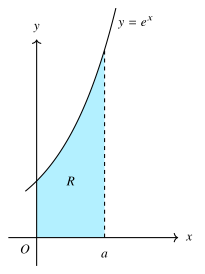
The region \(\displaystyle R\), shown shaded in the figure, is bounded by the curve with equation \(\displaystyle y = e^x\), the \(\displaystyle x\)-axis, the \(\displaystyle y\)-axis and the line with equation \(\displaystyle x = a\), where \(\displaystyle a > 0\).
- Find the exact area of \(\displaystyle R\) in terms of \(\displaystyle a\).
The region \(\displaystyle R\) is rotated through \(\displaystyle 360^{\circ}\) about the \(\displaystyle x\)-axis to generate a solid of volume \(\displaystyle V\).
Given that \(\displaystyle V = 12\pi\),
- find the exact value of \(\displaystyle a\).
\(\displaystyle \begin{aligned} \textbf{(a)} \quad & \text{Area } = \int_0^a e^x \, dx \\[2mm] & = \left[ e^x \right]_0^a = e^a - e^0 = e^a - 1 \\[2mm] \textbf{(b)} \quad & V = \pi \int_0^a (e^x)^2 \, dx = \pi \int_0^a e^{2x} \, dx \\[2mm] & V = \pi \left[ \frac{1}{2} e^{2x} \right]_0^a = \frac{\pi}{2}(e^{2a} - 1) \\[2mm] & \text{Given } V = 12\pi: \\[2mm] & \frac{\pi}{2}(e^{2a} - 1) = 12\pi \\[2mm] & e^{2a} - 1 = 24 \implies e^{2a} = 25 \\[2mm] & 2a = \ln 25 \implies a = \frac{1}{2} \ln 25 = \ln \sqrt{25} = \ln 5 \end{aligned} \) -
[Source: 4PM1/01 - June 2020 - Question 9]
A particle \(\displaystyle P\) is moving along the \(\displaystyle x\)-axis. At time \(\displaystyle t\) seconds (\(\displaystyle t \ge 0\)), the velocity, \(\displaystyle v\) m/s, of \(\displaystyle P\) is given by
\(\displaystyle v = t^2 - 4t + 3 \)
- Find the acceleration of \(\displaystyle P\) when \(\displaystyle t=5\)
Given that the distance of \(\displaystyle P\) from the origin when \(\displaystyle t=0\) is \(\displaystyle 0\),
- find the total distance travelled by \(\displaystyle P\) in the first \(\displaystyle 4\) seconds.
\(\displaystyle \begin{aligned} \textbf{(a)} \quad & \text{Acceleration } a = \frac{dv}{dt} = 2t - 4 \\[2mm] & \text{When } t = 5: \quad a = 2(5) - 4 = 6 \text{ m/s}^2 \\[2mm] \textbf{(b)} \quad & \text{Particle is at rest when } v = 0: \\[2mm] & t^2 - 4t + 3 = 0 \implies (t-1)(t-3) = 0 \implies t = 1, t = 3 \\[2mm] & \text{Displacement } s = \int (t^2 - 4t + 3) \, dt = \frac{t^3}{3} - 2t^2 + 3t + C \\[2mm] & \text{Since } s = 0 \text{ when } t = 0 \implies C = 0 \implies s(t) = \frac{t^3}{3} - 2t^2 + 3t \\[2mm] & \text{Calculate positions at key times:} \\[2mm] & s(0) = 0 \\[2mm] & s(1) = \frac{1}{3} - 2 + 3 = \frac{4}{3} \\[2mm] & s(3) = 9 - 18 + 9 = 0 \\[2mm] & s(4) = \frac{64}{3} - 32 + 12 = \frac{64 - 96 + 36}{3} = \frac{4}{3} \\[2mm] & \text{Total Distance } = |s(1) - s(0)| + |s(3) - s(1)| + |s(4) - s(3)| \\[2mm] & = \left|\frac{4}{3} - 0\right| + \left|0 - \frac{4}{3}\right| + \left|\frac{4}{3} - 0\right| \\[2mm] & = \frac{4}{3} + \frac{4}{3} + \frac{4}{3} = 4 \text{ m} \end{aligned} \) -
[Source: 4PM1/01 - June 2020 - Question 10]
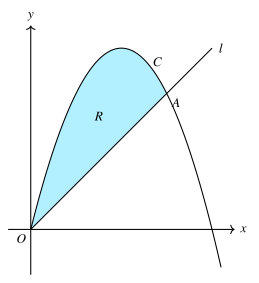
The figure shows part of the curve \(\displaystyle C\) with equation \(\displaystyle y = 4x - x^2\) and the line \(\displaystyle l\) with equation \(\displaystyle y = x\).
The curve \(\displaystyle C\) and the line \(\displaystyle l\) intersect at the origin \(\displaystyle O\) and the point \(\displaystyle A\).
- Find the coordinates of \(\displaystyle A\).
The finite region \(\displaystyle R\), shown shaded in the figure, is bounded by \(\displaystyle C\) and \(\displaystyle l\).
- Use calculus to find the exact area of \(\displaystyle R\).
\(\displaystyle \begin{aligned} \textbf{(a)} \quad & \text{For intersection points, equate the two equations:} \\[2mm] & 4x - x^2 = x \\[2mm] & 3x - x^2 = 0 \implies x(3 - x) = 0 \\[2mm] & x = 0 \text{ (Origin } O\text{) and } x = 3 \\[2mm] & \text{When } x = 3, y = 3. \therefore A(3, 3) \\[2mm] \textbf{(b)} \quad & \text{Area of } R = \int_0^3 (y_{\text{curve}} - y_{\text{line}}) \, dx \\[2mm] & = \int_0^3 (4x - x^2 - x) \, dx \\[2mm] & = \int_0^3 (3x - x^2) \, dx \\[2mm] & = \left[ \frac{3x^2}{2} - \frac{x^3}{3} \right]_0^3 \\[2mm] & = \left( \frac{3(9)}{2} - \frac{27}{3} \right) - (0) \\[2mm] & = \frac{27}{2} - 9 = \frac{27 - 18}{2} = \frac{9}{2} = 4.5 \end{aligned} \) -
[Source: 4PM1/01R - June 2020 - Question 8]
The curve \(\displaystyle C\) has equation \(\displaystyle y = x^2 e^{-x}\).
- Find \(\displaystyle \frac{dy}{dx}\)
- Find the coordinates of the turning points of \(\displaystyle C\).
- Determine the exact nature of each turning point.
\(\displaystyle \begin{aligned} \textbf{(a)} \quad & y = x^2 e^{-x} \\[2mm] & \text{Using Product Rule:} \\[2mm] & \frac{dy}{dx} = (2x)(e^{-x}) + (x^2)(-e^{-x}) \\[2mm] & \frac{dy}{dx} = e^{-x}(2x - x^2) = x(2 - x)e^{-x} \\[2mm] \textbf{(b)} \quad & \text{For turning points, } \frac{dy}{dx} = 0 \\[2mm] & x(2 - x)e^{-x} = 0 \implies x = 0 \text{ or } x = 2 \\[2mm] & \text{When } x = 0, y = 0^2 e^0 = 0 \implies (0, 0) \\[2mm] & \text{When } x = 2, y = 2^2 e^{-2} = 4e^{-2} \implies (2, 4e^{-2}) \\[2mm] \textbf{(c)} \quad & \frac{d^2y}{dx^2} = \frac{d}{dx} \left[ e^{-x}(2x - x^2) \right] \\[2mm] & = (-e^{-x})(2x - x^2) + (e^{-x})(2 - 2x) \\[2mm] & = e^{-x}(-2x + x^2 + 2 - 2x) = e^{-x}(x^2 - 4x + 2) \\[2mm] & \text{At } x = 0: \quad \frac{d^2y}{dx^2} = e^0(0 - 0 + 2) = 2 > 0 \therefore (0, 0) \text{ is a Minimum.} \\[2mm] & \text{At } x = 2: \quad \frac{d^2y}{dx^2} = e^{-2}(4 - 8 + 2) = -2e^{-2} < 0 \therefore (2, 4e^{-2}) \text{ is a Maximum.} \end{aligned} \) -
[Source: 4PM1/01R - June 2020 - Question 12]
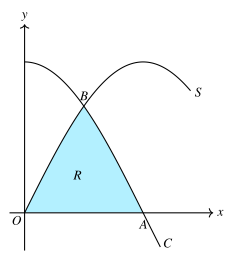
The region \(\displaystyle R\), shown shaded in the figure, is bounded by the \(\displaystyle x\)-axis, the curve \(\displaystyle S\) with equation \(\displaystyle y=2\sin x\) and the curve \(\displaystyle C\) with equation \(\displaystyle y=2\cos x\).
As shown in the figure, \(\displaystyle C\) crosses the \(\displaystyle x\)-axis at the point \(\displaystyle A\).
- Write down the \(\displaystyle x\) coordinate of \(\displaystyle A\).
As shown in the figure, \(\displaystyle C\) and \(\displaystyle S\) intersect at the point \(\displaystyle B\).
- Find the \(\displaystyle x\) coordinate of \(\displaystyle B\).
- Using calculus, find the area of the shaded region \(\displaystyle R\). Give your answer in the form \(\displaystyle a-\sqrt{b}\) where \(\displaystyle a\) and \(\displaystyle b\) are integers.
\(\displaystyle \begin{aligned} \textbf{(a)} \quad & \text{For curve } C: y = 2\cos x. \text{ Crosses } x\text{-axis when } y = 0. \\[2mm] & 2\cos x = 0 \implies \cos x = 0 \implies x = \frac{\pi}{2} \text{ (for Point } A\text{)} \\[2mm] \textbf{(b)} \quad & \text{At intersection } B: 2\sin x = 2\cos x \\[2mm] & \frac{\sin x}{\cos x} = 1 \implies \tan x = 1 \implies x = \frac{\pi}{4} \\[2mm] \textbf{(c)} \quad & \text{Area of } R \text{ is split at } x = \frac{\pi}{4}: \\[2mm] & \text{Area } = \int_0^{\pi/4} 2\sin x \, dx + \int_{\pi/4}^{\pi/2} 2\cos x \, dx \\[2mm] & = \left[ -2\cos x \right]_0^{\pi/4} + \left[ 2\sin x \right]_{\pi/4}^{\pi/2} \\[2mm] & = \left( -2\cos\frac{\pi}{4} - (-2\cos 0) \right) + \left( 2\sin\frac{\pi}{2} - 2\sin\frac{\pi}{4} \right) \\[2mm] & = \left( -2\left(\frac{\sqrt{2}}{2}\right) + 2(1) \right) + \left( 2(1) - 2\left(\frac{\sqrt{2}}{2}\right) \right) \\[2mm] & = (-\sqrt{2} + 2) + (2 - \sqrt{2}) = 4 - 2\sqrt{2} \\[2mm] & \text{To put in form } a - \sqrt{b}, \text{ note that } 2\sqrt{2} = \sqrt{4 \times 2} = \sqrt{8} \\[2mm] & \text{Area } = 4 - \sqrt{8} \quad \text{(where } a=4, b=8\text{)} \end{aligned} \) -
[Source: 4PM1/02 - June 2020 - Question 9]
The curve \(\displaystyle C\) has equation
\(\displaystyle y = \frac{2x - 3}{x + 2}, \quad x \ne -2 \)
- Find \(\displaystyle \frac{dy}{dx}\)
- Find an equation of the normal to \(\displaystyle C\) at the point where \(\displaystyle x = 1\). Give your answer in the form \(\displaystyle ax + by + c = 0\), where \(\displaystyle a\), \(\displaystyle b\) and \(\displaystyle c\) are integers.
\(\displaystyle \begin{aligned} \textbf{(a)} \quad & \text{Using the Quotient Rule: } y = \frac{u}{v} \implies y' = \frac{vu' - uv'}{v^2} \\[2mm] & u = 2x - 3 \implies u' = 2 \\[2mm] & v = x + 2 \implies v' = 1 \\[2mm] & \frac{dy}{dx} = \frac{(x+2)(2) - (2x-3)(1)}{(x+2)^2} \\[2mm] & \frac{dy}{dx} = \frac{2x + 4 - 2x + 3}{(x+2)^2} = \frac{7}{(x+2)^2} \\[2mm] \textbf{(b)} \quad & \text{At } x = 1: \\[2mm] & y = \frac{2(1) - 3}{1 + 2} = \frac{-1}{3} \implies \text{Point is } \left(1, -\frac{1}{3}\right) \\[2mm] & \text{Gradient of tangent } m_T = \frac{7}{(1+2)^2} = \frac{7}{9} \\[2mm] & \text{Gradient of normal } m_N = -\frac{1}{m_T} = -\frac{9}{7} \\[2mm] & \text{Equation of normal: } y - y_1 = m_N(x - x_1) \\[2mm] & y - \left(-\frac{1}{3}\right) = -\frac{9}{7}(x - 1) \\[2mm] & y + \frac{1}{3} = -\frac{9}{7}x + \frac{9}{7} \\[2mm] & \text{Multiply entirely by 21 to clear fractions:} \\[2mm] & 21y + 7 = -27x + 27 \\[2mm] & 27x + 21y - 20 = 0 \end{aligned} \) -
[Source: 4PM1/01 - June 2021 - Question 11]
- Using a formula from page 2, show that \(\displaystyle \cos 2x=1-2\sin^2 x\)
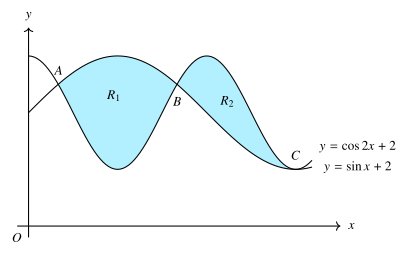
Figure 2 shows a sketch of part of the curves with equations \(\displaystyle y=\sin x+2\) and \(\displaystyle y=\cos 2x+2\)
The points \(\displaystyle A\), \(\displaystyle B\) and \(\displaystyle C\), shown in Figure 2, are three points that are common to both curves.
- Find the coordinates of each of these points.
\(\displaystyle R_1\) and \(\displaystyle R_2\) shown shaded in Figure 2, are two regions enclosed by the two curves.
- Use calculus to find, in its simplest form, the ratio
\(\displaystyle \text{area of } R_1 : \text{area of } R_2 \)
\(\displaystyle \begin{aligned} \textbf{(a)} \quad & \text{Using } \cos(A+B) = \cos A\cos B - \sin A\sin B \\[2mm] & \text{Let } A = x, B = x \implies \cos(2x) = \cos^2 x - \sin^2 x \\[2mm] & \text{Substitute } \cos^2 x = 1 - \sin^2 x \implies \cos(2x) = (1 - \sin^2 x) - \sin^2 x = 1 - 2\sin^2 x \quad \text{(shown)} \\[2mm] \textbf{(b)} \quad & \text{At intersection: } \sin x + 2 = \cos 2x + 2 \\[2mm] & \sin x = 1 - 2\sin^2 x \implies 2\sin^2 x + \sin x - 1 = 0 \\[2mm] & (2\sin x - 1)(\sin x + 1) = 0 \implies \sin x = \frac{1}{2} \text{ or } \sin x = -1 \\[2mm] & \text{For } \sin x = 0.5: \quad x = \frac{\pi}{6}, \frac{5\pi}{6}. \quad \text{For } \sin x = -1: \quad x = \frac{3\pi}{2} \\[2mm] & y\text{-coordinates: } y = \sin\left(\frac{\pi}{6}\right) + 2 = 2.5, \text{ etc.} \\[2mm] & \therefore A\left(\frac{\pi}{6}, 2.5\right), \quad B\left(\frac{5\pi}{6}, 2.5\right), \quad C\left(\frac{3\pi}{2}, 1\right) \\[2mm] \textbf{(c)} \quad & \text{Area } R_1 = \int_{\pi/6}^{5\pi/6} ( (\sin x + 2) - (\cos 2x + 2) ) \, dx = \int_{\pi/6}^{5\pi/6} (\sin x - \cos 2x) \, dx \\[2mm] & = \left[ -\cos x - \frac{1}{2}\sin 2x \right]_{\pi/6}^{5\pi/6} \\[2mm] & = \left( -\left(-\frac{\sqrt{3}}{2}\right) - \frac{1}{2}\left(-\frac{\sqrt{3}}{2}\right) \right) - \left( -\frac{\sqrt{3}}{2} - \frac{1}{2}\left(\frac{\sqrt{3}}{2}\right) \right) = \frac{3\sqrt{3}}{4} + \frac{3\sqrt{3}}{4} = \frac{3\sqrt{3}}{2} \\[2mm] & \text{Area } R_2 = \int_{5\pi/6}^{3\pi/2} (\cos 2x - \sin x) \, dx = \left[ \frac{1}{2}\sin 2x + \cos x \right]_{5\pi/6}^{3\pi/2} \\[2mm] & = (0 + 0) - \left( \frac{1}{2}\left(-\frac{\sqrt{3}}{2}\right) + \left(-\frac{\sqrt{3}}{2}\right) \right) = \frac{\sqrt{3}}{4} + \frac{\sqrt{3}}{2} = \frac{3\sqrt{3}}{4} \\[2mm] & \text{Ratio } R_1 : R_2 = \frac{3\sqrt{3}}{2} : \frac{3\sqrt{3}}{4} = 2 : 1 \end{aligned} \) -
[Source: 4PM1/02 - June 2021 - Question 11]
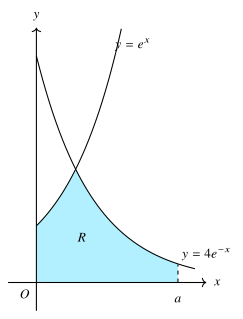
The region \(\displaystyle R\), shown shaded in Figure 4, is bounded by the curve with equation \(\displaystyle y=e^x\), the curve with equation \(\displaystyle y=4e^{-x}\), the straight line with equation \(\displaystyle x=a\), the \(\displaystyle x\)-axis and the \(\displaystyle y\)-axis.
When the region \(\displaystyle R\) is rotated through \(\displaystyle 360^{\circ}\) about the \(\displaystyle x\)-axis, the volume of the solid generated is
\(\displaystyle k-8\pi e^{-4} \)
where \(\displaystyle k\) is a constant.
Using algebraic integration, find a possible value of \(\displaystyle a\) and the exact corresponding value of \(\displaystyle k\).
\(\displaystyle \begin{aligned} & \text{Find intersection of curves: } e^x = 4e^{-x} \implies e^{2x} = 4 \implies e^x = 2 \implies x = \ln 2 \\[2mm] & \text{Volume } V = \pi \int_0^{\ln 2} (e^x)^2 \, dx + \pi \int_{\ln 2}^a (4e^{-x})^2 \, dx \\[2mm] & V = \pi \int_0^{\ln 2} e^{2x} \, dx + \pi \int_{\ln 2}^a 16e^{-2x} \, dx \\[2mm] & V = \pi \left[ \frac{1}{2} e^{2x} \right]_0^{\ln 2} + \pi \left[ -8e^{-2x} \right]_{\ln 2}^a \\[2mm] & V = \pi \left( \frac{1}{2}e^{2\ln 2} - \frac{1}{2}e^0 \right) + \pi \left( -8e^{-2a} - (-8e^{-2\ln 2}) \right) \\[2mm] & V = \pi \left( \frac{4}{2} - \frac{1}{2} \right) + \pi \left( -8e^{-2a} + 8\left(\frac{1}{4}\right) \right) \\[2mm] & V = \frac{3\pi}{2} + 2\pi - 8\pi e^{-2a} = \frac{7\pi}{2} - 8\pi e^{-2a} \\[2mm] & \text{Compare with given volume } k - 8\pi e^{-4}: \\[2mm] & 8\pi e^{-2a} = 8\pi e^{-4} \implies -2a = -4 \implies a = 2 \\[2mm] & \text{Constant } k = \frac{7\pi}{2} \end{aligned} \) -
[Source: 4PM1/01 - January 2022 - Question 11]
Given that
\(\displaystyle y=\frac{e^{4x}}{32}(8x^2-4x+1) \)
- show that \(\displaystyle \frac{dy}{dx}=x^2e^{4x}\)
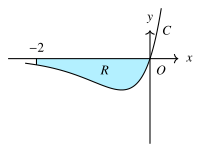
Figure 2 shows part of the curve \(\displaystyle C\) with equation \(\displaystyle y=3xe^{2x}\).
The finite region \(\displaystyle R\) bounded by \(\displaystyle C\), the straight line with equation \(\displaystyle x=-2\) and the \(\displaystyle x\)-axis, shown shaded in Figure 2, is rotated though \(\displaystyle 360^{\circ}\) about the \(\displaystyle x\)-axis.
- Using part (a), find the volume, to 2 significant figures, of the solid formed.
\(\displaystyle \begin{aligned} \textbf{(a)} \quad & y = \frac{e^{4x}}{32}(8x^2 - 4x + 1) \\[2mm] & \text{Using Product Rule:} \\[2mm] & \frac{dy}{dx} = \frac{4e^{4x}}{32}(8x^2 - 4x + 1) + \frac{e^{4x}}{32}(16x - 4) \\[2mm] & = \frac{e^{4x}}{8}(8x^2 - 4x + 1) + \frac{e^{4x}}{8}(4x - 1) \\[2mm] & = \frac{e^{4x}}{8}(8x^2 - 4x + 1 + 4x - 1) \\[2mm] & = \frac{e^{4x}}{8}(8x^2) = x^2e^{4x} \quad \text{(shown)} \\[2mm] \textbf{(b)} \quad & V = \pi \int_{-2}^0 y^2 \, dx = \pi \int_{-2}^0 (3xe^{2x})^2 \, dx \\[2mm] & V = 9\pi \int_{-2}^0 x^2e^{4x} \, dx \\[2mm] & \text{From part (a), } \int x^2e^{4x} \, dx = y = \frac{e^{4x}}{32}(8x^2 - 4x + 1) \\[2mm] & V = 9\pi \left[ \frac{e^{4x}}{32}(8x^2 - 4x + 1) \right]_{-2}^0 \\[2mm] & = 9\pi \left( \frac{e^0}{32}(0 - 0 + 1) - \frac{e^{-8}}{32}(8(4) - 4(-2) + 1) \right) \\[2mm] & = \frac{9\pi}{32} \left( 1 - 41e^{-8} \right) \\[2mm] & \approx 0.883... \implies 0.88 \text{ (to 2 s.f.)} \end{aligned} \) -
[Source: 4PM1/01R - January 2022 - Question 11]
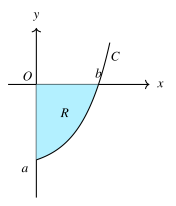
The finite region \(\displaystyle R\), shown shaded in Figure 3, is bounded by the curve with equation \(\displaystyle y=e^{2x}-9\) and the coordinate axes.
The curve crosses the coordinate axes at the points with coordinates \(\displaystyle (0, a)\) and \(\displaystyle (b, 0)\)
-
- Find the value of \(\displaystyle a\)
- Show that \(\displaystyle b=\ln 3\)
The region \(\displaystyle R\) is rotated through \(\displaystyle 360^{\circ}\) about the \(\displaystyle x\)-axis.
- Use calculus to find the volume of the solid generated. Give your answer in the form \(\displaystyle \pi(p\ln 3 + q)\), where \(\displaystyle p\) and \(\displaystyle q\) are integers.
\(\displaystyle \begin{aligned} \textbf{(a)(i)} \quad & \text{For } y\text{-intercept, let } x = 0: \\[2mm] & a = e^{2(0)} - 9 = 1 - 9 = -8 \\[2mm] \textbf{(a)(ii)} \quad & \text{For } x\text{-intercept, let } y = 0: \\[2mm] & 0 = e^{2b} - 9 \implies e^{2b} = 9 \\[2mm] & 2b = \ln 9 = \ln(3^2) = 2\ln 3 \implies b = \ln 3 \quad \text{(shown)} \\[2mm] \textbf{(b)} \quad & V = \pi \int_0^{\ln 3} y^2 \, dx = \pi \int_0^{\ln 3} (e^{2x} - 9)^2 \, dx \\[2mm] & V = \pi \int_0^{\ln 3} (e^{4x} - 18e^{2x} + 81) \, dx \\[2mm] & V = \pi \left[ \frac{1}{4}e^{4x} - 9e^{2x} + 81x \right]_0^{\ln 3} \\[2mm] & = \pi \left( \left(\frac{1}{4}e^{4\ln 3} - 9e^{2\ln 3} + 81\ln 3\right) - \left(\frac{1}{4}e^0 - 9e^0 + 0\right) \right) \\[2mm] & = \pi \left( \left(\frac{1}{4}(81) - 9(9) + 81\ln 3\right) - \left(\frac{1}{4} - 9\right) \right) \\[2mm] & = \pi \left( \frac{81}{4} - 81 + 81\ln 3 - \frac{1}{4} + 9 \right) \\[2mm] & = \pi \left( \frac{80}{4} - 72 + 81\ln 3 \right) = \pi(20 - 72 + 81\ln 3) \\[2mm] & = \pi(81\ln 3 - 52) \quad \text{where } p=81, q=-52 \end{aligned} \) -
-
[Source: 4PM1/02 - January 2022 - Question 10]
The curve \(\displaystyle C\) has equation \(\displaystyle y=\frac{2x-1}{x+4}\)
- Find \(\displaystyle \frac{dy}{dx}\)
- Write down an equation of the asymptote to \(\displaystyle C\) which is parallel to the
- \(\displaystyle x\)-axis
- \(\displaystyle y\)-axis
The line with equation \(\displaystyle y=x+k_1\) is the tangent to \(\displaystyle C\) at the point \(\displaystyle P\). The line with equation \(\displaystyle y=x+k_2\) is the tangent to \(\displaystyle C\) at the point \(\displaystyle Q\).
Given that the \(\displaystyle x\) coordinate of \(\displaystyle P\) is greater than the \(\displaystyle x\) coordinate of \(\displaystyle Q\)
- using calculus, find the coordinates of
- \(\displaystyle P\)
- \(\displaystyle Q\)
- Hence find the value of
- \(\displaystyle k_1\)
- \(\displaystyle k_2\)
\(\displaystyle \begin{aligned} \textbf{(a)} \quad & \text{Using Quotient Rule: } u = 2x - 1, v = x + 4 \\[2mm] & \frac{dy}{dx} = \frac{2(x+4) - (2x-1)(1)}{(x+4)^2} = \frac{2x + 8 - 2x + 1}{(x+4)^2} = \frac{9}{(x+4)^2} \\[2mm] \textbf{(b)(i)} \quad & \text{Parallel to } x\text{-axis (Horizontal Asymptote): as } x \to \pm\infty, y \to 2 \implies y = 2 \\[2mm] \textbf{(b)(ii)} \quad & \text{Parallel to } y\text{-axis (Vertical Asymptote): denominator } = 0 \implies x = -4 \\[2mm] \textbf{(c)} \quad & \text{The lines } y = x + k_1 \text{ and } y = x + k_2 \text{ have gradient } m = 1. \\[2mm] & \frac{9}{(x+4)^2} = 1 \implies (x+4)^2 = 9 \implies x+4 = \pm 3 \\[2mm] & x = -1 \text{ or } x = -7 \\[2mm] & \text{Since } x_P > x_Q, x_P = -1 \text{ and } x_Q = -7. \\[2mm] & \text{For } P: \quad y = \frac{2(-1)-1}{-1+4} = \frac{-3}{3} = -1 \implies P(-1, -1) \\[2mm] & \text{For } Q: \quad y = \frac{2(-7)-1}{-7+4} = \frac{-15}{-3} = 5 \implies Q(-7, 5) \\[2mm] \textbf{(d)(i)} \quad & P(-1, -1) \text{ lies on } y = x + k_1: \\[2mm] & -1 = -1 + k_1 \implies k_1 = 0 \\[2mm] \textbf{(d)(ii)} \quad & Q(-7, 5) \text{ lies on } y = x + k_2: \\[2mm] & 5 = -7 + k_2 \implies k_2 = 12 \end{aligned} \) -
[Source: 4PM1/02R - January 2022 - Question 3]
Differentiate with respect to \(\displaystyle x\)
- \(\displaystyle e^{2x}\sqrt{5x-3}\)
- \(\displaystyle \frac{x^3}{\cos 3x}\)
\(\displaystyle \begin{aligned} \textbf{(a)} \quad & \text{Let } y = e^{2x}(5x-3)^{1/2}. \text{ Using Product Rule:} \\[2mm] & \frac{dy}{dx} = 2e^{2x}(5x-3)^{1/2} + e^{2x} \left[ \frac{1}{2}(5x-3)^{-1/2}(5) \right] \\[2mm] & = 2e^{2x}\sqrt{5x-3} + \frac{5e^{2x}}{2\sqrt{5x-3}} \\[2mm] & = \frac{4e^{2x}(5x-3) + 5e^{2x}}{2\sqrt{5x-3}} = \frac{e^{2x}(20x - 12 + 5)}{2\sqrt{5x-3}} = \frac{e^{2x}(20x - 7)}{2\sqrt{5x-3}} \\[2mm] \textbf{(b)} \quad & \text{Let } y = \frac{x^3}{\cos 3x}. \text{ Using Quotient Rule:} \\[2mm] & u = x^3 \implies u' = 3x^2 \\[2mm] & v = \cos 3x \implies v' = -3\sin 3x \\[2mm] & \frac{dy}{dx} = \frac{3x^2\cos 3x - x^3(-3\sin 3x)}{(\cos 3x)^2} = \frac{3x^2\cos 3x + 3x^3\sin 3x}{\cos^2 3x} \end{aligned} \) -
[Source: 4PM1/02 - June 2022 - Question 11]
A curve \(\displaystyle C\) has equation
\(\displaystyle y=\frac{(2a-1)x+1}{ax-6} \)
where \(\displaystyle a\) is a constant and \(\displaystyle x\ne\frac{6}{a}\)
- Find \(\displaystyle \frac{dy}{dx}\)
The curve crosses the \(\displaystyle y\)-axis at the point \(\displaystyle A\). The normal to \(\displaystyle C\) at the point \(\displaystyle A\) is the line \(\displaystyle l\) with equation \(\displaystyle 66y-72x+11=0\).
Show that
-
- \(\displaystyle a=3\)
- the equation of \(\displaystyle C\) is \(\displaystyle y=\frac{5x+1}{3x-6}\) where \(\displaystyle x\ne 2\)
- Sketch \(\displaystyle C\), showing clearly the asymptotes with their equations and the coordinates of the points where \(\displaystyle C\) crosses the coordinate axes.
The line \(\displaystyle l\) meets \(\displaystyle C\) again at the point \(\displaystyle D\).
- Find the \(\displaystyle x\) coordinate of \(\displaystyle D\). Give your answer as an improper fraction.
\(\displaystyle \begin{aligned} \textbf{(a)} \quad & \frac{dy}{dx} = \frac{(2a-1)(ax-6) - a((2a-1)x+1)}{(ax-6)^2} \\[2mm] & = \frac{2a^2x - 12a - ax + 6 - 2a^2x + ax - a}{(ax-6)^2} = \frac{-13a+6}{(ax-6)^2} \\[2mm] \textbf{(b)(i)} \quad & \text{At } A \text{ (y-intercept): } x=0 \implies y = \frac{1}{-6}. \text{ Point } A\left(0, -\frac{1}{6}\right). \\[2mm] & \text{Normal } l: 66y = 72x - 11 \implies y = \frac{12}{11}x - \frac{1}{6}. \quad m_N = \frac{12}{11} \\[2mm] & \text{Gradient of tangent } m_T = -\frac{11}{12}. \\[2mm] & \text{At } x=0: \quad \frac{dy}{dx} = \frac{-13a+6}{36} \\[2mm] & \frac{-13a+6}{36} = -\frac{11}{12} \implies -13a + 6 = -33 \implies 13a = 39 \implies a = 3 \quad \text{(shown)} \\[2mm] \textbf{(b)(ii)} \quad & \text{Substitute } a=3 \text{ into } C: \quad y = \frac{(6-1)x+1}{3x-6} = \frac{5x+1}{3x-6} \quad \text{(shown)} \\[2mm] \textbf{(c)} \quad & \text{(Graph sketching details)} \\[2mm] & \text{Vertical Asymptote: } 3x-6 = 0 \implies x = 2 \\[2mm] & \text{Horizontal Asymptote: as } x \to \pm\infty, y \to \frac{5}{3} \implies y = \frac{5}{3} \\[2mm] & x\text{-intercept: } 5x+1 = 0 \implies x = -\frac{1}{5} \implies \left(-\frac{1}{5}, 0\right) \\[2mm] & y\text{-intercept: } A\left(0, -\frac{1}{6}\right) \\[2mm] \textbf{(d)} \quad & \text{Intersection of } l \text{ and } C: \\[2mm] & \frac{12}{11}x - \frac{1}{6} = \frac{5x+1}{3(x-2)} \implies \frac{72x-11}{66} = \frac{5x+1}{3(x-2)} \\[2mm] & (72x-11)(x-2) = 22(5x+1) \\[2mm] & 72x^2 - 144x - 11x + 22 = 110x + 22 \\[2mm] & 72x^2 - 155x = 110x \implies 72x^2 - 265x = 0 \\[2mm] & x(72x - 265) = 0 \implies x = 0 \text{ (Point } A\text{) or } x = \frac{265}{72} \text{ (Point } D\text{)} \end{aligned} \) -
[Source: 4PM1/02R - June 2022 - Question 11]
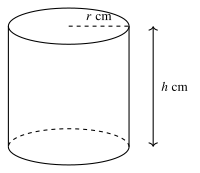
Figure 3 shows a solid metal right circular cylinder of radius \(\displaystyle r\) cm and height \(\displaystyle h\) cm.
The total surface area of the cylinder is \(\displaystyle 600\text{ cm}^2\). The volume of the cylinder is \(\displaystyle V\text{ cm}^3\).
- Show that \(\displaystyle V=300r-\pi r^3\)
Given that \(\displaystyle r\) can vary,
-
- use calculus to show that the exact value of \(\displaystyle r\) for which \(\displaystyle V\) is a maximum is \(\displaystyle r=\sqrt{\frac{100}{\pi}}\)
- justify that this value of \(\displaystyle r\) gives a maximum value of \(\displaystyle V\)
The cylinder is melted down and reformed into a sphere of radius \(\displaystyle p\) cm.
- Find, to one decimal place, the greatest possible value of \(\displaystyle p\).
\(\displaystyle \begin{aligned} \textbf{(a)} \quad & \text{Total Surface Area } S = 2\pi r^2 + 2\pi rh = 600 \\[2mm] & \pi r^2 + \pi rh = 300 \implies \pi rh = 300 - \pi r^2 \\[2mm] & \text{Volume } V = \pi r^2 h = r(\pi rh) = r(300 - \pi r^2) = 300r - \pi r^3 \quad \text{(shown)} \\[2mm] \textbf{(b)(i)} \quad & \frac{dV}{dr} = 300 - 3\pi r^2 = 0 \\[2mm] & 3\pi r^2 = 300 \implies r^2 = \frac{100}{\pi} \implies r = \sqrt{\frac{100}{\pi}} \quad \text{(shown)} \\[2mm] \textbf{(b)(ii)} \quad & \frac{d^2V}{dr^2} = -6\pi r \\[2mm] & \text{Since } r > 0, \frac{d^2V}{dr^2} < 0 \therefore \text{ it is a maximum.} \\[2mm] \textbf{(c)} \quad & \text{Max Volume } V = 300\left(\sqrt{\frac{100}{\pi}}\right) - \pi\left(\sqrt{\frac{100}{\pi}}\right)^3 = \frac{3000}{\sqrt{\pi}} - \pi\left(\frac{1000}{\pi\sqrt{\pi}}\right) = \frac{2000}{\sqrt{\pi}} \\[2mm] & \text{Volume of sphere } = \frac{4}{3}\pi p^3 = \frac{2000}{\sqrt{\pi}} \\[2mm] & p^3 = \frac{1500}{\pi\sqrt{\pi}} \implies p = \left( \frac{1500}{\pi^{1.5}} \right)^{1/3} \approx 6.463... \implies 6.5 \text{ cm (to 1 d.p.)} \end{aligned} \) -
[Source: 4PM1/01 - June 2022 - Question 9]
A particle \(\displaystyle P\) is moving along the \(\displaystyle x\)-axis. At time \(\displaystyle t\) seconds (\(\displaystyle t \ge 0\)), the velocity, \(\displaystyle v\) m/s, of \(\displaystyle P\) is given by
\(\displaystyle v = 2t^2 - 10t + 8 \)
- Find the acceleration of \(\displaystyle P\) when \(\displaystyle t=4\).
- Find the times when \(\displaystyle P\) is instantaneously at rest.
When \(\displaystyle t=0\), \(\displaystyle P\) is at the origin \(\displaystyle O\).
- Find the total distance travelled by \(\displaystyle P\) in the first \(\displaystyle 5\) seconds of its motion.
\(\displaystyle \begin{aligned} \textbf{(a)} \quad & a = \frac{dv}{dt} = 4t - 10 \\[2mm] & \text{At } t = 4: \quad a = 4(4) - 10 = 6 \text{ m/s}^2 \\[2mm] \textbf{(b)} \quad & \text{At rest, } v = 0: \\[2mm] & 2t^2 - 10t + 8 = 0 \implies t^2 - 5t + 4 = 0 \\[2mm] & (t-1)(t-4) = 0 \implies t = 1, t = 4 \text{ seconds.} \\[2mm] \textbf{(c)} \quad & s = \int (2t^2 - 10t + 8) \, dt = \frac{2}{3}t^3 - 5t^2 + 8t + C \\[2mm] & \text{At } t = 0, s = 0 \implies C = 0 \implies s(t) = \frac{2}{3}t^3 - 5t^2 + 8t \\[2mm] & \text{Evaluate at turning points and boundaries:} \\[2mm] & s(0) = 0 \\[2mm] & s(1) = \frac{2}{3} - 5 + 8 = \frac{11}{3} \\[2mm] & s(4) = \frac{2(64)}{3} - 5(16) + 8(4) = \frac{128}{3} - 80 + 32 = \frac{128}{3} - 48 = -\frac{16}{3} \\[2mm] & s(5) = \frac{2(125)}{3} - 5(25) + 8(5) = \frac{250}{3} - 125 + 40 = \frac{250}{3} - 85 = -\frac{5}{3} \\[2mm] & \text{Total Distance } = |s(1) - s(0)| + |s(4) - s(1)| + |s(5) - s(4)| \\[2mm] & = \left| \frac{11}{3} - 0 \right| + \left| -\frac{16}{3} - \frac{11}{3} \right| + \left| -\frac{5}{3} - \left(-\frac{16}{3}\right) \right| \\[2mm] & = \frac{11}{3} + \frac{27}{3} + \frac{11}{3} = \frac{49}{3} \text{ m} \end{aligned} \) -
[Source: 4PM1/01R - June 2022 - Question 10]
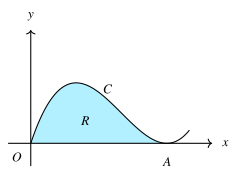
The figure shows part of the curve \(\displaystyle C\) with equation \(\displaystyle y = \frac{1}{3}x(x-3)^2\).
The curve \(\displaystyle C\) passes through the origin \(\displaystyle O\) and touches the \(\displaystyle x\)-axis at the point \(\displaystyle A\).
- Write down the coordinates of \(\displaystyle A\).
- Find \(\displaystyle \frac{dy}{dx}\)
- Find the coordinates of the local maximum turning point of \(\displaystyle C\).
The finite region \(\displaystyle R\), shown shaded in the figure, is bounded by \(\displaystyle C\) and the \(\displaystyle x\)-axis.
- Use algebraic integration to find the exact area of \(\displaystyle R\).
\(\displaystyle \begin{aligned} \textbf{(a)} \quad & \text{Curve touches } x\text{-axis when } (x-3)^2 = 0 \implies x = 3. \therefore A(3, 0) \\[2mm] \textbf{(b)} \quad & y = \frac{1}{3}x(x^2 - 6x + 9) = \frac{1}{3}x^3 - 2x^2 + 3x \\[2mm] & \frac{dy}{dx} = x^2 - 4x + 3 \\[2mm] \textbf{(c)} \quad & \text{Turning points: } x^2 - 4x + 3 = 0 \implies (x-1)(x-3) = 0 \implies x = 1, x = 3 \\[2mm] & \text{Local max is at } x = 1. \quad y = \frac{1}{3}(1)(1-3)^2 = \frac{4}{3}. \quad \text{Point is } \left(1, \frac{4}{3}\right) \\[2mm] \textbf{(d)} \quad & \text{Area } R = \int_0^3 \left(\frac{1}{3}x^3 - 2x^2 + 3x\right) \, dx \\[2mm] & = \left[ \frac{1}{12}x^4 - \frac{2}{3}x^3 + \frac{3}{2}x^2 \right]_0^3 \\[2mm] & = \left( \frac{81}{12} - \frac{2(27)}{3} + \frac{3(9)}{2} \right) - 0 \\[2mm] & = \frac{27}{4} - 18 + \frac{27}{2} = \frac{27 - 72 + 54}{4} = \frac{9}{4} \end{aligned} \) -
[Source: 4PM1/01 - November 2022 - Question 8]
A particle \(\displaystyle P\) is moving along the \(\displaystyle x\)-axis. At time \(\displaystyle t\) seconds (\(\displaystyle t \ge 0\)), the velocity, \(\displaystyle v\) m/s, of \(\displaystyle P\) is given by
\(\displaystyle v = 3t^2 - 18t + 24 \)
- Find the times when \(\displaystyle P\) is instantaneously at rest.
- Find the acceleration of \(\displaystyle P\) when \(\displaystyle t=2\).
When \(\displaystyle t=0\), \(\displaystyle P\) is at the origin \(\displaystyle O\).
- Find the total distance travelled by \(\displaystyle P\) in the first \(\displaystyle 5\) seconds of its motion.
\(\displaystyle \begin{aligned} \textbf{(a)} \quad & \text{At rest, } v = 0: \\[2mm] & 3t^2 - 18t + 24 = 0 \implies t^2 - 6t + 8 = 0 \\[2mm] & (t-2)(t-4) = 0 \implies t = 2, t = 4 \text{ seconds.} \\[2mm] \textbf{(b)} \quad & a = \frac{dv}{dt} = 6t - 18 \\[2mm] & \text{When } t = 2: \quad a = 6(2) - 18 = -6 \text{ m/s}^2 \\[2mm] \textbf{(c)} \quad & s = \int (3t^2 - 18t + 24) \, dt = t^3 - 9t^2 + 24t + C \\[2mm] & \text{When } t=0, s=0 \implies C=0 \implies s(t) = t^3 - 9t^2 + 24t \\[2mm] & \text{Evaluate at turning points and boundaries:} \\[2mm] & s(0) = 0 \\[2mm] & s(2) = 2^3 - 9(2^2) + 24(2) = 8 - 36 + 48 = 20 \\[2mm] & s(4) = 4^3 - 9(4^2) + 24(4) = 64 - 144 + 96 = 16 \\[2mm] & s(5) = 5^3 - 9(5^2) + 24(5) = 125 - 225 + 120 = 20 \\[2mm] & \text{Total Distance } = |s(2) - s(0)| + |s(4) - s(2)| + |s(5) - s(4)| \\[2mm] & = |20 - 0| + |16 - 20| + |20 - 16| \\[2mm] & = 20 + 4 + 4 = 28 \text{ m} \end{aligned} \) -
[Source: 4PM1/01R - November 2022 - Question 7]
A circular drop of oil is expanding on the surface of a pool of water. The radius of the drop of oil is increasing at a constant rate of \(\displaystyle 2 \text{ cm/s}\).
- Find the rate of increase of the area of the drop of oil, in \(\displaystyle \text{cm}^2/\text{s}\), at the instant when the radius is \(\displaystyle 5\) cm.
- Find the rate of increase of the area of the drop of oil, in \(\displaystyle \text{cm}^2/\text{s}\), at the instant when the circumference of the drop of oil is \(\displaystyle 16\pi \text{ cm}\).
\(\displaystyle \begin{aligned} \textbf{(a)} \quad & \text{Given } \frac{dr}{dt} = 2 \\[2mm] & A = \pi r^2 \implies \frac{dA}{dr} = 2\pi r \\[2mm] & \frac{dA}{dt} = \frac{dA}{dr} \times \frac{dr}{dt} = 2\pi r(2) = 4\pi r \\[2mm] & \text{When } r = 5: \quad \frac{dA}{dt} = 4\pi(5) = 20\pi \text{ cm}^2/\text{s} \\[2mm] \textbf{(b)} \quad & \text{Circumference } C = 2\pi r = 16\pi \implies r = 8 \\[2mm] & \text{When } r = 8: \quad \frac{dA}{dt} = 4\pi(8) = 32\pi \text{ cm}^2/\text{s} \end{aligned} \) -
[Source: 4PM1/02 - November 2022 - Question 9]
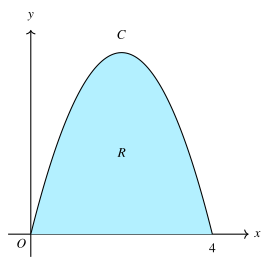
The figure shows part of the curve \(\displaystyle C\) with equation \(\displaystyle y = 4x - x^2\). The finite region \(\displaystyle R\), shown shaded in the figure, is bounded by \(\displaystyle C\) and the \(\displaystyle x\)-axis.
- Use calculus to find the exact area of \(\displaystyle R\).
The region \(\displaystyle R\) is rotated through \(\displaystyle 360^{\circ}\) about the \(\displaystyle x\)-axis to form a solid.
- Find the exact volume of the solid generated.
\(\displaystyle \begin{aligned} \textbf{(a)} \quad & \text{Curve meets } x\text{-axis when } 4x - x^2 = 0 \implies x(4-x) = 0 \implies x = 0, 4 \\[2mm] & \text{Area } = \int_0^4 (4x - x^2) \, dx = \left[ 2x^2 - \frac{x^3}{3} \right]_0^4 \\[2mm] & = \left( 2(16) - \frac{64}{3} \right) - 0 = 32 - \frac{64}{3} = \frac{96 - 64}{3} = \frac{32}{3} \\[2mm] \textbf{(b)} \quad & V = \pi \int_0^4 (4x - x^2)^2 \, dx = \pi \int_0^4 (16x^2 - 8x^3 + x^4) \, dx \\[2mm] & V = \pi \left[ \frac{16x^3}{3} - 2x^4 + \frac{x^5}{5} \right]_0^4 \\[2mm] & = \pi \left( \frac{16(64)}{3} - 2(256) + \frac{1024}{5} \right) = \pi \left( \frac{1024}{3} - 512 + \frac{1024}{5} \right) \\[2mm] & = \pi \left( \frac{5120 - 7680 + 3072}{15} \right) = \frac{512\pi}{15} \end{aligned} \) -
[Source: 4PM1/02R - November 2022 - Question 10]
A piece of wire of length \(\displaystyle 40\) cm is bent to form the perimeter of a sector of a circle of radius \(\displaystyle r\) cm.
- Show that the area, \(\displaystyle A \text{ cm}^2\), of the sector is given by \(\displaystyle A = 20r - r^2\).
Given that \(\displaystyle r\) can vary,
- use calculus to find the maximum area of the sector.
- Justify that the area you have found is a maximum.
\(\displaystyle \begin{aligned} \textbf{(a)} \quad & \text{Perimeter } P = 2r + r\theta = 40 \implies r\theta = 40 - 2r \\[2mm] & \text{Area } A = \frac{1}{2} r^2 \theta = \frac{1}{2} r(r\theta) \\[2mm] & A = \frac{1}{2} r(40 - 2r) = 20r - r^2 \quad \text{(shown)} \\[2mm] \textbf{(b)} \quad & \frac{dA}{dr} = 20 - 2r = 0 \implies 2r = 20 \implies r = 10 \\[2mm] & \text{Max Area } = 20(10) - 10^2 = 200 - 100 = 100 \text{ cm}^2 \\[2mm] \textbf{(c)} \quad & \frac{d^2A}{dr^2} = -2 \\[2mm] & \text{Since } \frac{d^2A}{dr^2} < 0, \text{ the area is a maximum.} \end{aligned} \) -
[Source: 4PM1/01 - January 2023 - Question 8]
A solid right circular cylinder has radius \(\displaystyle r\) cm and height \(\displaystyle h\) cm. The volume of the cylinder is \(\displaystyle 1000 \text{ cm}^3\).
The total surface area of the cylinder is \(\displaystyle S \text{ cm}^2\).
- Show that \(\displaystyle S = 2\pi r^2 + \frac{2000}{r}\)
Given that \(\displaystyle r\) can vary,
- use calculus to find the minimum value of \(\displaystyle S\).
- Justify that your value of \(\displaystyle S\) is a minimum.
\(\displaystyle \begin{aligned} \textbf{(a)} \quad & V = \pi r^2 h = 1000 \implies h = \frac{1000}{\pi r^2} \\[2mm] & S = 2\pi r^2 + 2\pi rh = 2\pi r^2 + 2\pi r \left( \frac{1000}{\pi r^2} \right) \\[2mm] & S = 2\pi r^2 + \frac{2000}{r} \quad \text{(shown)} \\[2mm] \textbf{(b)} \quad & \frac{dS}{dr} = 4\pi r - \frac{2000}{r^2} = 0 \implies 4\pi r = \frac{2000}{r^2} \\[2mm] & r^3 = \frac{500}{\pi} \implies r = \left(\frac{500}{\pi}\right)^{1/3} \approx 5.419 \\[2mm] & S_{\text{min}} = 2\pi(5.419)^2 + \frac{2000}{5.419} \approx 554 \text{ cm}^2 \\[2mm] \textbf{(c)} \quad & \frac{d^2S}{dr^2} = 4\pi + \frac{4000}{r^3} \\[2mm] & \text{Since } r > 0, \frac{d^2S}{dr^2} > 0 \therefore \text{ it is a minimum.} \end{aligned} \) -
[Source: 4PM1/01R - January 2023 - Question 9]
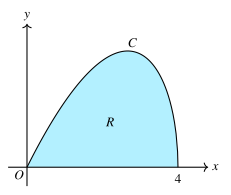
The figure shows part of the curve \(\displaystyle C\) with equation \(\displaystyle y = x\sqrt{4-x}\) for \(\displaystyle 0 \le x \le 4\). The finite region \(\displaystyle R\), shown shaded in the figure, is bounded by \(\displaystyle C\) and the \(\displaystyle x\)-axis.
The region \(\displaystyle R\) is rotated through \(\displaystyle 360^{\circ}\) about the \(\displaystyle x\)-axis to form a solid.
- Use algebraic integration to find the exact volume of the solid generated.
Using the substitution \(\displaystyle u = 4 - x\),
- find the exact area of \(\displaystyle R\).
\(\displaystyle \begin{aligned} \textbf{(a)} \quad & V = \pi \int_0^4 y^2 \, dx = \pi \int_0^4 \left(x\sqrt{4-x}\right)^2 \, dx \\[2mm] & V = \pi \int_0^4 x^2(4-x) \, dx = \pi \int_0^4 (4x^2 - x^3) \, dx \\[2mm] & V = \pi \left[ \frac{4x^3}{3} - \frac{x^4}{4} \right]_0^4 = \pi \left( \frac{4(64)}{3} - \frac{256}{4} \right) = \pi \left( \frac{256}{3} - 64 \right) \\[2mm] & V = \pi \left( \frac{256 - 192}{3} \right) = \frac{64\pi}{3} \\[2mm] \textbf{(b)} \quad & \text{Let } u = 4 - x \implies dx = -du. \text{ When } x=0, u=4. \text{ When } x=4, u=0. \\[2mm] & x = 4 - u. \\[2mm] & \text{Area } = \int_0^4 x\sqrt{4-x} \, dx = \int_4^0 (4-u)\sqrt{u} \, (-du) = \int_0^4 (4-u)u^{1/2} \, du \\[2mm] & = \int_0^4 (4u^{1/2} - u^{3/2}) \, du = \left[ 4\left(\frac{2}{3}u^{3/2}\right) - \frac{2}{5}u^{5/2} \right]_0^4 \\[2mm] & = \left[ \frac{8}{3}u^{3/2} - \frac{2}{5}u^{5/2} \right]_0^4 = \left( \frac{8}{3}(8) - \frac{2}{5}(32) \right) - 0 \\[2mm] & = \frac{64}{3} - \frac{64}{5} = \frac{320 - 192}{15} = \frac{128}{15} \end{aligned} \) -
[Source: 4PM1/02 - January 2023 - Question 10]
A particle \(\displaystyle P\) is moving along the \(\displaystyle x\)-axis. At time \(\displaystyle t\) seconds, \(\displaystyle t \ge 0\), the displacement, \(\displaystyle x\) metres, of \(\displaystyle P\) from the origin \(\displaystyle O\) is given by
\(\displaystyle x = t^3 - 6t^2 + 9t + 2 \)
- Find the velocity of \(\displaystyle P\) when \(\displaystyle t = 4\).
- Find the times when \(\displaystyle P\) is instantaneously at rest.
- Find the acceleration of \(\displaystyle P\) at the instant when \(\displaystyle P\) is first at rest.
- Find the total distance travelled by \(\displaystyle P\) in the first \(\displaystyle 4\) seconds.
\(\displaystyle \begin{aligned} \textbf{(a)} \quad & v = \frac{dx}{dt} = 3t^2 - 12t + 9 \\[2mm] & \text{When } t=4: \quad v = 3(16) - 12(4) + 9 = 48 - 48 + 9 = 9 \text{ m/s} \\[2mm] \textbf{(b)} \quad & \text{At rest, } v = 0: \quad 3t^2 - 12t + 9 = 0 \implies t^2 - 4t + 3 = 0 \\[2mm] & (t-1)(t-3) = 0 \implies t = 1, t = 3 \text{ seconds.} \\[2mm] \textbf{(c)} \quad & a = \frac{dv}{dt} = 6t - 12 \\[2mm] & \text{First at rest when } t=1: \quad a = 6(1) - 12 = -6 \text{ m/s}^2 \\[2mm] \textbf{(d)} \quad & x(0) = 2 \\[2mm] & x(1) = 1 - 6 + 9 + 2 = 6 \\[2mm] & x(3) = 27 - 54 + 27 + 2 = 2 \\[2mm] & x(4) = 64 - 96 + 36 + 2 = 6 \\[2mm] & \text{Total Distance } = |x(1)-x(0)| + |x(3)-x(1)| + |x(4)-x(3)| \\[2mm] & = |6-2| + |2-6| + |6-2| = 4 + 4 + 4 = 12 \text{ m} \end{aligned} \) -
[Source: 4PM1/02 - January 2023 - Question 11]
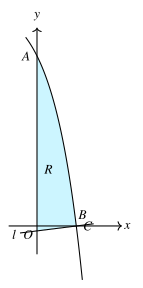
Figure 3 shows part of the curve \(\displaystyle C\) with equation \(\displaystyle y=4-e^{2x}\).
The curve \(\displaystyle C\) crosses the \(\displaystyle y\)-axis at the point \(\displaystyle A\) and the \(\displaystyle x\)-axis at the point \(\displaystyle B\).
-
- Write down the \(\displaystyle y\) coordinate of point \(\displaystyle A\).
- Show that the \(\displaystyle x\) coordinate of \(\displaystyle B\) is \(\displaystyle x=\ln 2\).
The line \(\displaystyle l\) is the normal to \(\displaystyle C\) at the point \(\displaystyle B\).
- Find an equation for \(\displaystyle l\), giving your answer in the form \(\displaystyle y=mx+c\)
The finite region \(\displaystyle R\) is bounded by \(\displaystyle C\), \(\displaystyle l\) and the \(\displaystyle y\)-axis.
- Using calculus, find the area of \(\displaystyle R\). Give your answer to one decimal place.
\(\displaystyle \begin{aligned} \textbf{(a)(i)} \quad & \text{At } A, x=0: \quad y = 4 - e^0 = 4 - 1 = 3. \\[2mm] \textbf{(a)(ii)} \quad & \text{At } B, y=0: \quad 4 - e^{2x} = 0 \implies e^{2x} = 4 \\[2mm] & 2x = \ln 4 = \ln(2^2) = 2\ln 2 \implies x = \ln 2 \quad \text{(shown)} \\[2mm] \textbf{(b)} \quad & \frac{dy}{dx} = -2e^{2x} \\[2mm] & \text{At } x = \ln 2, m_T = -2e^{2\ln 2} = -2(4) = -8 \\[2mm] & \text{Gradient of normal } m_N = \frac{1}{8} \\[2mm] & \text{Equation of } l: \quad y - 0 = \frac{1}{8}(x - \ln 2) \implies y = \frac{1}{8}x - \frac{1}{8}\ln 2 \\[2mm] \textbf{(c)} \quad & \text{Area } = \int_0^{\ln 2} (y_C - y_l) \, dx = \int_0^{\ln 2} \left( 4 - e^{2x} - \left(\frac{1}{8}x - \frac{1}{8}\ln 2\right) \right) \, dx \\[2mm] & = \left[ 4x - \frac{1}{2}e^{2x} - \frac{1}{16}x^2 + \left(\frac{\ln 2}{8}\right)x \right]_0^{\ln 2} \\[2mm] & = \left( 4\ln 2 - \frac{1}{2}e^{2\ln 2} - \frac{1}{16}(\ln 2)^2 + \frac{(\ln 2)^2}{8} \right) - \left( 0 - \frac{1}{2}e^0 - 0 + 0 \right) \\[2mm] & = 4\ln 2 - 2 + \frac{(\ln 2)^2}{16} + \frac{1}{2} = 4\ln 2 - 1.5 + \frac{(\ln 2)^2}{16} \\[2mm] & = 4(0.6931...) - 1.5 + \frac{(0.6931...)^2}{16} \approx 2.7725 - 1.5 + 0.0300 \approx 1.302 \\[2mm] & \approx 1.3 \text{ (to 1 d.p.)} \end{aligned} \) -
-
[Source: 4PM1/02R - January 2023 - Question 8]
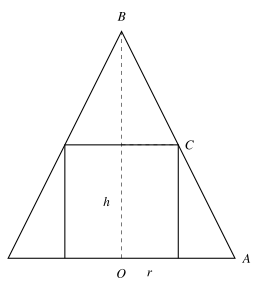
The figure shows a cross-section of a solid cylinder inscribed in a hollow right circular cone. The cone has base radius \(\displaystyle 12\) cm and height \(\displaystyle 24\) cm. The cylinder has radius \(\displaystyle r\) cm and height \(\displaystyle h\) cm.
- By using similar triangles, show that \(\displaystyle h = 24 - 2r\).
The volume of the cylinder is \(\displaystyle V \text{ cm}^3\).
- Show that \(\displaystyle V = 24\pi r^2 - 2\pi r^3\).
- Use calculus to find the maximum volume of the cylinder.
- Justify that your volume is a maximum.
\(\displaystyle \begin{aligned} \textbf{(a)} \quad & \text{Using similar triangles, the large half-triangle has height 24 and base 12.} \\[2mm] & \text{The small triangle above the cylinder has height } (24-h) \text{ and base } r. \\[2mm] & \frac{24-h}{r} = \frac{24}{12} \implies \frac{24-h}{r} = 2 \\[2mm] & 24 - h = 2r \implies h = 24 - 2r \quad \text{(shown)} \\[2mm] \textbf{(b)} \quad & V = \pi r^2 h = \pi r^2 (24 - 2r) = 24\pi r^2 - 2\pi r^3 \quad \text{(shown)} \\[2mm] \textbf{(c)} \quad & \frac{dV}{dr} = 48\pi r - 6\pi r^2 = 0 \implies 6\pi r(8 - r) = 0 \\[2mm] & \text{Since } r > 0, r = 8. \\[2mm] & V_{\text{max}} = 24\pi(8^2) - 2\pi(8^3) = 1536\pi - 1024\pi = 512\pi \text{ cm}^3 \\[2mm] \textbf{(d)} \quad & \frac{d^2V}{dr^2} = 48\pi - 12\pi r \\[2mm] & \text{When } r = 8: \quad \frac{d^2V}{dr^2} = 48\pi - 96\pi = -48\pi \\[2mm] & \text{Since } \frac{d^2V}{dr^2} < 0, \text{ the volume is a maximum.} \end{aligned} \) -
[Source: 4PM1/02R - January 2023 - Question 11]
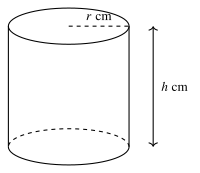
Figure 5 shows an open container in the shape of a cylinder with radius \(\displaystyle r\) cm and height \(\displaystyle h\) cm. Given that the total surface area of the container is \(\displaystyle 625\pi \text{ cm}^2\)
- show that \(\displaystyle h=\frac{625-r^2}{2r}\)
The volume of the container is \(\displaystyle V \text{ cm}^3\). Given that \(\displaystyle r\) can vary,
- use calculus to find the value, to 3 significant figures, of \(\displaystyle r\) for which \(\displaystyle V\) is a maximum. Justify that this value of \(\displaystyle r\) gives a maximum value of \(\displaystyle V\)
- For the value of \(\displaystyle r\) found in part (b), find the corresponding value, to 3 significant figures, of \(\displaystyle h\)
\(\displaystyle \begin{aligned} \textbf{(a)} \quad & \text{For an open cylinder, } S = \pi r^2 + 2\pi rh = 625\pi \\[2mm] & r^2 + 2rh = 625 \implies 2rh = 625 - r^2 \\[2mm] & h = \frac{625 - r^2}{2r} \quad \text{(shown)} \\[2mm] \textbf{(b)} \quad & V = \pi r^2 h = \pi r^2 \left(\frac{625 - r^2}{2r}\right) = \frac{\pi}{2}r(625 - r^2) = \frac{625\pi}{2}r - \frac{\pi}{2}r^3 \\[2mm] & \frac{dV}{dr} = \frac{625\pi}{2} - \frac{3\pi}{2}r^2 = 0 \implies 3r^2 = 625 \\[2mm] & r^2 = \frac{625}{3} \implies r = \frac{25}{\sqrt{3}} \approx 14.43... \implies r = 14.4 \text{ (to 3 s.f.)} \\[2mm] & \frac{d^2V}{dr^2} = -3\pi r. \text{ Since } r > 0, \frac{d^2V}{dr^2} < 0 \therefore \text{ it is a maximum.} \\[2mm] \textbf{(c)} \quad & h = \frac{625 - 625/3}{2(25/\sqrt{3})} = \frac{1250/3}{50/\sqrt{3}} = \frac{1250\sqrt{3}}{150} = \frac{25}{\sqrt{3}} \approx 14.43... \implies 14.4 \text{ (to 3 s.f.)} \end{aligned} \) -
[Source: 4PM1/01 - June 2023 - Question 10]
The curve \(\displaystyle C\) has equation \(\displaystyle y = \frac{3x+2}{x-2}\) where \(\displaystyle x \ne 2\).
- Find \(\displaystyle \frac{dy}{dx}\)
- Find the equation of the normal to \(\displaystyle C\) at the point where \(\displaystyle x = 3\).
The normal to \(\displaystyle C\) at the point where \(\displaystyle x = 3\) intersects the \(\displaystyle x\)-axis at the point \(\displaystyle P\) and the \(\displaystyle y\)-axis at the point \(\displaystyle Q\).
- Find the exact area of triangle \(\displaystyle OPQ\), where \(\displaystyle O\) is the origin.
\(\displaystyle \begin{aligned} \textbf{(a)} \quad & \text{Let } u = 3x+2, v = x-2. \text{ Using Quotient Rule:} \\[2mm] & \frac{dy}{dx} = \frac{3(x-2) - 1(3x+2)}{(x-2)^2} = \frac{3x - 6 - 3x - 2}{(x-2)^2} = \frac{-8}{(x-2)^2} \\[2mm] \textbf{(b)} \quad & \text{At } x = 3: \quad y = \frac{3(3)+2}{3-2} = 11. \quad \text{Point is } (3, 11). \\[2mm] & \text{Gradient of tangent } m_T = \frac{-8}{(3-2)^2} = -8 \\[2mm] & \text{Gradient of normal } m_N = -\frac{1}{-8} = \frac{1}{8} \\[2mm] & \text{Equation of normal: } y - 11 = \frac{1}{8}(x - 3) \\[2mm] & 8y - 88 = x - 3 \implies x - 8y + 85 = 0 \\[2mm] \textbf{(c)} \quad & \text{For point } P \text{ (x-intercept), let } y = 0: \\[2mm] & x - 0 + 85 = 0 \implies x = -85 \implies P(-85, 0) \\[2mm] & \text{For point } Q \text{ (y-intercept), let } x = 0: \\[2mm] & 0 - 8y + 85 = 0 \implies y = \frac{85}{8} \implies Q\left(0, \frac{85}{8}\right) \\[2mm] & \text{Area of } \triangle OPQ = \frac{1}{2} \times \text{base} \times \text{height} = \frac{1}{2} \times 85 \times \frac{85}{8} = \frac{7225}{16} \end{aligned} \) -
[Source: 4PM1/01R - June 2023 - Question 11]
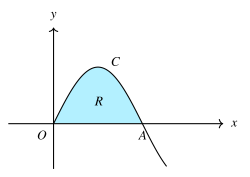
The figure shows part of the curve \(\displaystyle C\) with equation \(\displaystyle y = \sin 2x\).
The curve \(\displaystyle C\) crosses the \(\displaystyle x\)-axis at the origin \(\displaystyle O\) and at the point \(\displaystyle A\).
- Find the exact \(\displaystyle x\)-coordinate of \(\displaystyle A\).
The finite region \(\displaystyle R\), shown shaded in the figure, is bounded by \(\displaystyle C\) and the \(\displaystyle x\)-axis.
- Use calculus to find the exact area of \(\displaystyle R\).
The region \(\displaystyle R\) is rotated through \(\displaystyle 360^{\circ}\) about the \(\displaystyle x\)-axis to generate a solid of volume \(\displaystyle V\).
- Use algebraic integration to find the exact value of \(\displaystyle V\).
\(\displaystyle \begin{aligned} \textbf{(a)} \quad & \text{Curve meets x-axis when } y = 0: \\[2mm] & \sin 2x = 0 \implies 2x = \pi \implies x = \frac{\pi}{2}. \therefore \text{ x-coord of } A \text{ is } \frac{\pi}{2}. \\[2mm] \textbf{(b)} \quad & \text{Area } R = \int_0^{\pi/2} \sin 2x \, dx = \left[ -\frac{1}{2}\cos 2x \right]_0^{\pi/2} \\[2mm] & = \left( -\frac{1}{2}\cos\pi \right) - \left( -\frac{1}{2}\cos 0 \right) = \left(-\frac{1}{2}(-1)\right) - \left(-\frac{1}{2}(1)\right) \\[2mm] & = \frac{1}{2} + \frac{1}{2} = 1 \\[2mm] \textbf{(c)} \quad & V = \pi \int_0^{\pi/2} y^2 \, dx = \pi \int_0^{\pi/2} \sin^2 2x \, dx \\[2mm] & \text{Using identity: } \cos 4x = 1 - 2\sin^2 2x \implies \sin^2 2x = \frac{1 - \cos 4x}{2} \\[2mm] & V = \frac{\pi}{2} \int_0^{\pi/2} (1 - \cos 4x) \, dx = \frac{\pi}{2} \left[ x - \frac{1}{4}\sin 4x \right]_0^{\pi/2} \\[2mm] & = \frac{\pi}{2} \left( \left(\frac{\pi}{2} - \frac{1}{4}\sin 2\pi\right) - (0 - 0) \right) = \frac{\pi}{2} \left(\frac{\pi}{2}\right) = \frac{\pi^2}{4} \end{aligned} \) -
[Source: 4PM1/01R - June 2023 - Question 8]
A particle \(\displaystyle P\) is moving along the \(\displaystyle x\)-axis. At time \(\displaystyle t\) seconds (\(\displaystyle t \ge 0\)), the velocity, \(\displaystyle v\) m/s, of \(\displaystyle P\) is given by
\(\displaystyle v = t^2 - 6t + 8 \)
- Find the acceleration of \(\displaystyle P\) when \(\displaystyle t = 5\).
- Find the times when \(\displaystyle P\) is instantaneously at rest.
When \(\displaystyle t=0\), \(\displaystyle P\) is at the origin \(\displaystyle O\).
- Find the total distance travelled by \(\displaystyle P\) in the first \(\displaystyle 5\) seconds of its motion.
\(\displaystyle \begin{aligned} \textbf{(a)} \quad & a = \frac{dv}{dt} = 2t - 6 \\[2mm] & \text{When } t=5: \quad a = 2(5) - 6 = 4 \text{ m/s}^2 \\[2mm] \textbf{(b)} \quad & \text{At rest, } v = 0: \quad t^2 - 6t + 8 = 0 \\[2mm] & (t-2)(t-4) = 0 \implies t = 2, t = 4 \text{ seconds.} \\[2mm] \textbf{(c)} \quad & s = \int (t^2 - 6t + 8) \, dt = \frac{t^3}{3} - 3t^2 + 8t + C \\[2mm] & \text{At } t=0, s=0 \implies C=0 \implies s(t) = \frac{t^3}{3} - 3t^2 + 8t \\[2mm] & s(0) = 0 \\[2mm] & s(2) = \frac{8}{3} - 12 + 16 = \frac{20}{3} \\[2mm] & s(4) = \frac{64}{3} - 48 + 32 = \frac{64}{3} - 16 = \frac{16}{3} \\[2mm] & s(5) = \frac{125}{3} - 75 + 40 = \frac{125}{3} - 35 = \frac{20}{3} \\[2mm] & \text{Total Distance } = |s(2)-s(0)| + |s(4)-s(2)| + |s(5)-s(4)| \\[2mm] & = \left|\frac{20}{3} - 0\right| + \left|\frac{16}{3} - \frac{20}{3}\right| + \left|\frac{20}{3} - \frac{16}{3}\right| = \frac{20}{3} + \frac{4}{3} + \frac{4}{3} = \frac{28}{3} \text{ m} \end{aligned} \) -
[Source: 4PM1/02 - June 2023 - Question 10]
A particle \(\displaystyle P\) moves along the \(\displaystyle x\)-axis. At time \(\displaystyle t\) seconds, \(\displaystyle t \ge 0\), the displacement, \(\displaystyle x\) metres, of \(\displaystyle P\) from the origin \(\displaystyle O\) is given by
\(\displaystyle x = 2t^3 - 9t^2 + 12t + 4 \)
- Find the velocity of \(\displaystyle P\) when \(\displaystyle t = 3\).
- Find the times when \(\displaystyle P\) is instantaneously at rest.
- Find the total distance travelled by \(\displaystyle P\) in the first \(\displaystyle 4\) seconds.
\(\displaystyle \begin{aligned} \textbf{(a)} \quad & v = \frac{dx}{dt} = 6t^2 - 18t + 12 \\[2mm] & \text{When } t=3: \quad v = 6(3^2) - 18(3) + 12 = 54 - 54 + 12 = 12 \text{ m/s} \\[2mm] \textbf{(b)} \quad & \text{At rest, } v = 0: \quad 6t^2 - 18t + 12 = 0 \\[2mm] & 6(t^2 - 3t + 2) = 0 \implies 6(t-1)(t-2) = 0 \implies t = 1, t = 2 \text{ seconds.} \\[2mm] \textbf{(c)} \quad & \text{Evaluate displacement at key times:} \\[2mm] & x(0) = 4 \\[2mm] & x(1) = 2(1) - 9(1) + 12(1) + 4 = 9 \\[2mm] & x(2) = 2(8) - 9(4) + 12(2) + 4 = 16 - 36 + 24 + 4 = 8 \\[2mm] & x(4) = 2(64) - 9(16) + 12(4) + 4 = 128 - 144 + 48 + 4 = 36 \\[2mm] & \text{Total Distance } = |x(1)-x(0)| + |x(2)-x(1)| + |x(4)-x(2)| \\[2mm] & = |9 - 4| + |8 - 9| + |36 - 8| = 5 + 1 + 28 = 34 \text{ m} \end{aligned} \) -
[Source: 4PM1/02R - June 2023 - Question 9]
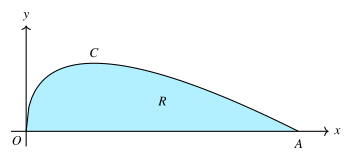
The figure shows part of the curve \(\displaystyle C\) with equation \(\displaystyle y = 3\sqrt{x} - x\).
The curve \(\displaystyle C\) crosses the \(\displaystyle x\)-axis at the origin \(\displaystyle O\) and at the point \(\displaystyle A\).
- Find the coordinates of \(\displaystyle A\).
The finite region \(\displaystyle R\), shown shaded in the figure, is bounded by \(\displaystyle C\) and the \(\displaystyle x\)-axis.
- Use algebraic integration to find the exact area of \(\displaystyle R\).
The region \(\displaystyle R\) is rotated through \(\displaystyle 360^{\circ}\) about the \(\displaystyle x\)-axis to form a solid.
- Find the exact volume of the solid generated.
\(\displaystyle \begin{aligned} \textbf{(a)} \quad & \text{Curve crosses x-axis when } y=0: \\[2mm] & 3\sqrt{x} - x = 0 \implies \sqrt{x}(3 - \sqrt{x}) = 0 \\[2mm] & \sqrt{x} = 0 \implies x=0 \text{ (Origin } O) \\[2mm] & \sqrt{x} = 3 \implies x=9 \implies A(9, 0) \\[2mm] \textbf{(b)} \quad & \text{Area } R = \int_0^9 (3x^{1/2} - x) \, dx = \left[ \frac{3x^{3/2}}{3/2} - \frac{x^2}{2} \right]_0^9 = \left[ 2x^{3/2} - \frac{x^2}{2} \right]_0^9 \\[2mm] & = \left( 2(9)^{3/2} - \frac{9^2}{2} \right) - 0 = \left( 2(27) - \frac{81}{2} \right) = 54 - 40.5 = 13.5 = \frac{27}{2} \\[2mm] \textbf{(c)} \quad & V = \pi \int_0^9 y^2 \, dx = \pi \int_0^9 (3x^{1/2} - x)^2 \, dx \\[2mm] & V = \pi \int_0^9 (9x - 6x^{3/2} + x^2) \, dx = \pi \left[ \frac{9x^2}{2} - \frac{6x^{5/2}}{5/2} + \frac{x^3}{3} \right]_0^9 \\[2mm] & = \pi \left[ \frac{9x^2}{2} - \frac{12x^{5/2}}{5} + \frac{x^3}{3} \right]_0^9 = \pi \left( \frac{9(81)}{2} - \frac{12(243)}{5} + \frac{729}{3} \right) \\[2mm] & = \pi \left( \frac{729}{2} - \frac{2916}{5} + 243 \right) = \pi \left( \frac{3645 - 5832 + 2430}{10} \right) = \frac{243\pi}{10} \end{aligned} \) -
[Source: 4PM1/01 - November 2023 - Question 8]
A solid cuboid has length \(\displaystyle 3x\) cm, width \(\displaystyle x\) cm and height \(\displaystyle h\) cm. The volume of the cuboid is \(\displaystyle 972 \text{ cm}^3\).
The total surface area of the cuboid is \(\displaystyle S \text{ cm}^2\).
- Show that \(\displaystyle S = 6x^2 + \frac{2592}{x}\)
Given that \(\displaystyle x\) can vary,
- use calculus to find the value of \(\displaystyle x\) for which \(\displaystyle S\) is a minimum.
- Find the minimum value of \(\displaystyle S\).
- Justify that the value of \(\displaystyle S\) you have found is a minimum.
\(\displaystyle \begin{aligned} \textbf{(a)} \quad & V = (3x)(x)(h) = 3x^2h = 972 \implies h = \frac{972}{3x^2} = \frac{324}{x^2} \\[2mm] & S = 2(lw + wh + lh) = 2(3x^2 + xh + 3xh) = 2(3x^2 + 4xh) = 6x^2 + 8xh \\[2mm] & S = 6x^2 + 8x\left(\frac{324}{x^2}\right) = 6x^2 + \frac{2592}{x} \quad \text{(shown)} \\[2mm] \textbf{(b)} \quad & \frac{dS}{dx} = 12x - \frac{2592}{x^2} = 0 \\[2mm] & 12x^3 = 2592 \implies x^3 = \frac{2592}{12} = 216 \implies x = 6 \\[2mm] \textbf{(c)} \quad & S_{\text{min}} = 6(6^2) + \frac{2592}{6} = 6(36) + 432 = 216 + 432 = 648 \text{ cm}^2 \\[2mm] \textbf{(d)} \quad & \frac{d^2S}{dx^2} = 12 + \frac{5184}{x^3} \\[2mm] & \text{When } x=6: \quad \frac{d^2S}{dx^2} = 12 + \frac{5184}{216} = 12 + 24 = 36 \\[2mm] & \text{Since } \frac{d^2S}{dx^2} > 0, \text{ the value is a minimum.} \end{aligned} \) -
[Source: 4PM1/01R - November 2023 - Question 9]
The curve \(\displaystyle C\) has equation \(\displaystyle y = \frac{x^2 + 4}{x - 2}\) where \(\displaystyle x \ne 2\).
- Find \(\displaystyle \frac{dy}{dx}\)
- Find the coordinates of the turning points of \(\displaystyle C\).
- Determine the nature of each of these turning points.
\(\displaystyle \begin{aligned} \textbf{(a)} \quad & \text{Using Quotient Rule: } u = x^2+4, v = x-2 \\[2mm] & \frac{dy}{dx} = \frac{2x(x-2) - (x^2+4)(1)}{(x-2)^2} = \frac{2x^2 - 4x - x^2 - 4}{(x-2)^2} = \frac{x^2 - 4x - 4}{(x-2)^2} \\[2mm] \textbf{(b)} \quad & \text{For turning points, } \frac{dy}{dx} = 0 \implies x^2 - 4x - 4 = 0 \\[2mm] & x = \frac{-(-4) \pm \sqrt{(-4)^2 - 4(1)(-4)}}{2} = \frac{4 \pm \sqrt{16+16}}{2} = \frac{4 \pm \sqrt{32}}{2} = 2 \pm 2\sqrt{2} \\[2mm] & \text{When } x = 2 + 2\sqrt{2}: \quad y = \frac{(2+2\sqrt{2})^2 + 4}{2+2\sqrt{2}-2} = \frac{4 + 8\sqrt{2} + 8 + 4}{2\sqrt{2}} = \frac{16 + 8\sqrt{2}}{2\sqrt{2}} = 4\sqrt{2} + 4 \\[2mm] & \text{When } x = 2 - 2\sqrt{2}: \quad y = \frac{(2-2\sqrt{2})^2 + 4}{2-2\sqrt{2}-2} = \frac{4 - 8\sqrt{2} + 8 + 4}{-2\sqrt{2}} = \frac{16 - 8\sqrt{2}}{-2\sqrt{2}} = -4\sqrt{2} + 4 \\[2mm] & \text{Turning points are } \left(2 + 2\sqrt{2}, 4 + 4\sqrt{2}\right) \text{ and } \left(2 - 2\sqrt{2}, 4 - 4\sqrt{2}\right) \\[2mm] \textbf{(c)} \quad & \text{Let's check the sign of } \frac{dy}{dx} \text{ around } x = 2 \pm 2\sqrt{2}: \\[2mm] & \text{Or find second derivative: } \frac{d^2y}{dx^2} = \frac{(2x-4)(x-2)^2 - 2(x-2)(x^2-4x-4)}{(x-2)^4} = \frac{16}{(x-2)^3} \\[2mm] & \text{At } x = 2 + 2\sqrt{2}, \frac{d^2y}{dx^2} = \frac{16}{(2\sqrt{2})^3} > 0 \therefore \left(2+2\sqrt{2}, 4+4\sqrt{2}\right) \text{ is a Minimum.} \\[2mm] & \text{At } x = 2 - 2\sqrt{2}, \frac{d^2y}{dx^2} = \frac{16}{(-2\sqrt{2})^3} < 0 \therefore \left(2-2\sqrt{2}, 4-4\sqrt{2}\right) \text{ is a Maximum.} \end{aligned} \) -
[Source: 4PM1/02 - November 2023 - Question 8]
A particle \(\displaystyle P\) moves along the \(\displaystyle x\)-axis. At time \(\displaystyle t\) seconds, \(\displaystyle t \ge 0\), the acceleration, \(\displaystyle a\) m/s\(^2\), of \(\displaystyle P\) is given by
\(\displaystyle a = 4t - 12 \)
When \(\displaystyle t = 0\), \(\displaystyle P\) is at the origin \(\displaystyle O\) and has velocity \(\displaystyle 16\) m/s.
- Find an expression for the velocity of \(\displaystyle P\) at time \(\displaystyle t\).
- Find the times when \(\displaystyle P\) is instantaneously at rest.
- Find the total distance travelled by \(\displaystyle P\) in the first \(\displaystyle 5\) seconds of its motion.
\(\displaystyle \begin{aligned} \textbf{(a)} \quad & v = \int a \, dt = \int (4t - 12) \, dt = 2t^2 - 12t + C \\[2mm] & \text{When } t=0, v=16 \implies C = 16 \\[2mm] & v = 2t^2 - 12t + 16 \\[2mm] \textbf{(b)} \quad & \text{At rest, } v = 0: \quad 2t^2 - 12t + 16 = 0 \\[2mm] & 2(t^2 - 6t + 8) = 0 \implies (t-2)(t-4) = 0 \implies t = 2, t = 4 \text{ seconds.} \\[2mm] \textbf{(c)} \quad & x = \int v \, dt = \int (2t^2 - 12t + 16) \, dt = \frac{2}{3}t^3 - 6t^2 + 16t + K \\[2mm] & \text{When } t=0, x=0 \implies K = 0 \implies x(t) = \frac{2}{3}t^3 - 6t^2 + 16t \\[2mm] & x(0) = 0 \\[2mm] & x(2) = \frac{16}{3} - 24 + 32 = \frac{16}{3} + 8 = \frac{40}{3} \\[2mm] & x(4) = \frac{128}{3} - 96 + 64 = \frac{128}{3} - 32 = \frac{32}{3} \\[2mm] & x(5) = \frac{250}{3} - 150 + 80 = \frac{250}{3} - 70 = \frac{40}{3} \\[2mm] & \text{Total Distance } = |x(2)-x(0)| + |x(4)-x(2)| + |x(5)-x(4)| \\[2mm] & = \left|\frac{40}{3} - 0\right| + \left|\frac{32}{3} - \frac{40}{3}\right| + \left|\frac{40}{3} - \frac{32}{3}\right| = \frac{40}{3} + \frac{8}{3} + \frac{8}{3} = \frac{56}{3} \text{ m} \end{aligned} \) -
[Source: 4PM1/02R - November 2023 - Question 10]
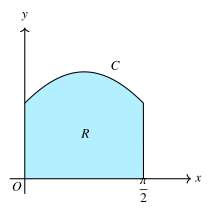
The figure shows part of the curve \(\displaystyle C\) with equation \(\displaystyle y = \sin x + \cos x\) for \(\displaystyle 0 \le x \le \frac{\pi}{2}\).
The finite region \(\displaystyle R\), shown shaded in the figure, is bounded by \(\displaystyle C\), the \(\displaystyle y\)-axis and the \(\displaystyle x\)-axis.
- Find the exact coordinates of the turning point of \(\displaystyle C\).
- Use calculus to find the exact area of \(\displaystyle R\).
The region \(\displaystyle R\) is rotated through \(\displaystyle 360^{\circ}\) about the \(\displaystyle x\)-axis.
- Use algebraic integration to find the exact volume of the solid generated.
\(\displaystyle \begin{aligned} \textbf{(a)} \quad & \frac{dy}{dx} = \cos x - \sin x \\[2mm] & \text{Turning point when } \frac{dy}{dx} = 0: \quad \cos x = \sin x \implies \tan x = 1 \implies x = \frac{\pi}{4} \\[2mm] & y = \sin\frac{\pi}{4} + \cos\frac{\pi}{4} = \frac{\sqrt{2}}{2} + \frac{\sqrt{2}}{2} = \sqrt{2} \\[2mm] & \text{Coordinates: } \left(\frac{\pi}{4}, \sqrt{2}\right) \\[2mm] \textbf{(b)} \quad & \text{Area } R = \int_0^{\pi/2} (\sin x + \cos x) \, dx = \left[ -\cos x + \sin x \right]_0^{\pi/2} \\[2mm] & = \left(-\cos\frac{\pi}{2} + \sin\frac{\pi}{2}\right) - (-\cos 0 + \sin 0) = (0 + 1) - (-1 + 0) = 2 \\[2mm] \textbf{(c)} \quad & V = \pi \int_0^{\pi/2} y^2 \, dx = \pi \int_0^{\pi/2} (\sin x + \cos x)^2 \, dx \\[2mm] & = \pi \int_0^{\pi/2} (\sin^2 x + \cos^2 x + 2\sin x\cos x) \, dx \\[2mm] & = \pi \int_0^{\pi/2} (1 + \sin 2x) \, dx = \pi \left[ x - \frac{1}{2}\cos 2x \right]_0^{\pi/2} \\[2mm] & = \pi \left( \left(\frac{\pi}{2} - \frac{1}{2}\cos\pi\right) - \left(0 - \frac{1}{2}\cos 0\right) \right) \\[2mm] & = \pi \left( \left(\frac{\pi}{2} + \frac{1}{2}\right) - \left(-\frac{1}{2}\right) \right) = \pi\left(\frac{\pi}{2} + 1\right) \end{aligned} \) -
[Source: 4PM1/01 - June 2024 - Question 10]
A rectangular piece of card measures \(\displaystyle 30\) cm by \(\displaystyle 20\) cm. Squares of side \(\displaystyle x\) cm are cut from each of the four corners.
The remainder is folded to form an open box of volume \(\displaystyle V \text{ cm}^3\).
- Show that \(\displaystyle V = 4x^3 - 100x^2 + 600x\).
- Use calculus to find the value of \(\displaystyle x\) for which \(\displaystyle V\) is a maximum.
- Find the maximum value of \(\displaystyle V\).
\(\displaystyle \begin{aligned} \textbf{(a)} \quad & \text{The dimensions of the base of the box are } (30 - 2x) \text{ and } (20 - 2x). \text{ The height is } x. \\[2mm] & V = x(30 - 2x)(20 - 2x) = x(600 - 60x - 40x + 4x^2) = x(600 - 100x + 4x^2) \\[2mm] & V = 4x^3 - 100x^2 + 600x \quad \text{(shown)} \\[2mm] \textbf{(b)} \quad & \frac{dV}{dx} = 12x^2 - 200x + 600 = 0 \\[2mm] & \text{Divide by 4: } 3x^2 - 50x + 150 = 0 \\[2mm] & x = \frac{50 \pm \sqrt{(-50)^2 - 4(3)(150)}}{2(3)} = \frac{50 \pm \sqrt{2500 - 1800}}{6} = \frac{50 \pm \sqrt{700}}{6} = \frac{25 \pm 5\sqrt{7}}{3} \\[2mm] & \text{Since } 20 - 2x > 0 \implies x < 10, \text{ we must choose the negative sign:} \\[2mm] & x = \frac{25 - 5\sqrt{7}}{3} \approx 3.924 \text{ cm} \\[2mm] \textbf{(c)} \quad & \text{Substitute } x = \frac{25 - 5\sqrt{7}}{3} \text{ into } V: \\[2mm] & V_{\text{max}} = 4(3.9237...)^3 - 100(3.9237...)^2 + 600(3.9237...) \\[2mm] & V_{\text{max}} \approx 1056.3 \text{ cm}^3 \end{aligned} \)
Post a Comment